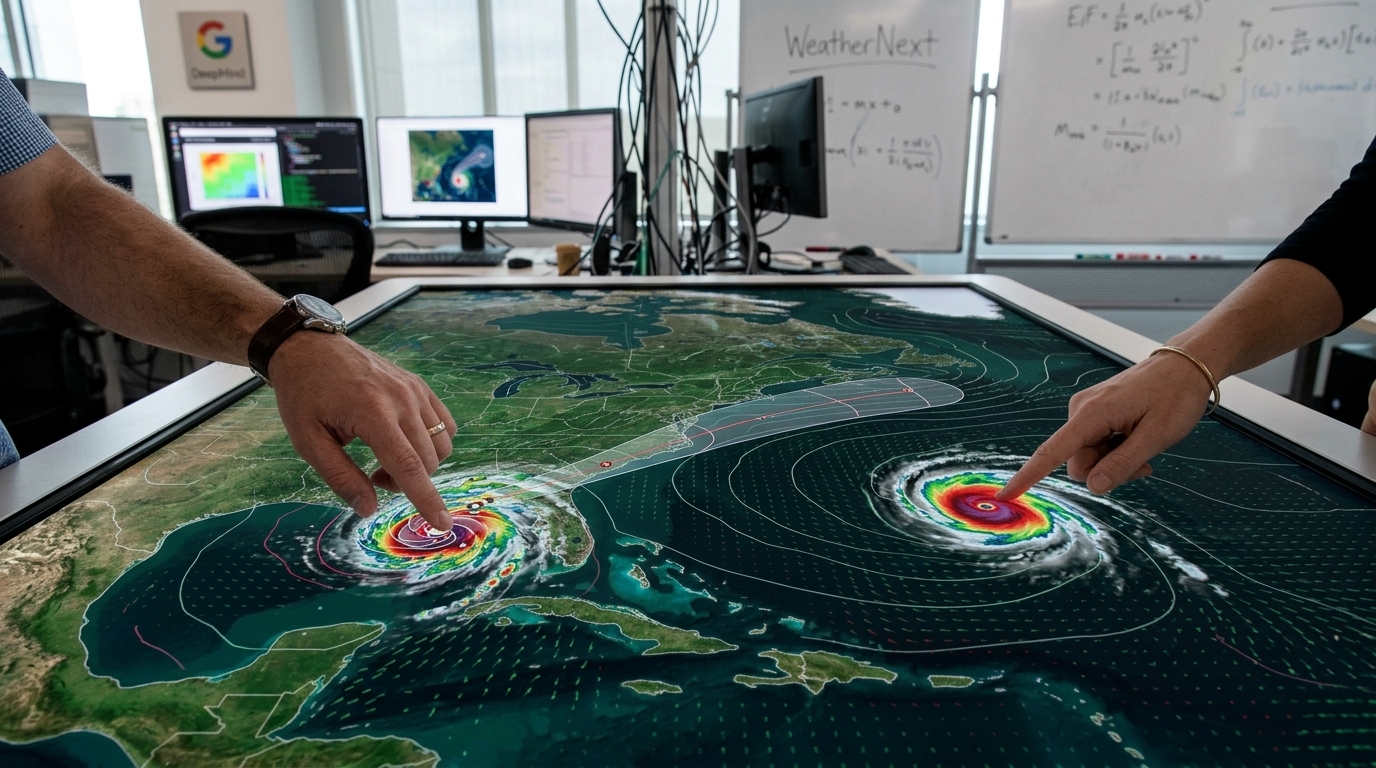
In October 2025, as a storm brewed over the Caribbean Sea, traditional weather models struggled to agree on its trajectory. However, WeatherNext—an AI model developed by Google DeepMind and Google Research—predicted with 80 percent confidence that the system would strike Jamaica as a Category 5 hurricane. This forecast arrived five days before landfall, providing a critical window for preparation before Hurricane Melissa caused catastrophic flooding.
The Value of an Extra Day
A paper published in Nature reveals that WeatherNext provides forecasters with an average of one additional day of lead time compared to existing models. In practical terms, its three-day forecasts are now as accurate as the two-day forecasts of previous systems. Mike Brennan, director of the US National Hurricane Center, emphasizes that "time is really golden" when organizing evacuations and staging emergency supplies, where even a few hours can save lives.
Intensity and the 'Black Box' Mystery
Predicting a hurricane's intensity has historically been a challenge for AI, as it requires fine-grained data on local atmospheric and ocean conditions. WeatherNext has broken this barrier, successfully predicting rapid intensifications that global models often miss. Surprisingly, it achieves this using lower-resolution data than traditional numerical models.
- The model generates 1,000 potential scenarios per storm to account for the "butterfly effect."
- It successfully predicted Hurricane Melissa's jump from Category 1 to Category 5.
- Researchers describe the model as a "black box," as they do not yet fully understand how it extracts such high-quality signals from coarse data.
Google DeepMind has announced it is open-sourcing the WeatherNext models. By sharing the technology, researchers hope to uncover fresh insights into the physics of cyclones and the "laws of the universe" that the AI is currently navigating with unprecedented efficiency.