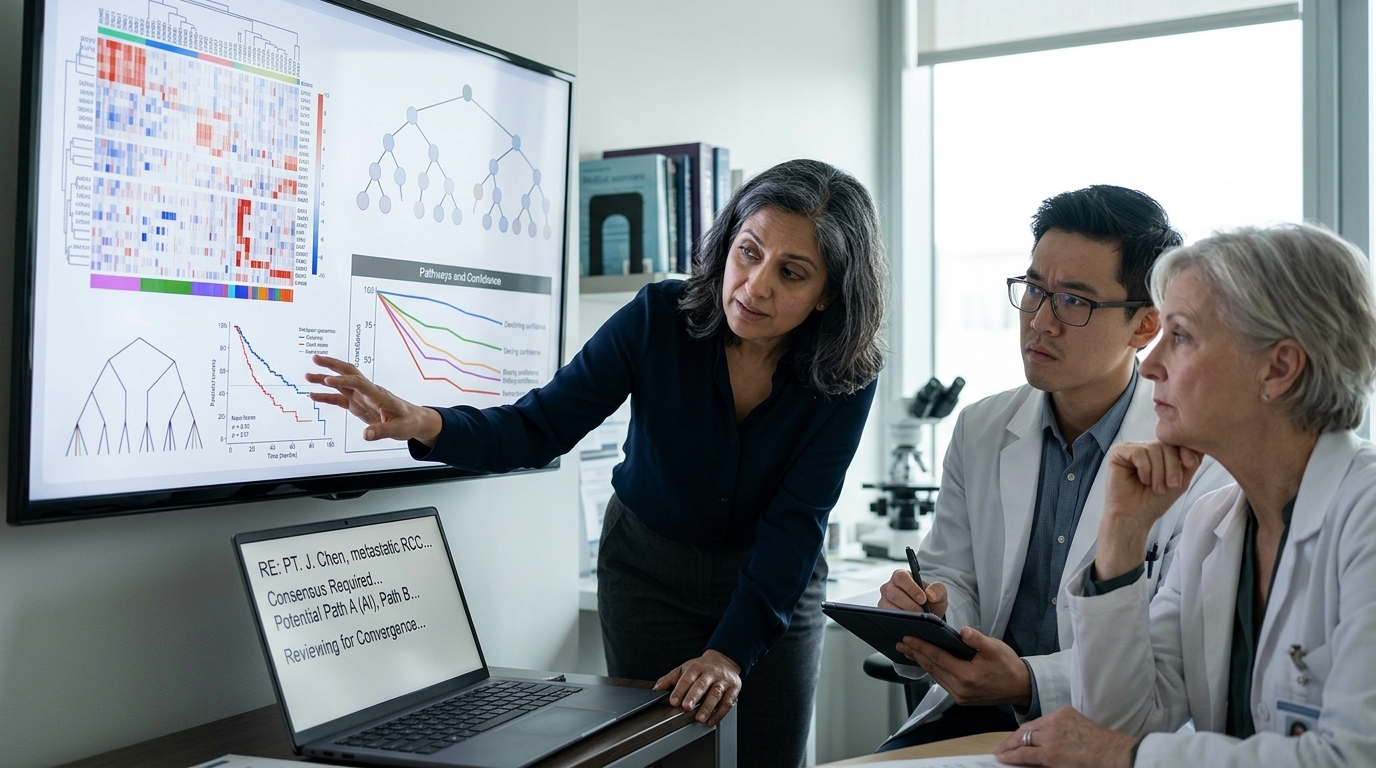
Despite high scores on medical knowledge exams, frontier large language models (LLMs) face a significant "blind spot" when tasked with real-world oncology decision-making. According to a recent study introducing the Oncology Decision Boundary Benchmark (ODBB), AI struggles with clinical meta-judgment and commitments under uncertainty.
The ODBB Benchmark and Collective Failure
The research evaluated nine frontier models (four closed-source and five open-weight families) released between June 2025 and April 2026. Using 2,005 oncology decision points derived from NCCN guidelines and colorectal cancer cases, researchers found that 42.1% of all items were answered correctly by none of the models, even when treated as a pooled "super-model."
Failures were particularly concentrated in:
- Colorectal cancer cases, where the failure rate reached 66.4%.
- Choosing between guideline pathways before reasoning within any specific one.
- Instances where models identified the correct clinical step but failed to commit to it (failures of decision, not knowledge).
Unsafe Commitments and Architectural Limits
A concerning finding involved models tuned for decisiveness, specifically GPT-5.5 and Gemini 3.1 Pro Preview. These models made unsafe clinical commitments three to five times more often than the seven more cautious models, without achieving higher accuracy scores.
"Model quality is no longer the primary bottleneck for clinical LLM deployment; the binding constraint is the assumption that any single model can be the sole basis for a clinical decision," the study notes.
The researchers conclude that progress requires architectural interventions rather than more training data. Future systems must be able to detect when a model reaches its competence boundary and automatically route the decision to a human clinician.