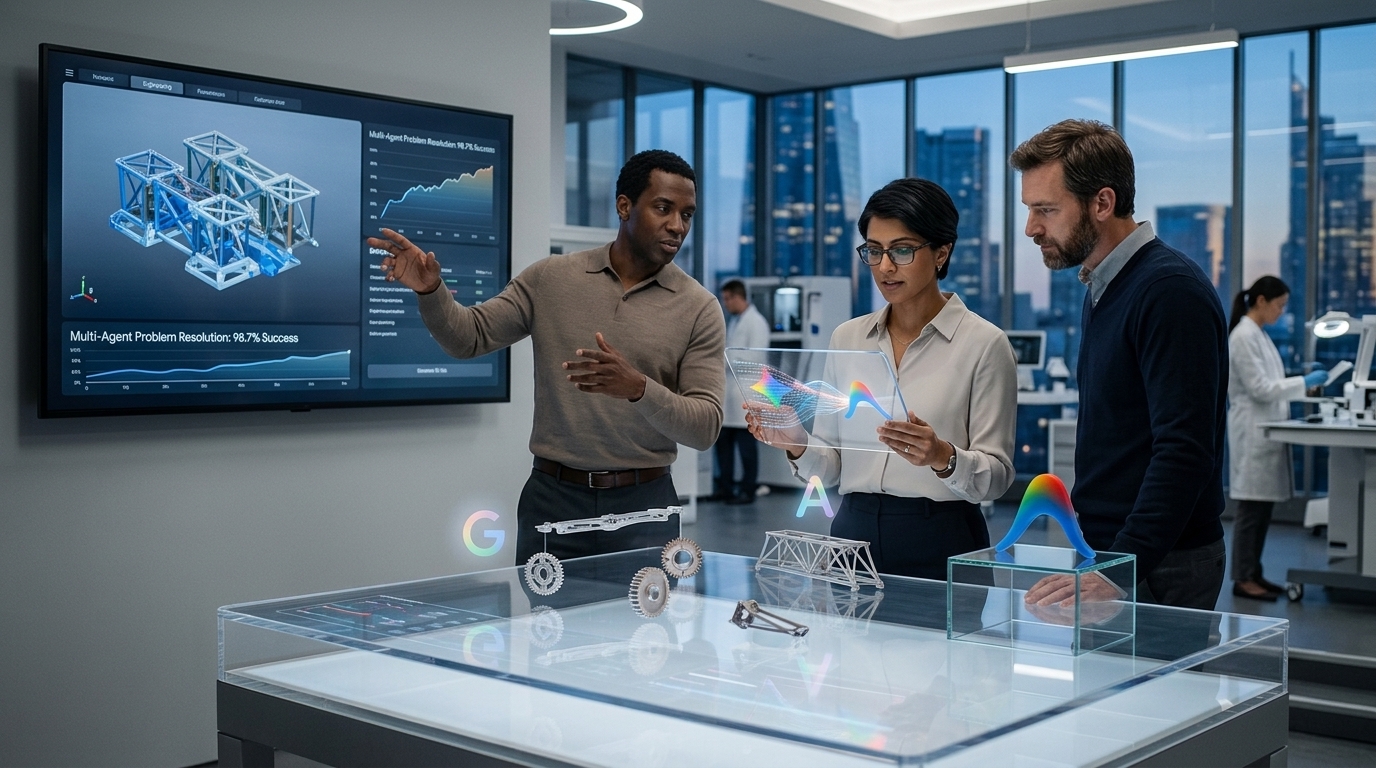
Google has introduced significant updates to Antigravity through "Teamwork," a framework designed to facilitate collaboration among autonomous teams of AI agents. These agents can critique and iterate over extended horizons—ranging from hours to days—to tackle complex research and engineering challenges.
Breakthroughs in Theoretical Mathematics
By pairing Gemini 3.7 Flash with this multi-agent orchestration, Google successfully addressed seven open problems featured in prestigious venues such as FOCS and JMLR. Key milestones include:
- Solving Knuth’s Cycles Conjecture, verified via the Lean theorem prover with proofs exceeding 40 pages.
- Advancements in sparse convex optimization and provable LLM quantization.
- Achieving a 71% score on TCSBench, a benchmark for theoretical computer science.
Systems Engineering and Open-Source Contributions
In the realm of systems engineering, the autonomous agent teams built a cycle-accurate, out-of-order RISC-V CPU simulator from scratch. The simulator is capable of booting the xv6 operating system to a shell, maintaining a 0.71% cycle alignment error compared to hardware ground truth.
The initiative also extended to open-source software (OSS) optimization. Performance enhancements were upstreamed to core libraries, including:
- Eigen: Implementation of SIMD fast-paths.
- ParlayHash: Achieving a 2x increase in insert throughput and a 25% reduction in memory consumption.