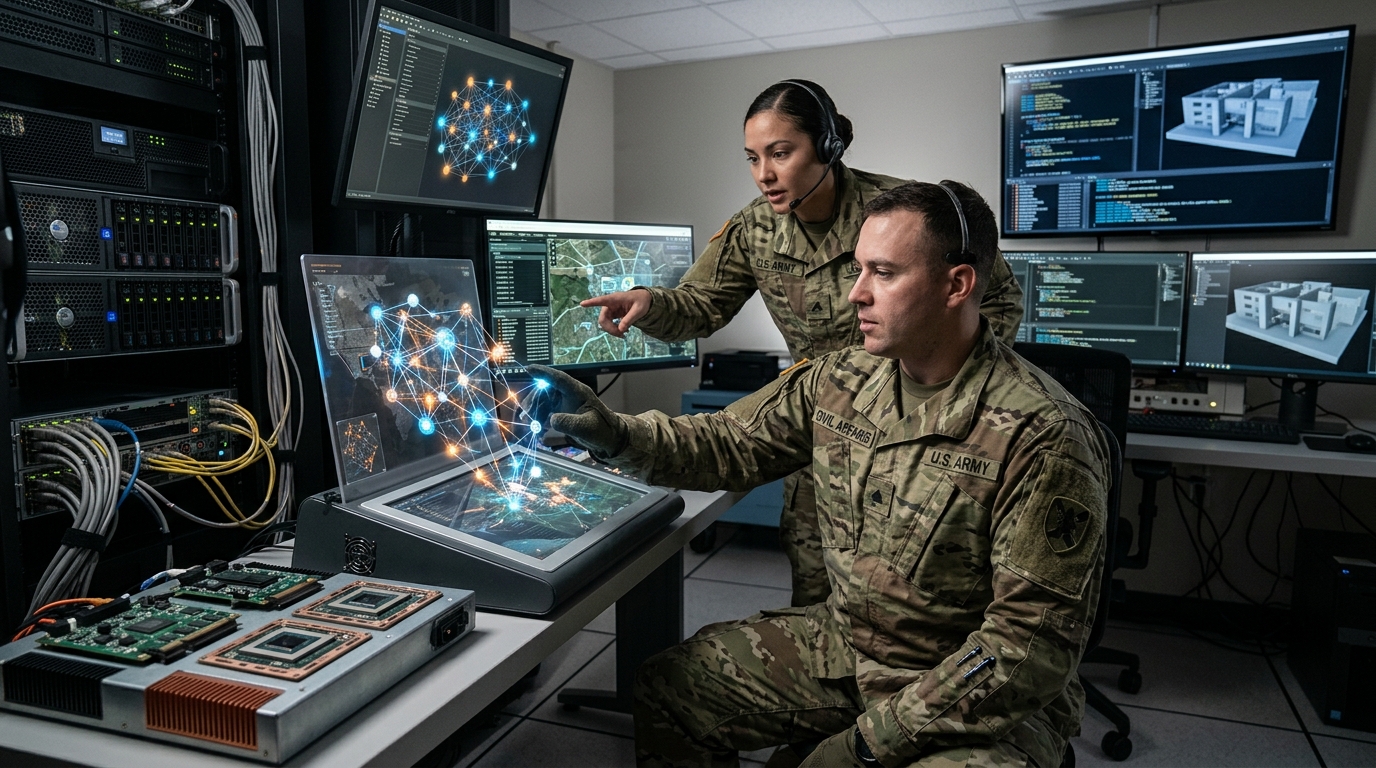
In the modern theater of operations, battles are won not only with kinetic force but through the sophisticated understanding of local populations. The U.S. Army Reserve Civil Affairs units, traditionally tasked with bridging the gap between military forces and civilian authorities, are now at the vanguard of a technological revolution. Recent reports from DVIDS highlight a significant shift: soldiers are increasingly utilizing Artificial Intelligence (AI)-driven scenarios to sharpen their crisis management, negotiation, and cultural proficiency skills.
From Role-Players to Algorithms
For decades, Civil Affairs training relied heavily on human role-players. These professionals would portray local mayors, religious leaders, or displaced persons, providing soldiers with the opportunity to practice realistic interactions. While effective, this method is fraught with logistical hurdles: it is expensive, difficult to scale, and limited by the inherent biases and physical exhaustion of human actors.
The integration of AI is fundamentally altering this landscape. Through advanced Large Language Models (LLMs) and dynamic simulations, soldiers can now interact with virtual characters possessing deep knowledge of local history, political dynamics, and cultural nuances. These AI entities do not merely follow a script; they react to a soldier's proposals, tone, and decisions in real-time. This creates a training environment as unpredictable and volatile as reality itself, allowing for a broader range of scenarios than any human troupe could provide.
Strategic Implications and Cultural Depth
Civil Affairs operations are vital for stabilizing regions following conflict or natural disasters. A soldier's ability to persuade a local leader to cooperate on infrastructure repair or humanitarian aid distribution can prevent a resurgence of violence. AI enables the creation of thousands of distinct 'personas,' allowing soldiers to practice with a vast spectrum of linguistic idioms and social beliefs.
Furthermore, this technology facilitates data analysis at an unprecedented scale. Instructors can pinpoint exactly where a negotiation faltered, identifying specific phrases that triggered a negative response from the AI. This level of granular feedback was previously unattainable. The AI serves as an unceasing mirror for the unit's diplomatic capabilities, offering a precision that borders on science fiction, yet remains grounded in operational necessity.
Ethical Challenges and the Human Element
Despite the clear advantages, the use of AI for 'human' interactions raises poignant questions. There is a risk that AI might reinforce stereotypes or present an oversimplified view of complex societies. Critics argue that human empathy cannot be fully encoded and that over-reliance on digital simulators might make soldiers 'mechanical' in their approach, potentially losing the ability to read body language or the subtle nuances of genuine human connection.
However, proponents emphasize that AI is not intended to replace human contact but to prepare for it. In the context of the Army Reserve, where training time is a precious commodity, the ability to access high-fidelity scenarios remotely is invaluable. The challenge for the U.S. Army in 2026 is to find the equilibrium: leveraging computational power to enhance the humanity of its soldiers on the ground.
The Future of Stability Operations
As global geopolitical tensions rise, the necessity for effective Civil Affairs has never been greater. The integration of AI into training is just the beginning. Looking ahead, we may see AI systems supporting soldiers in real-time during missions, providing cultural advisories or high-precision translations. The 'digital diplomacy' of Civil Affairs represents a critical experiment in how technology can be used not for destruction, but for reconstruction and mutual understanding in a fragmented world.