In a development that could reshape the future of global energy and computing systems, Alibaba’s DAMO Academy, the research arm of the Chinese tech giant, has announced the autonomous discovery of four new superconducting materials. This breakthrough is not merely a theoretical prediction; it has already been validated through rigorous experimental testing, marking a critical turning point in the application of Artificial Intelligence to the physical sciences—a field now widely known as AI for Science (AI4S).
The Significance of Superconductivity
Superconductivity is a phenomenon where certain materials allow electricity to flow with zero resistance when cooled below a critical temperature. Since its discovery in 1911, scientists have been searching for materials that function at higher temperatures, which would enable lossless power transmission, faster quantum computers, and low-cost maglev trains. Traditionally, finding such materials relied on serendipity and decades of painstaking laboratory trial-and-error.
The DAMO Academy Methodology
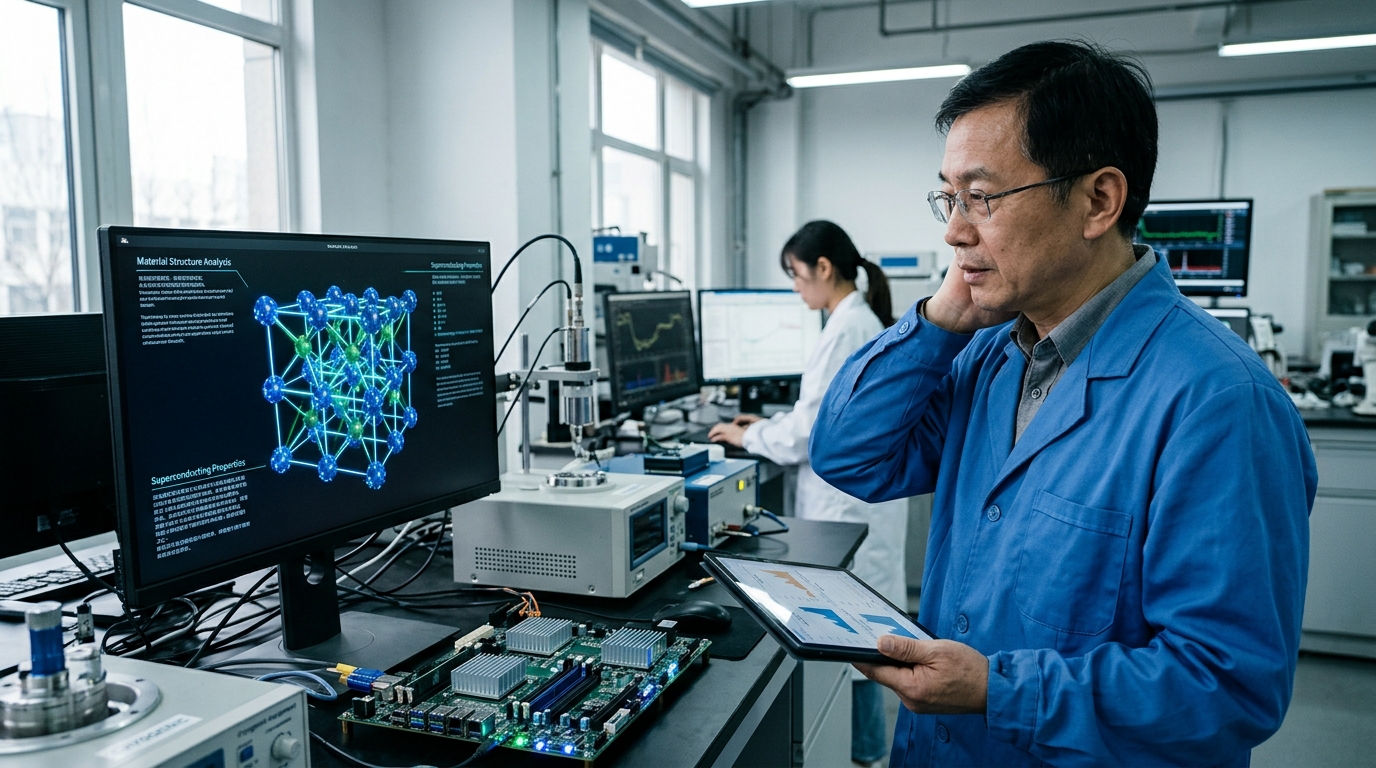
The AI system developed by Alibaba utilized advanced Graph Neural Networks (GNNs) to scan millions of potential crystal combinations. The innovation of DAMO Academy lies in the model's ability to predict not only structural stability but also the critical transition temperature to the superconducting state. The process was fully autonomous: the AI proposed the chemical compositions, and researchers then proceeded to synthesize and experimentally verify these materials. The four new materials belong to families of compounds that had not been extensively studied, proving that AI can "see" beyond human intuition and established chemical paradigms.
Geopolitical and Economic Implications
This announcement comes at a time of intense competition between the US and China for dominance in cutting-edge technologies. China’s ability to generate fundamental scientific knowledge through AI, rather than just applying existing algorithms to commercial ends, sends a clear signal to the West. Alibaba, despite the regulatory pressures it faced in recent years, demonstrates that it remains at the forefront of global innovation. Using AI to accelerate material science discoveries could compress research timelines from decades to months, granting a massive strategic advantage to whoever controls these proprietary algorithms.
The Future of Material Science
The success of DAMO Academy paves the way for AI-driven discovery of next-generation battery materials, more efficient solar panels, and new catalysts for hydrogen production. The convergence of data science with solid-state physics is no longer a promise; it is a reality producing tangible results. The next major milestone is the discovery of a room-temperature, ambient-pressure superconductor—the "holy grail" that would radically transform our civilization.
- Zero-loss electrical grids worldwide.
- Quantum computers requiring minimal cooling.
- A revolution in medical imaging (MRI) accessibility.
In conclusion, Alibaba has not just discovered four materials; it has proven that the map of scientific discovery has changed forever. Artificial Intelligence is now the new "experimenter," and the speed at which our knowledge of the physical world evolves is set to accelerate exponentially. The transition from bits to atoms is finally complete.