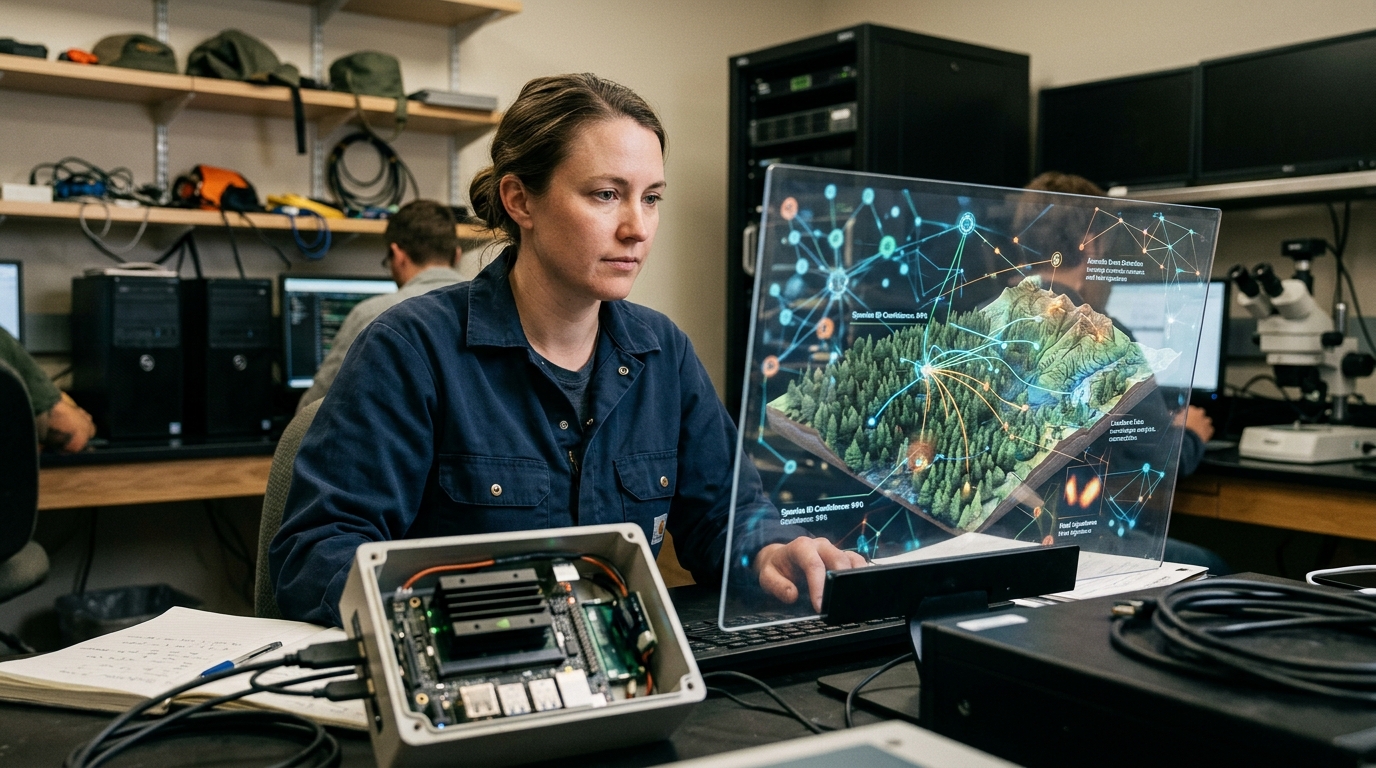
In the heart of the Pacific Northwest’s dense forests, a silent revolution is unfolding. Where biologists once spent thousands of exhausting hours squinting at grainy trail camera photos or listening to endless hours of audio recordings, Artificial Intelligence (AI) is now taking the lead. As reported by Oregon Public Broadcasting (OPB), the integration of advanced algorithms into wildlife management is no longer a science fiction scenario, but a daily necessity redefining our relationship with the natural world.
The Challenge of the 'Data Deluge'
For decades, the biggest hurdle in effective species conservation wasn't a lack of data, but the inability to process it. Researchers deployed hundreds of motion-activated cameras, gathering millions of images. However, 90% of these images often contained nothing more than branches swaying in the wind or crows passing by. Manually sorting through this material required armies of students and volunteers, delaying critical decision-making for years.
Today, machine learning models like the renowned MegaDetector can scan hundreds of thousands of photos in a matter of hours. These systems are trained to recognize specific shapes and movement patterns, immediately separating empty frames from those depicting a rare mountain lion or an endangered wolf. This speed allows scientists to react in real-time, identifying threats such as poaching or the spread of disease before they become uncontrollable.
From Image to Sound: The Bioacoustic Revolution
The use of AI is not limited to visual recognition. In Oregon, the monitoring of the Northern Spotted Owl—an iconic species for the region—now relies heavily on bioacoustics. Researchers place autonomous recording units that operate for months. The challenge here is even greater: how do you distinguish an owl's call during a thunderstorm or over the roar of a nearby highway?
Deep learning algorithms work by converting sound into spectrograms—visual representations of frequencies. The AI then 'looks' at the sound, identifying the unique visual footprint of each species. This method has proven extremely effective in tracking the invasive Barred Owl, which is displacing native populations. The ability to map species distribution through sound offers a holistic view of ecosystem health that was impossible to achieve with traditional methods.
Ethical Considerations and the Future of Conservation
Despite the excitement, the use of AI in the wilderness raises significant questions. There is the risk of 'algorithmic bias,' where a model trained in one region might fail in another due to different lighting or vegetation. Furthermore, over-reliance on technology could lead to a detachment of biologists from the field, turning ecology into a desk-based science.
However, the reality of the climate crisis leaves little room for romanticism. With species extinction rates accelerating, AI is perhaps the only tool that can scale sufficiently to address the problem. The future lies in a hybrid approach: AI does the heavy lifting of sorting, and the human scientist focuses on interpreting results and strategic planning. As the Oregon example shows, technology is not replacing the naturalist, but giving them 'superpowers' to protect a world that is slowly fading.
- AI reduces data processing time from months to mere seconds.
- Bioacoustics enable species monitoring in inaccessible terrains.
- Technology assists in controlling invasive species that threaten ecological balance.
- Constant human oversight remains necessary to prevent identification errors.