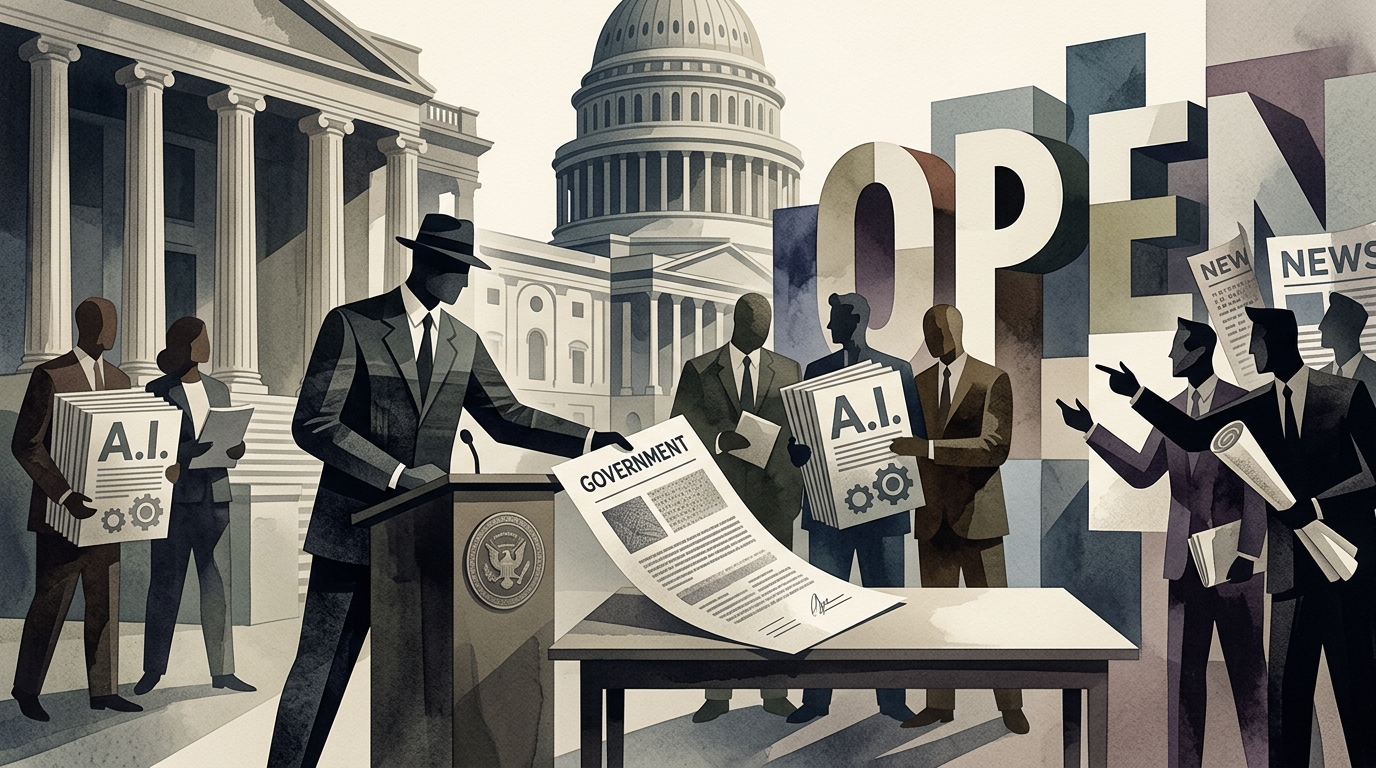
The Trump administration has formally sided with OpenAI in the company’s high-stakes legal battle against The New York Times, a move that could define the trajectory of AI development in the United States. In a letter submitted to the court on Tuesday, the federal government argued that training artificial intelligence models on copyrighted works falls within the bounds of the "fair use" doctrine.
National Interest and Global Leadership
According to the Department of Justice, the United States has a "strong interest" in the case's outcome because it is tied to the nation's ability to "retain global leadership in artificial intelligence." Government lawyers warned that constraining the development of Large Language Models (LLMs) under a misunderstanding of copyright law would "thwart creative and scientific progress while hindering American prosperity and economic mobility."
The administration characterized the training of LLMs as "extraordinarily transformative," asserting that these systems meaningfully change their inputs and do not significantly compete with the original articles of The New York Times. The letter even drew a comparison to a teenage Joan Didion typing out Ernest Hemingway’s stories to learn the craft of writing.
Backlash from Creators and Publishers
The response from The New York Times was swift and sharp. A spokesperson for the paper stated that the administration is siding with "handful of trillion-dollar AI companies at the expense of the countless American creators whose work they stole." The Author’s Guild also expressed extreme disappointment, calling the government's arguments "replete with faulty arguments."
While U.S. District Judge Sidney H. Stein is not obligated to follow the government's stance, legal experts suggest that a brief from the DOJ inherently carries significant weight. This development occurs amidst a flurry of litigation; notably, Anthropic recently faced a $1.5 billion settlement in a piracy-related case, even though the judge in that instance ruled that the act of AI training itself constituted fair use.