

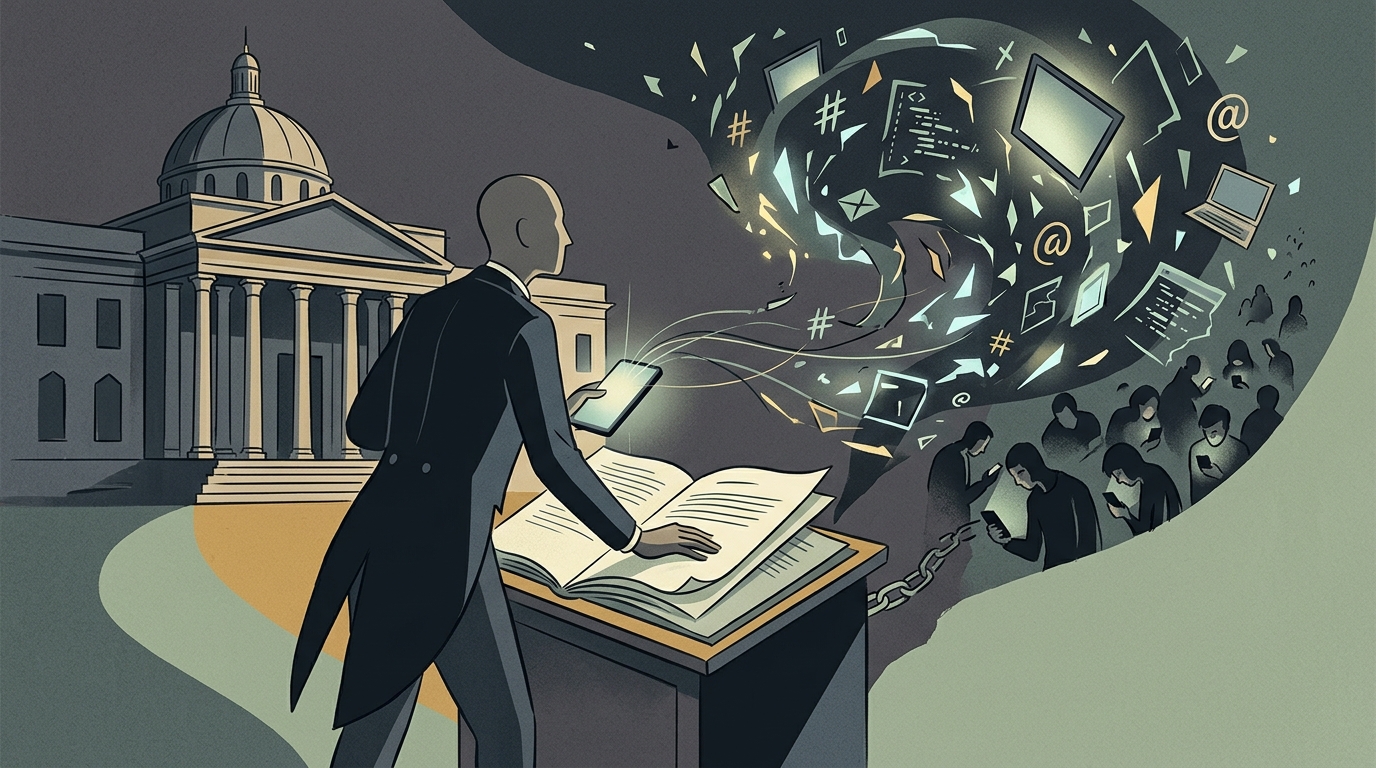
In an era where the digital sphere dominates daily life, government spokesperson Pavlos Marinakis has raised a critical concern regarding the quality of democracy in 2026. His intervention, focusing on the 'poisoning' of political discourse through social media, is not merely an observation but a warning about the gradual erosion of the institutional foundations of communication. According to Mr. Marinakis, the speed and anonymity of the internet have created an environment where polarization prevails over synthesis and shouting over reasoned argument.
Toxicity and Algorithms: The New Reality
Mr. Marinakis's analysis begins with the admission that social media has transformed from a tool for democratizing information into a mechanism for reproducing hatred. 'Social media often poisons political discourse,' he noted, referring to the ease with which fake news and personal attacks are disseminated. In the political landscape of 2026, where Artificial Intelligence can produce plausible but false content in seconds, the danger is greater than ever.
The algorithms of major platforms, designed to maximize engagement, tend to promote content that triggers anger or fear. This results in the creation of 'echo chambers,' where citizens are exposed only to views that confirm their biases. Political discourse thus loses its basis: the exchange of opposing but documented views for the common good. Instead, we witness a constant clash for impressions, where substance is sacrificed on the altar of likes.
Apolitical or Distanced? The Diagnosis for the New Generation
One of the most interesting points of Pavlos Marinakis's position concerns the relationship of young people with politics. Common criticism suggests that Gen Z and Gen Alpha are 'apolitical,' indifferent to public affairs. Mr. Marinakis radically disagrees with this reading. 'Young people are not apolitical; they are distanced,' he emphasized. This distinction is pivotal for understanding modern sociology.
Distancing implies a conscious choice. Young people today are informed; they have strong views on climate change, human rights, and economic justice, but they do not find a 'home' in traditional party rhetoric. The toxicity described above acts as a repellent. When a young person sees political dialogue exhausted in insults on Twitter (X) or shallow videos on TikTok, they choose to move away from active participation, considering the system impenetrable and hostile.
- Abstention is not a lack of interest, but a lack of trust.
- Social issues mobilize youth more than party identities.
- Digital communication from parties often fails to speak the language of truth.
The Challenge of Populism and the Day After
Mr. Marinakis also warned about the rise of digital populism. Simplistic solutions to complex problems find fertile ground on social media. The populism of 2026 does not always wear the face of rage; it often wears the face of the 'lifestyle' politician who communicates directly with their audience, bypassing journalistic scrutiny and institutional criticism.
"Democracy requires time, thought, and dialogue. Social media requires speed, instinct, and reaction. This incompatibility is the great challenge of our time."
To bridge the gap with 'distanced' citizens, a new approach is required. It is not enough for politicians to be present on social media; the content itself must change. Pavlos Marinakis argues that the government and the political system as a whole must invest in authenticity and the production of policy that has a direct and visible impact on citizens' lives, away from communication gimmicks.
In conclusion, the 'poisoning' of political discourse is a reality that cannot be ignored. However, acknowledging that young people remain political beings, even from a distance, leaves a glimmer of hope. If the political system manages to cleanse public discourse of the toxins of the digital age, perhaps distancing will once again turn into active participation.




