

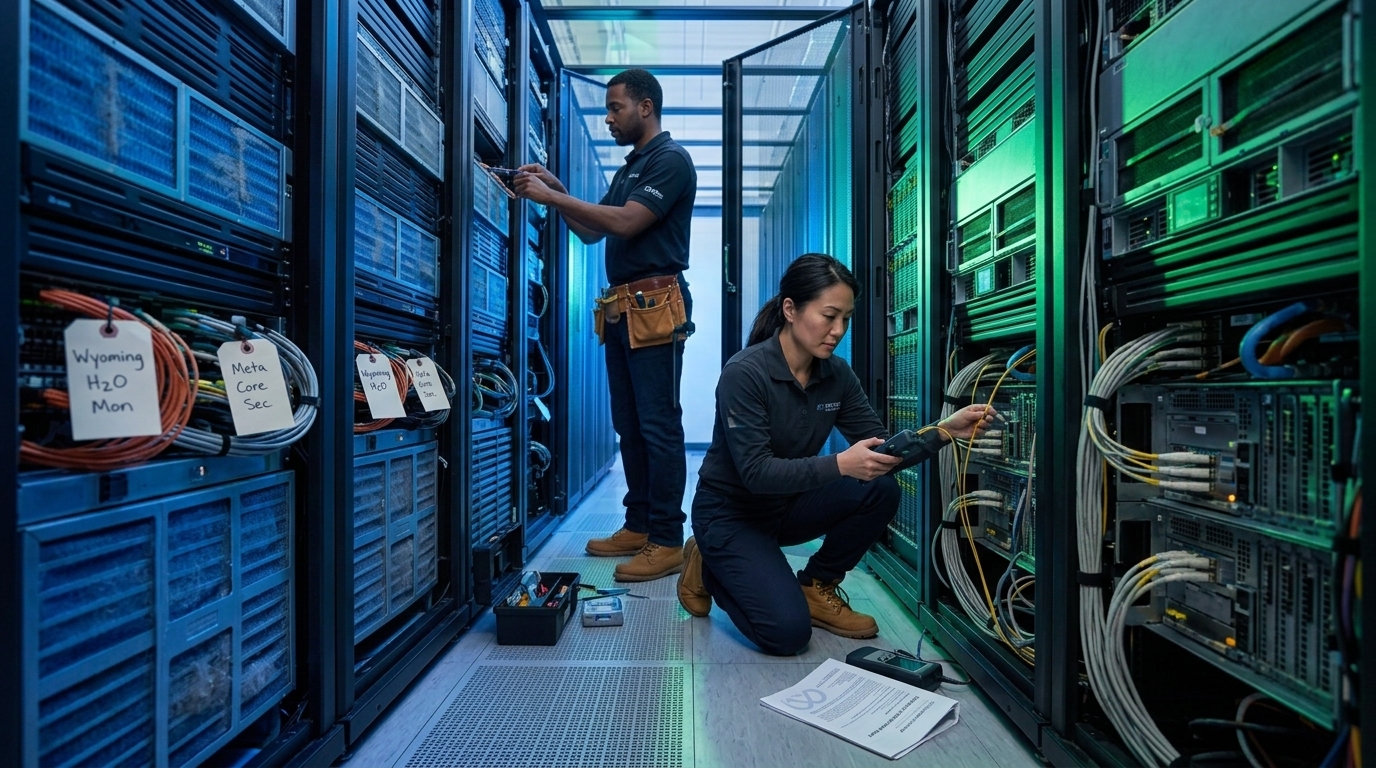
In the heart of the United States, where the vast plains of Wyoming meet the cutting edge of the digital revolution, an unexpected biological threat has emerged to remind the world that Artificial Intelligence does not reside in an abstract "cloud," but in physical facilities with immense environmental footprints. The recent incident at Meta’s data center facilities in Cheyenne, where a rare and multi-drug resistant bacterium was detected in industrial wastewater, is not merely a local news item; it is the catalyst for a radical reassessment of how tech giants manage natural resources.
The Chronicle of a Biological Warning
It all began when routine inspections of Cheyenne's sewage and water network revealed the presence of a microorganism showing alarming resistance to antibiotics. Although authorities were quick to clarify that the municipal drinking water remains safe, the source of the problem was traced back to the cooling systems of Meta's data centers. To keep thousands of processors within functional temperature ranges, these centers utilize millions of gallons of water, which is often recycled or discharged back into the municipal system after chemical treatment.
The presence of the bacterium suggests that traditional disinfection and wastewater management methods in data centers may no longer suffice for the volume and temperature of effluent generated by intensive AI operations. The heat dissipated by high-performance chips creates an ideal breeding ground for pathogens if safety protocols are not strictly followed and updated for the AI era.
From Tolerance to Strict Regulation
The response from local authorities was immediate and unprecedented. The Cheyenne Board of Public Utilities announced strict restrictions on all data center facilities connected to the municipal grid. These new regulations do not target Meta alone but set a new standard for any company wishing to invest in the region. Moving forward, companies are required to present detailed water management plans, utilize closed-loop cooling technologies that minimize wastewater discharge, and undergo frequent biological load testing.
This development comes at a time when Meta, Google, and Microsoft are facing fierce criticism for their surging global water consumption. Estimates suggest that training a single model like GPT-4 requires millions of liters of water, while a simple interaction of 20-50 questions with a chatbot effectively "drinks" about half a liter of water used for server cooling.
Political and Social Implications
The Wyoming incident highlights a deeper conflict: the global race for AI supremacy versus the fundamental needs of local communities. In Wyoming, a state frequently grappling with drought, water usage is a matter of survival for ranchers and farmers. The notion that community water is being sacrificed so an algorithm can generate images or text has sparked significant public backlash.
- Stricter limits on water permits for new infrastructure.
- Mandatory use of reclaimed water for industrial cooling.
- Heavy fines for exceeding biological pollutant thresholds.
- Full transparency regarding water consumption data per facility.
Meta, for its part, claims a commitment to being "water positive" by 2030, promising to restore more water to the environment than it consumes. However, the bacterial incident demonstrates that future promises are insufficient to mitigate present-day risks. The demand for cooling is immediate, and alternative technological solutions, such as air cooling or liquid immersion, remain expensive and difficult to scale across massive server farms.
Conclusion: The End of Environmental Immunity
The Wyoming incident is a milestone. It marks the end of the era where data centers were viewed as "clean" investments with zero local pollutants. The AI industry is now being called upon to prove it can grow without endangering public health or depleting the resources of its host regions. Regulators worldwide are closely monitoring the Cheyenne case, and it is highly likely we will see similar rules adopted in Europe and Asia, as the climate crisis cements water as the most precious commodity of the 21st century.





