Europe stands at a critical crossroads. The transition to green energy, while politically non-negotiable, is clashing with an aging and often fragmented transmission network. The new European Grids Action Plan is not merely a technical directive but a geopolitical manifesto aimed at the continent's energy autonomy. In this new landscape, Greece is emerging as a central player—no longer a peripheral consumer, but a strategic hub connecting three continents.
The Strategic Importance of the European Action Plan
For decades, the focus of European policy was on energy production—wind turbines and solar panels. However, reality has proven that production without adequate "cables" is a gift without a box. The new EU package recognizes that investments of 584 billion euros are required by 2030 to modernize the grids. Without these investments, 40% of existing distribution networks will be over 40 years old by the end of the decade, making it impossible to absorb the intermittent production from Renewable Energy Sources (RES).
The action plan focuses on accelerating permitting, improving access to financing, and strengthening cross-border cooperation. For Greece, this translates into a golden opportunity to leverage its geographical position, turning its comparative advantage into permanent economic and political power.
The Three Greek Keys to Energy Security
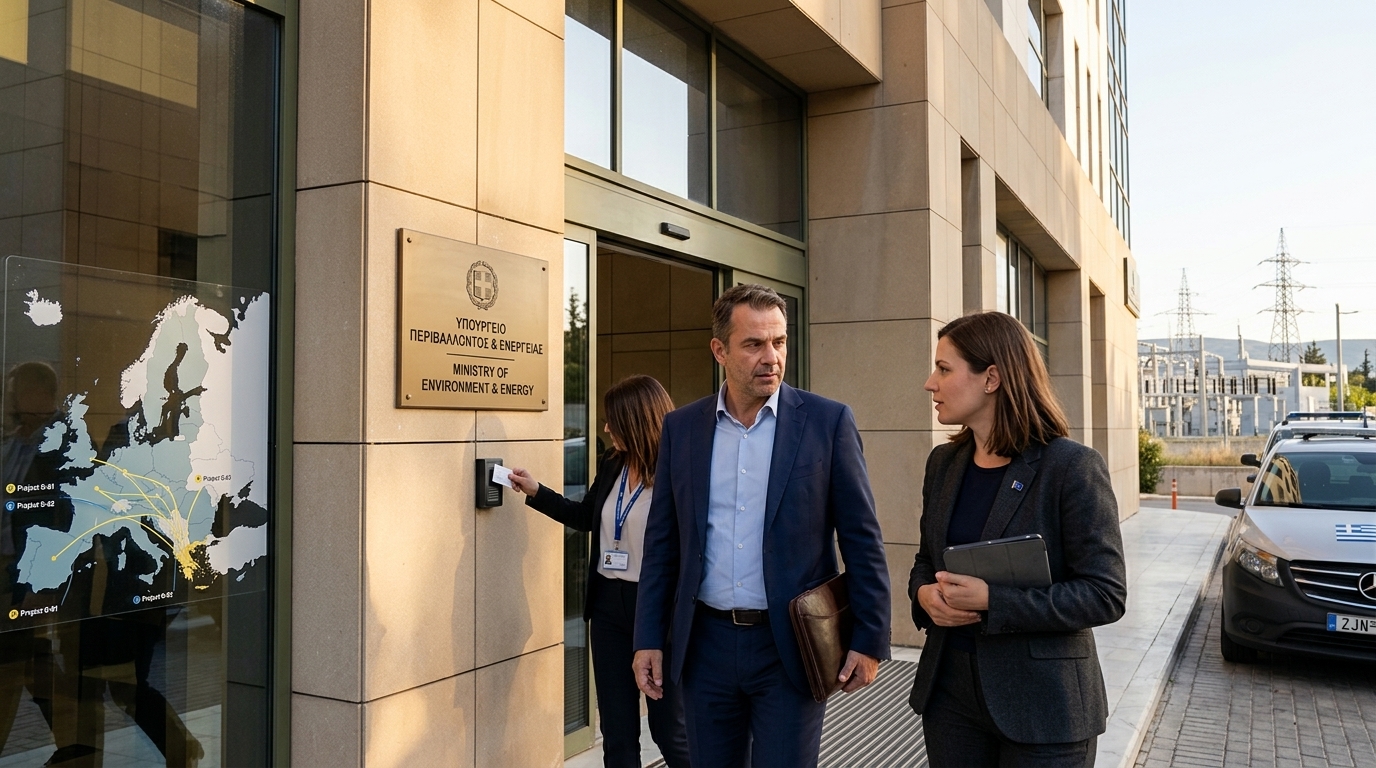
At the heart of the interest are three projects included in the EU's Lists of Projects of Common Interest (PCI) and Projects of Mutual Interest (PMI):
- Great Sea Interconnector (formerly EuroAsia Interconnector): The electricity interconnection between Greece, Cyprus, and Israel is the most ambitious project in the Eastern Mediterranean. Its goal is to end the energy isolation of Cyprus—the last non-interconnected EU member state—and connect Europe with the Middle Eastern energy market.
- GREGY (Greece-Egypt Interconnector): A subsea interconnection that will transport 3,000 MW of green energy from Egypt directly to Greece and then to the rest of Europe. This project highlights Greece as the primary gateway for Africa's clean energy.
- Vertical Corridor: Although primarily focused on natural gas and eventually hydrogen, the Vertical Corridor connects Greek LNG terminals (such as Revithoussa and Alexandroupoli) with Central and Eastern Europe, reducing dependence on Russian flows.
"Greece is no longer the end of the line, but the beginning of a new energy era for Europe," say sources within the European Commission, emphasizing the importance of Greek infrastructure.
Challenges and Geopolitical Risks
Despite the optimism, the road is not without obstacles. Implementing these projects requires massive capital, which, in a period of high interest rates, is difficult to secure solely from the private sector. Furthermore, geopolitical tensions in the Eastern Mediterranean and instability in the Middle East add layers of risk that investors must account for.
Bureaucracy also remains a significant deterrent. Although the Grids Action Plan promises "fast-track" procedures, harmonizing national legislations remains a slow process. For Greece, the challenge is twofold: to maintain the pace of domestic reforms and to exercise effective diplomacy abroad to secure the necessary alliances.
The Economic Footprint and the Next Day
The completion of these interconnections will have a direct impact on the Greek economy. Beyond the jobs created during the construction phase, Greece will be able to export its surplus RES production, reducing the trade deficit and boosting GDP. At the same time, lowering energy costs for industry and households will make the Greek economy more competitive internationally.
In conclusion, the European Grids Package provides Greece with the framework to take a leading role. The success of these projects will determine whether the country establishes itself as the energy pillar of Southeast Europe or remains a spectator of developments. The political will exists; implementation is now the great bet.