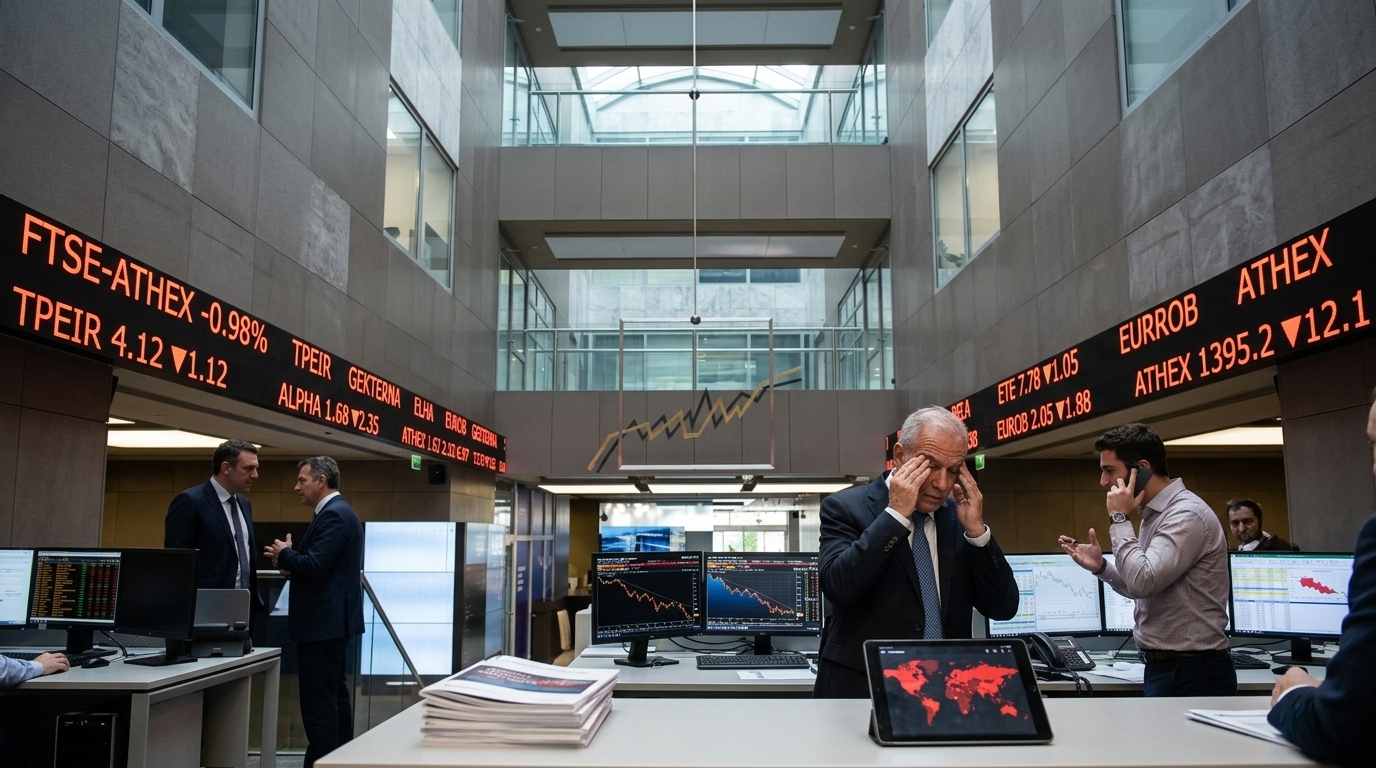
The performance of the Athens Stock Exchange (ASE) in recent days leaves little room for misinterpretation: the market is in a phase of controlled but clear correction. Completing four consecutive bearish sessions, which led to a negative week with losses of 1.08%, reflects a broader nervousness among investors as the end of the first half of 2026 approaches. Despite the Greek economy's continued resilience, the stock market appears to be "panting" in its attempt to secure higher price levels, trapped between the need for profit-taking and a lack of new, powerful catalysts.
The Psychology of Correction and the Banking Sector
The banking sector, the traditional "protagonist" and barometer of the Greek market, has been at the center of the pressure. Following an impressive rally in the previous period, institutional investors proceeded with selective liquidations, locking in part of their capital gains. This nervousness is not accidental. Markets are awaiting the next steps from the European Central Bank (ECB) regarding interest rates, as inflation in the Eurozone shows signs of persistence, limiting the scope for further aggressive cuts that would favor borrowing costs and corporate profitability.
According to analysts, this correction is deemed "healthy" in the sense that it offloads technical indicators that had entered overbought zones. However, the duration of the decline—four consecutive days—suggests that this is not merely a transient move but a reassessment of risks. Banks, despite their strong fundamentals and the dividend policies they announced, are now called to prove they can maintain profitability in an environment where interest rates may remain higher for longer than initially anticipated.
Global Environment and Geopolitical Uncertainty
It is not only domestic issues pressing stock prices. The international climate remains fragile. Volatility in major European markets, such as Frankfurt and Paris, directly impacts the periphery, with Athens being no exception. Geopolitical tensions in Eastern Europe and the Middle East continue to fuel uncertainty in energy prices, directly affecting the operating costs of listed companies, particularly in the industrial and construction sectors.
- The General Index's fall below critical technical support levels triggered automatic sell orders (stop-loss).
- Trading volume remained at moderate levels, indicating that major players are adopting a wait-and-see stance.
- The absence of "fresh" money from abroad is evident, as capital shifts toward safer havens.
Furthermore, the domestic political scene, while stable, does not currently offer the "narrative" that could trigger a new buying wave. Reforms are progressing, but the absorption rate of Recovery Fund resources remains a critical question mark for the real economy, which is reflected in the valuations of mid- and small-cap stocks.
Technical Outlook and Summer Prospects
From a technical perspective, the General Index must now defend the 1,400-point level, which serves as a strong psychological and technical boundary. If pressure continues into next week, we might see a test of the 1,380-point level, where the 200-day moving average is located. Maintaining these levels is vital to ensure that the long-term upward trend that began last year is not invalidated.
"The market needs a period of respite to digest its gains. The current nervousness is the price of the Greek stock market's maturation," a brokerage firm executive noted.
Looking toward the rest of the summer, investors will focus on second-quarter corporate results. If listed companies manage to exceed expectations, then this correction will prove to be an excellent entry opportunity for those who missed the previous rally. Otherwise, the risk of a prolonged sideways movement or further decline is visible, especially if the international environment deteriorates further. Athinon Avenue stands at a crossroads, and the coming sessions will determine whether 2026 will close on a positive note or if "fatigue" will turn into a deeper crisis of confidence.