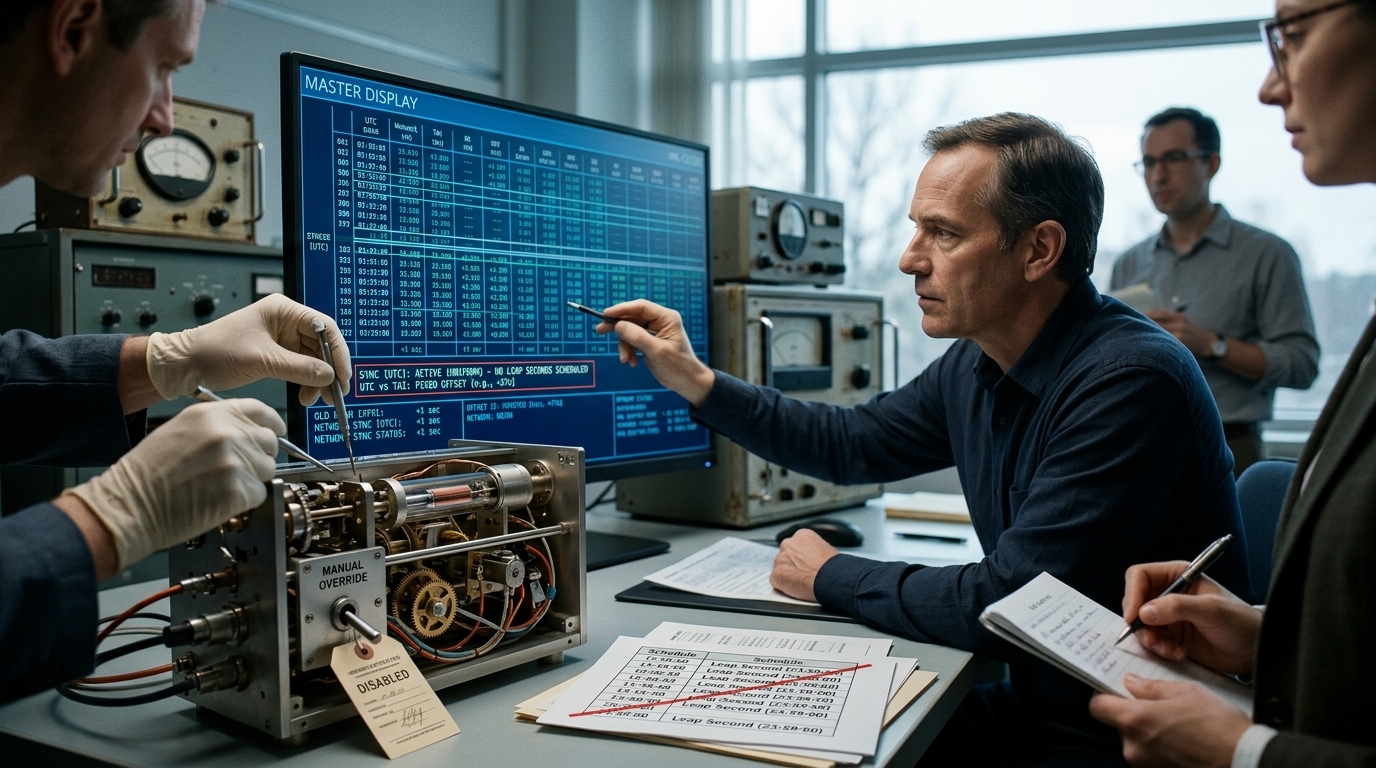
After three decades of debate in the metrological community, the leap second is officially dead. The International Bureau of Weights and Measures (BIPM) announced that starting in May 2027, it will stop issuing leap seconds, 32 of which have been added since 1972 to adjust Coordinated Universal Time (UTC).
The Struggle for Synchronization
The leap second was implemented to bridge the growing gap between time measured by atomic clocks and time based on the Earth’s rotation. While atomic time is constant, Earth's spin is affected by tidal friction, its molten core, and the atmosphere. Keeping these two in sync was like adding extra track for a train to keep it parallel with another, but this manual adjustment caused significant technical friction.
- Tech giants like Google and Meta resorted to a "smear" method, spreading the extra second over 24 hours in tiny increments.
- In 2012, the airline Qantas saw its booking system crash due to a leap second adjustment.
The Threat of the Negative Second
A driving force behind this abolition is the rising probability of a "negative" leap second—a scenario never before tested. Climate change has played an unexpected role; melting ice has shifted the planet's gravity so significantly that Earth has actually picked up rotational speed. According to a 2024 Nature study, a negative leap second might have been required as early as 2029, posing a dangerous risk to global infrastructure.
A Millennial Solution
The BIPM chose May 20, 2027, as the implementation date to honor the anniversary of the 1875 Metre Convention. While atomic and astronomical time will continue to drift apart, the BIPM has proposed a "leap hour" as a long-term solution. However, since it takes 3,600 seconds to make an hour, this adjustment is millennia away, effectively leaving the problem to far-future generations.