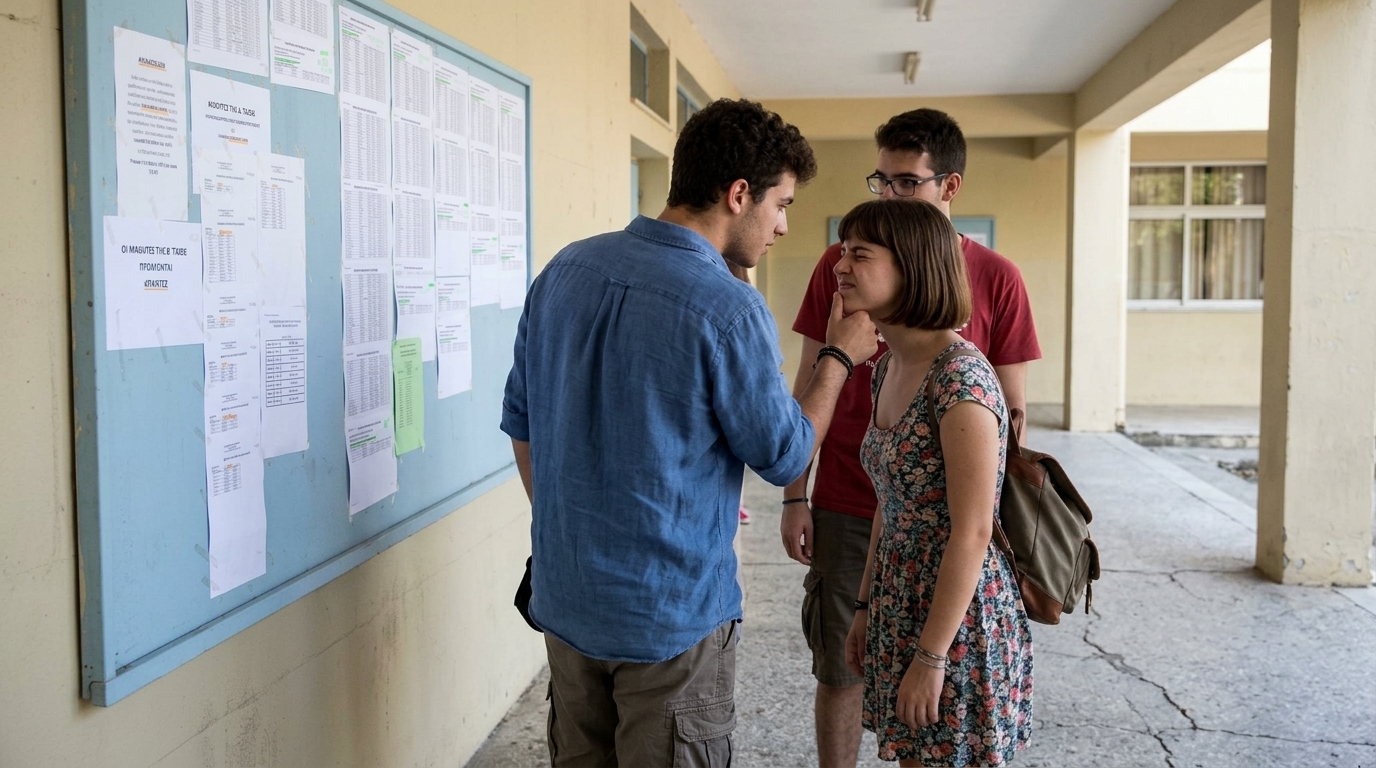
Today marks the culmination of years of rigorous preparation for thousands of teenagers and their families across Greece. According to the official announcement by the Ministry of Education, Religious Affairs, and Sports, the results for the National Exams (Panellinies) for both General (GEL) and Vocational (EPAL) High Schools are scheduled to be released this afternoon. This process is far more than a mere bureaucratic disclosure of numbers; it is the moment where academic ambition meets the reality of performance within a system that remains the central pillar of social mobility in Greek society.
Digital Integration and the Modern Results Day
For another consecutive year, technology plays a pivotal role in how candidates receive their news. Most students have opted to receive their grades via SMS, a service that has significantly reduced the traditional morning-long wait at school gates. Simultaneously, the specialized government portal (results.it.minedu.gov.gr) will allow students to access their scores using their unique candidate codes. While digitalization has streamlined the process, the traditional posting of results at high schools continues, preserving a fragment of the collective anxiety of previous decades, though now lists display codes rather than names to comply with GDPR regulations.
Analyzing the 2026 Academic Performance
Initial reports from grading centers suggest a year of significant fluctuations in performance. The Physics and Mathematics exams were characterized by many educators as some of the most challenging in recent history. This complexity is expected to exert downward pressure on the entry requirements (the 'bases') for prestigious Engineering and Science faculties. Conversely, performance in the Humanities appears more stable, with Modern Greek Language acting as the traditional stabilizer for overall scores.
- Physics: A high degree of difficulty that challenged even the top-tier students.
- Mathematics: Demanding problems that prioritized critical thinking over rote memorization.
- Modern Greek: Generally perceived as accessible, allowing the majority to secure decent foundational scores.
- EBE (Minimum Entry Base): This controversial threshold is expected once again to exclude a portion of candidates who failed to meet the minimum average required for specific departments.
The Strategic Shift: Non-State Universities and the Road Ahead
With the grades in hand, the critical phase of filling out the 'Michanografiko' (the university preference form) begins. Candidates must now balance their aspirations with their actual scores in a rapidly evolving educational landscape. 2026 is a landmark year for Greek higher education, as the establishment of the first non-state, non-profit universities begins to alter the competitive map. Students who miss the mark for public universities may now consider domestic private alternatives, a shift that could potentially mitigate the long-standing 'brain drain' of students moving abroad for undergraduate studies.
A Broader Perspective on Educational Success
The intensity surrounding the Panellinies often obscures a fundamental truth: the exams are a milestone, not a final destination. In an era defined by Artificial Intelligence and the necessity for lifelong learning, the rigid structure of the Greek exam system is increasingly under scrutiny. While it remains a transparent and meritocratic process, its focus on a single, high-stakes performance is often criticized for failing to capture the diverse talents of the youth.
"Success in the 21st century is rarely defined by a single exam score. Resilience and the ability to pivot are the true currencies of the modern workforce," notes a prominent educational analyst.
As the afternoon unfolds, the atmosphere in Greek households will range from jubilation to introspection. Regardless of the outcome, the 2026 results serve as a reminder of the need for a broader dialogue on how Greece educates its next generation—moving away from 'exam-factories' and towards a more holistic, skills-based approach that aligns with global economic realities.