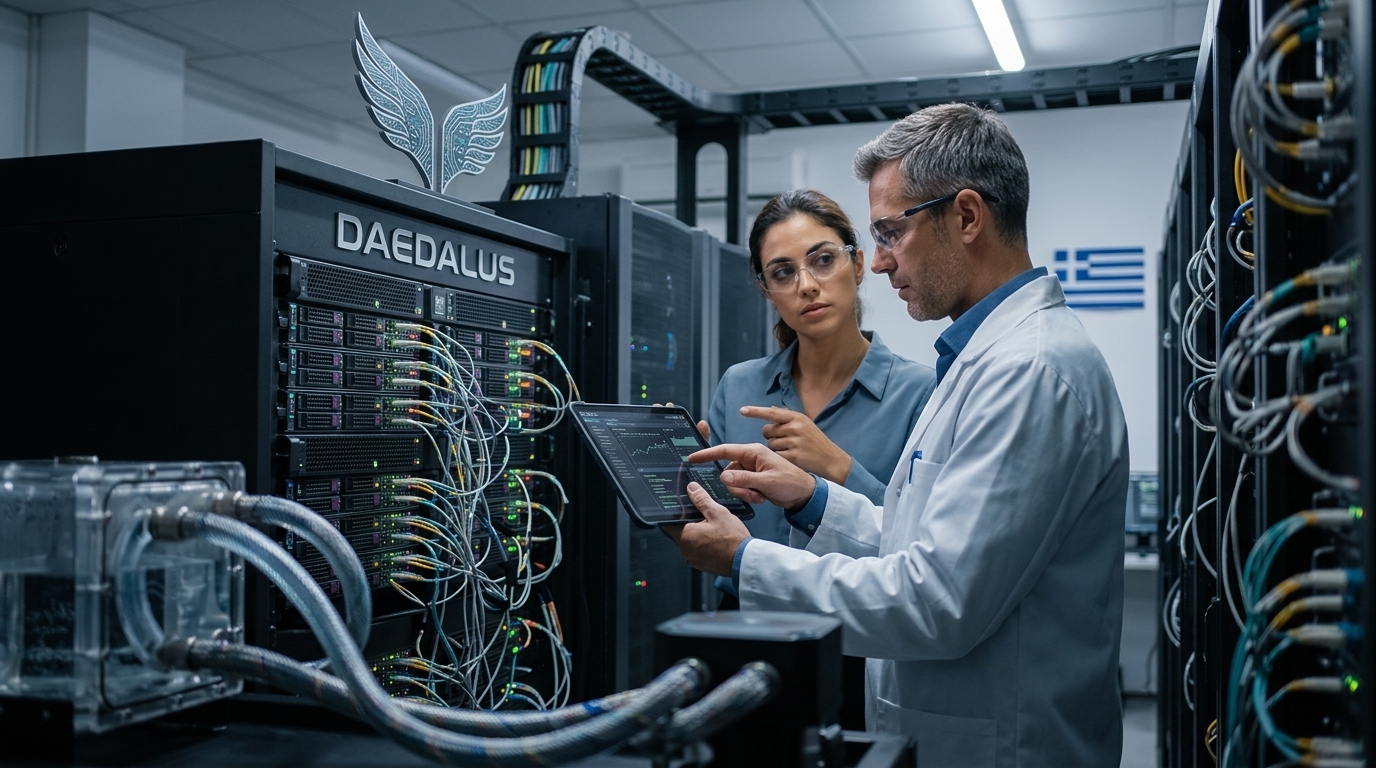
Greece is securing the computational power necessary to develop advanced artificial intelligence (AI) models and decrease its reliance on foreign infrastructure. The Daedalus supercomputer, the most powerful ever installed in the country, is being inaugurated at the Lavrio Technological and Cultural Park, housed within the historic building of a former power station.
Technical Specifications and Global Standing
Daedalus boasts a measured performance of 85.69 petaflops, placing it 31st in the global rankings. The system is built on Nvidia Grace Hopper GH200 technology and utilizes liquid cooling. It also stands out for its energy efficiency, having ranked 23rd in the global Green500 list as of June 2026.
The management and technical operation of the system are handled by the National Infrastructures for Research and Technology (GRNET). Hewlett Packard Enterprise supplied the equipment (€41 million), while Mainsys managed the electromechanical installations and data center fit-out (€17.9 million).
Access for Businesses and Startups
Business access to the supercomputer will be facilitated by the Pharos AI Factory, one of the first seven AI factories selected by the European Union. Services are expected to become generally available to businesses in March 2027. Key access points include:
- Start-ups and small-to-medium enterprises (SMEs) will receive free access, subject to EU state aid regulations.
- Large corporations may face charges based on computing resource usage time.
- Hellenic AI Factory S.A., owned by the Growthfund (70%) and the Ministry of Digital Governance (30%), will manage commercial exploitation.
A Complementary System in Kozani
The national strategic plan includes a second supercomputer to be installed at the University of Western Macedonia in Kozani. With a budget of €21.57 million for its initial subproject, this infrastructure will work in tandem with Daedalus. Digital Governance Minister Dimitris Papastergiou noted that models will be trained on Daedalus and run on the Kozani system, ensuring the two infrastructures operate complementarily.