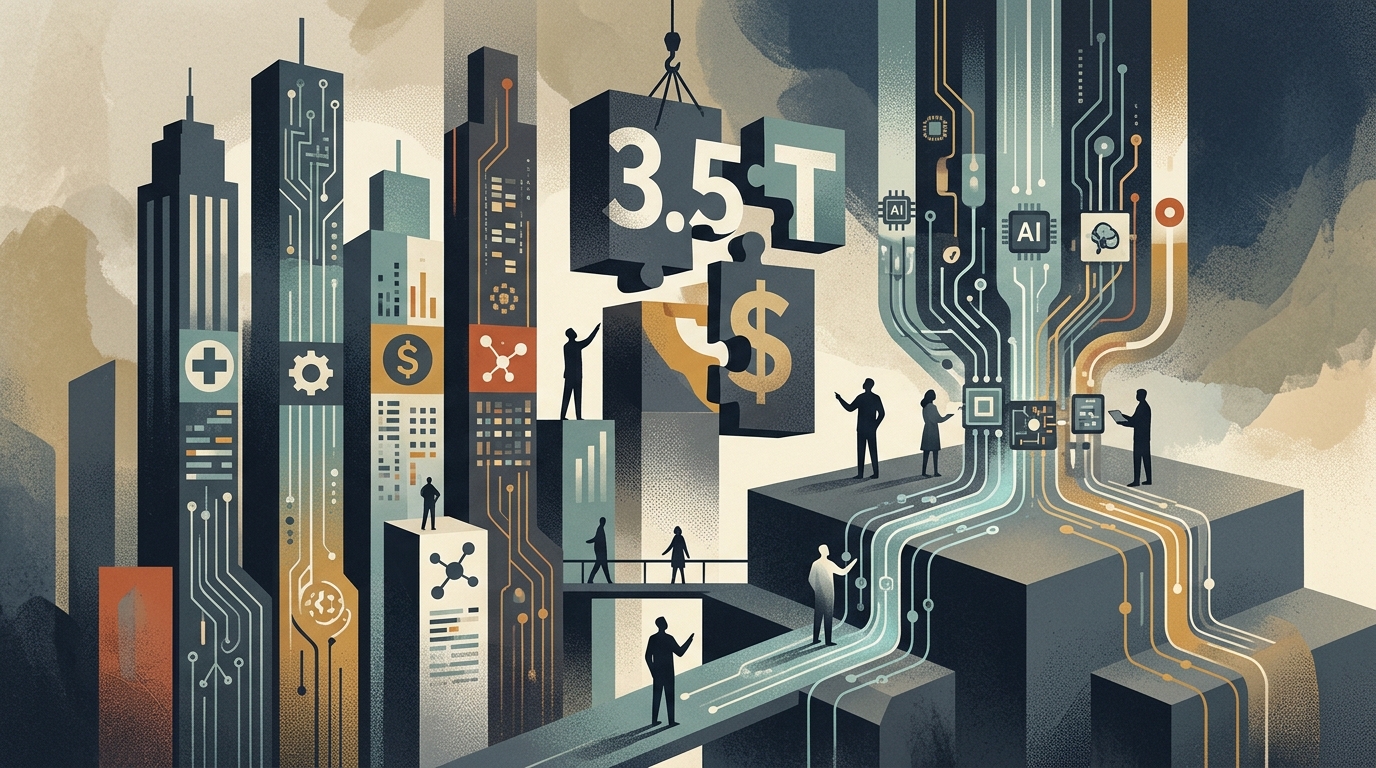
The discourse surrounding Artificial Intelligence (AI) often descends into a simplistic dichotomy: on one side, the utopian promise of liberation from toil, and on the other, the dystopian fear of mass unemployment. However, at the heart of the technological revolution, the engineering sector—from civil and mechanical to software engineers—seems to be defying the doomsayers. The resilience of jobs in this field is no coincidence; it is the result of a profound transformation of what it means to be an "engineer" in the 21st century.
The Shift from Execution to Strategic Design
For decades, a significant portion of an engineer's work was consumed by repetitive processes, routine calculations, and low-level code drafting. The advent of Generative AI is now automating precisely these aspects. Tools like GitHub Copilot for programming or advanced CAD systems for architectural design are reducing production time by 30% to 50%. Instead of leading to layoffs, however, this is driving a qualitative upgrade. The engineer is ceasing to be the "executor" and is becoming the "systems architect." The focus is shifting from "how to build it" to "why am I building it" and "what are the safety and ethical constraints?"
In the global market, this phenomenon is particularly evident. Engineers are now tasked with managing complex infrastructure and digital transformation projects that were previously unthinkable. AI's ability to process vast amounts of data allows engineers to compete on a global scale, offering solutions that combine traditional technical proficiency with algorithmic innovation. The mundane is outsourced to the machine, leaving the creative and strategic heavy lifting to the human mind.
Human Judgment and Legal Liability
One of the primary reasons AI cannot fully replace the engineer is the issue of liability. In critical infrastructure, such as bridges, power grids, or autonomous transport systems, decisions cannot be left solely to an algorithmic "black box." The signature of a licensed engineer carries legal and ethical weight. The judgment required to assess risks in unpredictable environments remains an exclusively human trait. AI might suggest ten different structural designs, but the human engineer is the one who will select the optimal one, taking into account local specificities, environmental impacts, and social needs that AI fails to fully comprehend.
- Ethical decision-making in complex environments.
- Legal accountability and responsibility for project safety.
- Management of unpredictable factors not included in training data.
- Interdisciplinary collaboration requiring empathy and negotiation.
The Jevons Paradox and the Demand for Talent
Economically, this phenomenon is explained by the "Jevons Paradox": as technology makes a service more efficient (and thus cheaper), the demand for that service increases so much that more resources (and people) are ultimately required to meet it. As AI makes design and development more accessible, corporations and governments embark on more ambitious projects. This creates a job gap that only skilled engineers with AI knowledge can fill. We are observing that job postings for engineers are not decreasing; rather, they now require a new mix of skills: "AI-literacy" combined with a deep understanding of physical sciences.
Conclusion: The Era of the Augmented Engineer
Artificial Intelligence is not the enemy of the engineer; it is their most powerful ally. Jobs are resisting the pressure because the essence of engineering was never mere data processing, but problem-solving for the improvement of human life. The "augmented engineer" of the future will be the one who uses AI to push the boundaries of what is possible, while maintaining control and vision. We are moving toward a synthesis where the machine handles the complexity of data and the human handles the complexity of meaning. For the global economy, this represents a shift toward higher-value labor, where the engineer's role is more critical than ever.