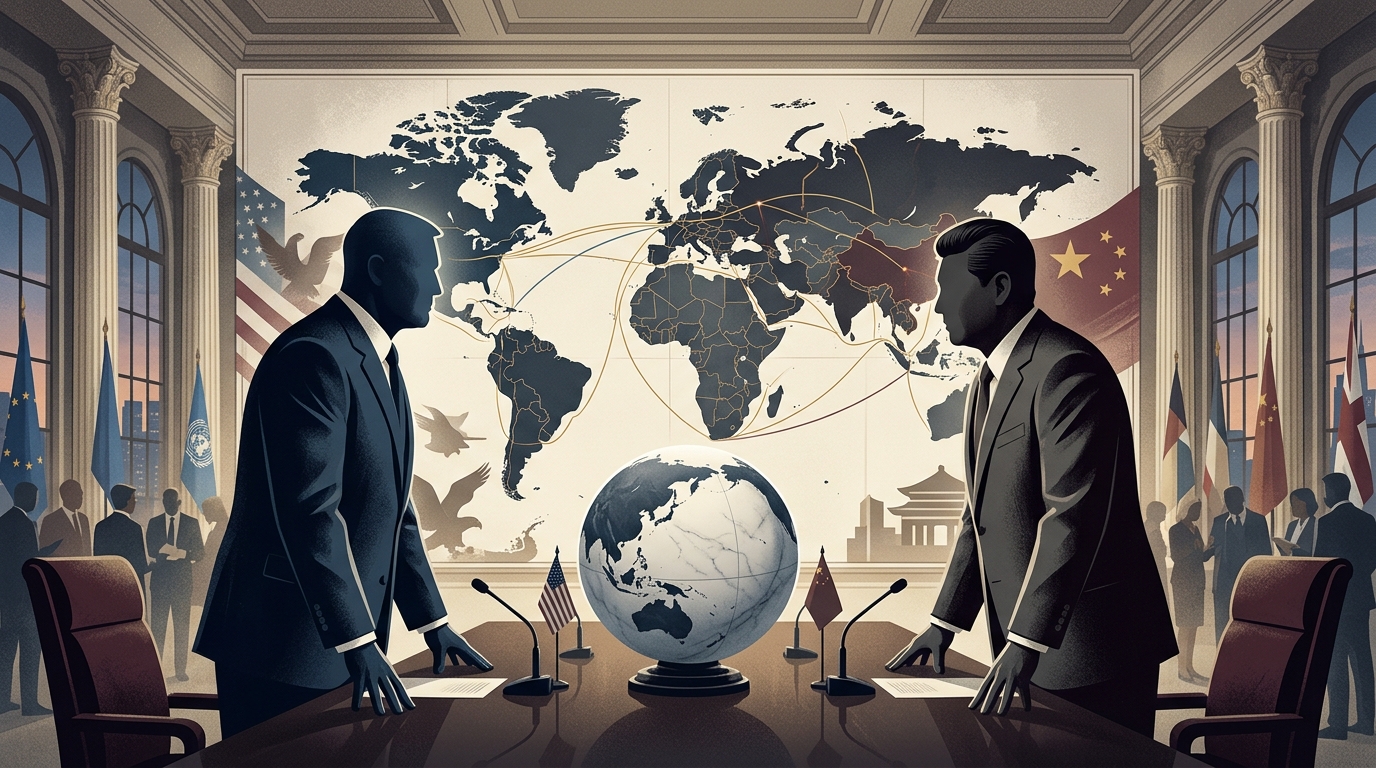
History warns of the greatest danger in international relations: not a war chosen by design, but one into which rivals are dragged by the dynamics of power. During his recent visit to Washington, Chinese President Xi Jinping posed a fundamental question to Donald Trump: Can a rising superpower coexist with the dominant power without their rivalry ending in war?
What Thucydides Actually Said
The term "Thucydides Trap," popularized by Harvard professor Graham Allison, describes the root cause of the Peloponnesian War: the rise of Athens and the fear it instilled in Sparta. According to this logic, an explicit desire for destruction is not required. It is enough for the balance of power to shift so rapidly that it breeds suspicion, leading to arms races and eventually a crisis that acts as a spark.
From Athens to Washington
In Allison's historical analysis, 12 out of 16 cases of power shifts over the last five centuries ended in war. Today, China is no longer just an emerging economy but an industrial powerhouse dominating electric vehicles, AI, and rare earths. Conversely, the US maintains its lead in military power, capital markets, and advanced semiconductors.
Xi Jinping stated in Washington that "the Thucydides Trap can be overcome," describing competition as a race where one tries to catch up with the other, rather than a struggle where one must win and the other lose.
Taiwan and Technology: The Battlefields
Taiwan remains the most dangerous military flashpoint. While Xi asked the US to oppose Taiwan's independence, the Trump administration recently approved a large arms sale package to the island. Simultaneously, a "war without weapons" is underway in semiconductors and AI. Paradoxically, AI is also a field of forced cooperation, as risks from autonomous systems know no borders.
The Lesson of the Cold War
History shows that conflict is not inevitable. The US and the Soviet Union avoided direct war through communication mechanisms and understanding "red lines." The 21st century offers additional safeguards: nuclear weapons acting as a deterrent and a deep economic interdependence that makes a conflict catastrophic for both sides.