In a move that redraws the global technological map, the South Korean government has announced an unprecedented investment program of $1 trillion, aimed at establishing the country as the undisputed superpower in next-generation memory chip production and commercial dominance in humanoid robots by 2028. This announcement, coming at a time of intense geopolitical competition between the US and China, marks the transition from digital Artificial Intelligence (AI) to "Physical AI."
The Semiconductor Mega-Cluster and HBM Dominance
The heart of this investment beats in Yongin, where the world's largest semiconductor "mega cluster" is being created. South Korea, home to giants like Samsung Electronics and SK Hynix, recognizes that the AI race is not won by algorithms alone, but by the hardware that powers them. Demand for High Bandwidth Memory (HBM) has skyrocketed, as it is the critical component for NVIDIA's processors and other manufacturers' high-end AI chips.
The plan involves the construction of dozens of new fabrication plants (fabs), which will focus on HBM4 and HBM5 technologies. Seoul's strategic choice is clear: if Taiwan (via TSMC) controls logic processing, South Korea will control the "memory" of the global digital brain. This dependence makes the country an indispensable partner for every tech giant, offering it a "silicon shield" against geopolitical turbulence.
The Humanoid Revolution: From Labs to Market
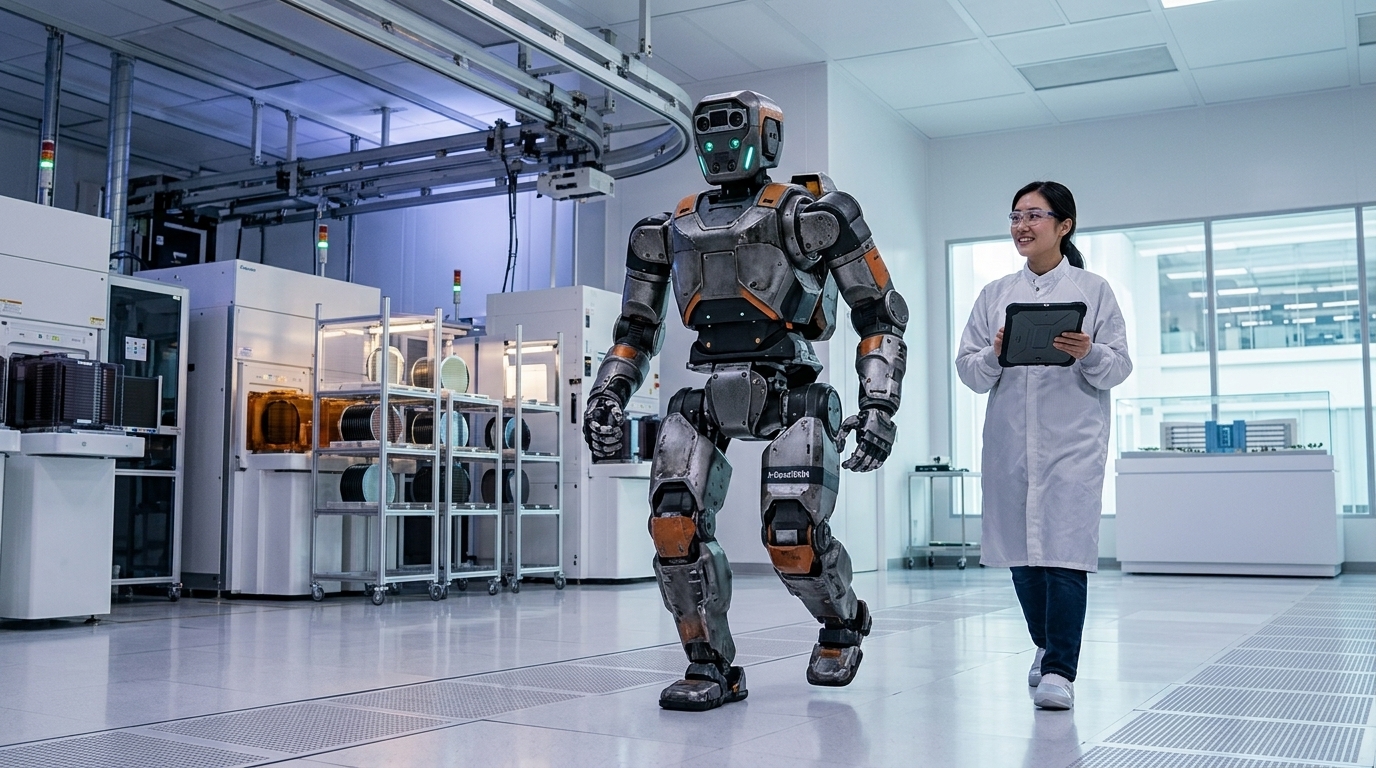
Perhaps the most ambitious part of the announcement concerns the development and commercialization of humanoid robots. South Korea aims to have fully functional, commercially available humanoid robots in mass production by 2028. This move is not just technological, but deeply social. Facing one of the world's sharpest demographic crises, Seoul sees robots as the solution to the labor shortage in manufacturing and services.
- Development of advanced actuators and sensors that mimic human movement with high precision.
- Integration of Physical AI models that allow robots to learn through interaction with their environment.
- Creation of a regulatory framework for the coexistence of humans and robots in shared workspaces.
The investment will be directed to state research centers and subsidies to the private sector, encouraging the creation of an ecosystem that combines manufacturing excellence with cutting-edge AI.
Geopolitical Implications and the "Silicon War"
The $1 trillion investment is a resounding response to the US CHIPS Act and China's efforts for technological self-sufficiency. South Korea refuses to be limited to the role of a supplier and claims the role of the architect of the next industrial revolution. However, the challenges are enormous. The energy consumption required to operate these giant production units and the need for rare earth minerals raise questions about the sustainability of the project.
"This is not just a financial investment; it is a strategic survival plan for the 21st century," said a senior official from Korea's Ministry of Trade. "Whoever controls the AI hardware will control the future of the global economy."
In conclusion, South Korea is betting everything on the physical manifestation of technology. In a world that often focuses on software, Seoul reminds us that intelligence needs a body and a memory to function. The success of this plan will determine whether Korea remains at the forefront of innovation or buckles under the weight of global competition.