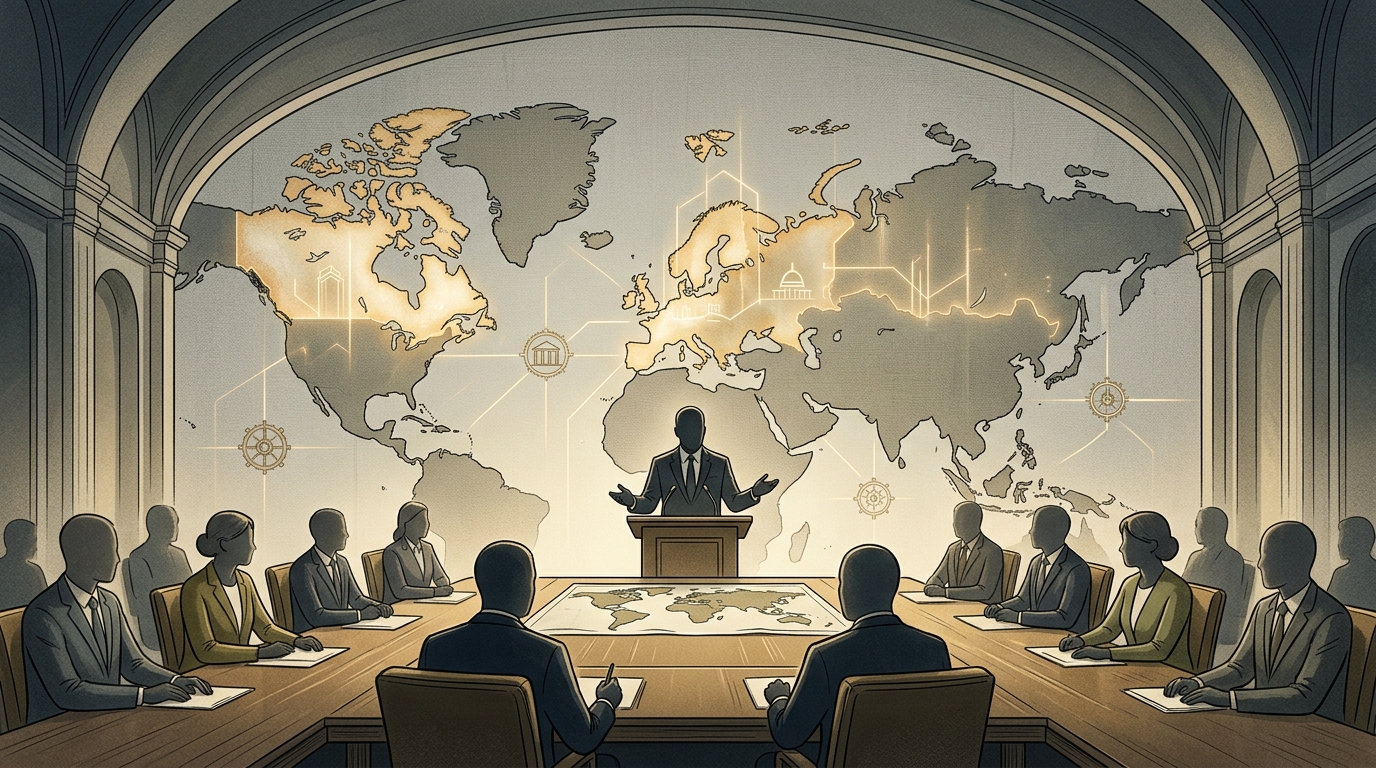
In a speech poised to become a turning point in international diplomacy, Canadian Prime Minister Mark Carney declared from Brussels that the "new world order" will no longer be dictated solely by traditional superpowers, but will instead be built around an axis of democratic middle powers centered on the European Union. His assertion that "Canada is the most European of non-European countries" was not merely a compliment, but a strategic declaration of intent signaling a move away from absolute dependence on Washington.
The Decline of Unipolarity and the Rise of Middle Powers
Carney, the former Governor of the Bank of England and the Bank of Canada, is leveraging his technocratic prowess to analyze the geopolitical instability of the current decade. According to his analysis, the inward turn of the United States and the aggressive rise of authoritarian regimes have created a power vacuum. In this void, Canada and Europe are called upon to act as guardians of liberal democracy and international law.
This approach is rooted in the idea that "middle powers," when acting in concert, can balance the pressures exerted by superpowers. Carney argued that Canada-EU cooperation in security, energy, and technology serves as the blueprint for how democracies can thrive without becoming satellites of China or the U.S. His rhetoric reflects a deep concern over the reliability of the U.S. as a strategic partner, especially following recent electoral turbulence and the trend toward protectionism.
Technological Sovereignty and AI Regulation
A central pillar of Carney's speech was the necessity for a shared governance framework for Artificial Intelligence. While the U.S. follows a free-market model dominated by Big Tech and China pursues a model of state control, Canada and Europe are proposing a "third way." This path prioritizes human rights, ethics, and transparency.
- Convergence of regulatory frameworks (EU's AI Act and corresponding Canadian initiatives).
- Establishment of joint research centers for "Safe AI."
- Protection of digital sovereignty against Silicon Valley monopolies.
Carney emphasized that technological sovereignty is inseparable from national sovereignty. "If we do not control the algorithms that shape our society, we do not control our future," he stated. His proposal includes the creation of an "Atlantic Digital Alliance" that transcends NATO, focusing on cyberspace and informational integrity.
The Green Transition as a Geopolitical Tool
As a former UN Special Envoy for Climate Action, Carney did not fail to link the new world order to the green economy. Canada, with its vast natural resources and critical minerals, is positioning itself as the primary supplier for European industry, replacing the continent's reliance on authoritarian regimes. The CETA (Comprehensive Economic and Trade Agreement) is expected to be expanded with specific protocols for hydrogen and lithium.
"Europe's energy security is Canada's national security. Together, we can set the rules of the green market before others impose them on us," the Prime Minister noted.
This strategic convergence aims to weaken the geopolitical influence of fossil fuel exporters who use energy as a weapon. Carney envisions a market where environmental standards act as a prerequisite for trade access, creating a "closed club" of economic prosperity based on shared values.
Challenges and Reactions
Despite the optimism, Carney's vision faces significant hurdles. Domestically, the Canadian opposition accuses him of abandoning the traditional relationship with the U.S., which remains the country's largest trading partner. In Europe, the EU's bureaucracy and internal divisions often hinder the rapid decision-making required by the modern geopolitical chessboard.
Furthermore, China has already expressed its dissatisfaction, speaking of a "Cold War mentality" disguised as "multilateral cooperation." However, for Carney, the risk of inaction is greater than the risk of rupture. The new world order he proposes is not a utopia but a survival necessity for middle democratic powers in a century defined by the rise of authoritarianism and the climate crisis.