

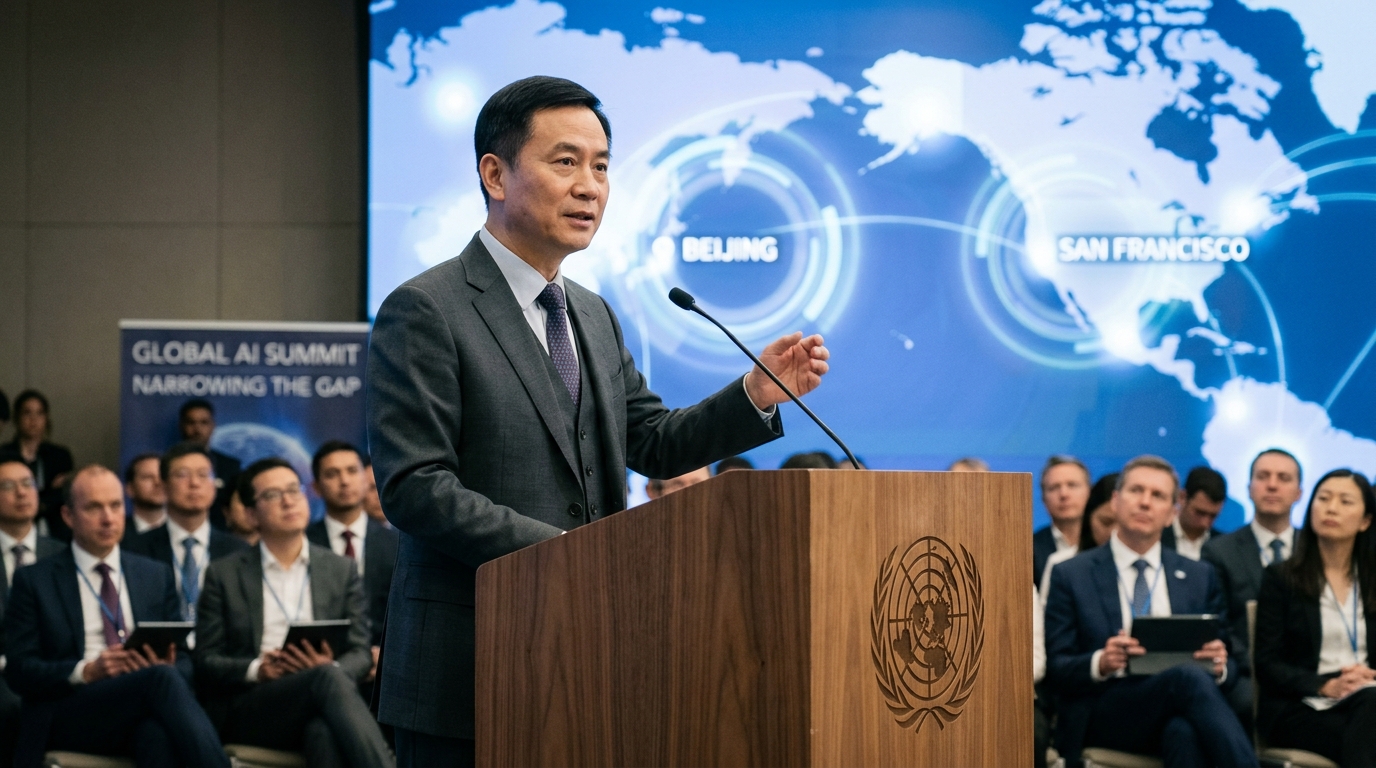
In the high-stakes arena of global technology, the long-held assumption that the United States maintains an unassailable two-to-three-year lead in Artificial Intelligence is being rigorously tested. Zhipu AI, a Chinese startup forged within the prestigious halls of Tsinghua University, has recently unveiled data suggesting its latest model, GLM-4, is standing toe-to-toe with OpenAI’s GPT-4. This parity spans critical domains such as complex coding, mathematical reasoning, and nuanced linguistic understanding. This development is far more than a corporate milestone; it represents a sophisticated counter-maneuver to Washington’s efforts to stifle Beijing’s technological ascent through stringent semiconductor export controls.
The Tsinghua Legacy and Zhipu’s Strategic Moat
Zhipu AI is not a typical startup. Founded in 2019 by veterans of the Knowledge Engineering Group (KEG) at Tsinghua University—often called the 'MIT of China'—it inherits a decade of foundational research in Large Language Models (LLMs). The company has masterfully navigated the 'open-core' strategy: releasing high-quality open-source models to anchor the developer ecosystem while reserving its most potent iterations, like GLM-4, for high-value enterprise clients. The level of institutional backing is staggering. With investments from tech titans like Alibaba, Tencent, and Meituan, alongside state-backed funds, Zhipu has been effectively anointed as a 'national champion' in the race for AI supremacy.
Circumventing the Silicon Ceiling
The central puzzle for Western analysts is how Zhipu and its peers, such as Kai-Fu Lee’s 01.AI and the rising DeepSeek, continue to produce world-class models despite the Biden administration's embargo on Nvidia’s H100 and B200 GPUs. The answer lies in a tripartite strategy: extreme algorithmic efficiency, the adoption of domestic hardware (notably Huawei’s Ascend series), and the ingenious optimization of legacy clusters. Chinese engineers have become adept at extracting maximum utility from limited compute, proving that intelligence can be refined through software elegance rather than just brute force. Furthermore, Zhipu leverages a massive, unique dataset in the Chinese language, providing a specialized edge that Western models, often trained on English-centric data, struggle to replicate.
Geopolitical Fallout: The Great AI Decoupling
The rapid progress of Zhipu AI underscores the limitations of broad-spectrum sanctions in halting innovation. Rather than being suppressed, the Chinese AI industry appears to have been galvanized toward technological self-reliance. As OpenAI and Anthropic remain effectively barred from the Chinese market due to mutual regulatory friction, Zhipu is filling the vacuum. This is creating a bifurcated AI landscape where the West and East operate within separate ecosystems, governed by divergent ethical frameworks and technical standards. The quest for Artificial General Intelligence (AGI) is no longer a localized Silicon Valley narrative; it is a global marathon with profound implications for economic hegemony and national security. The gap is closing, and the rules of engagement are being rewritten in real-time.
- Zhipu AI's valuation has soared past $3 billion, signaling robust confidence from both private and state investors.
- GLM-4 benchmarks suggest it reaches approximately 90% of GPT-4's capability across diverse cognitive tasks.
- China's AI focus is pivoting toward industrial integration and manufacturing, contrasting with the U.S. consumer-centric model.
- Compute scarcity has birthed a new generation of 'lean' models that challenge the 'bigger is better' scaling laws.





