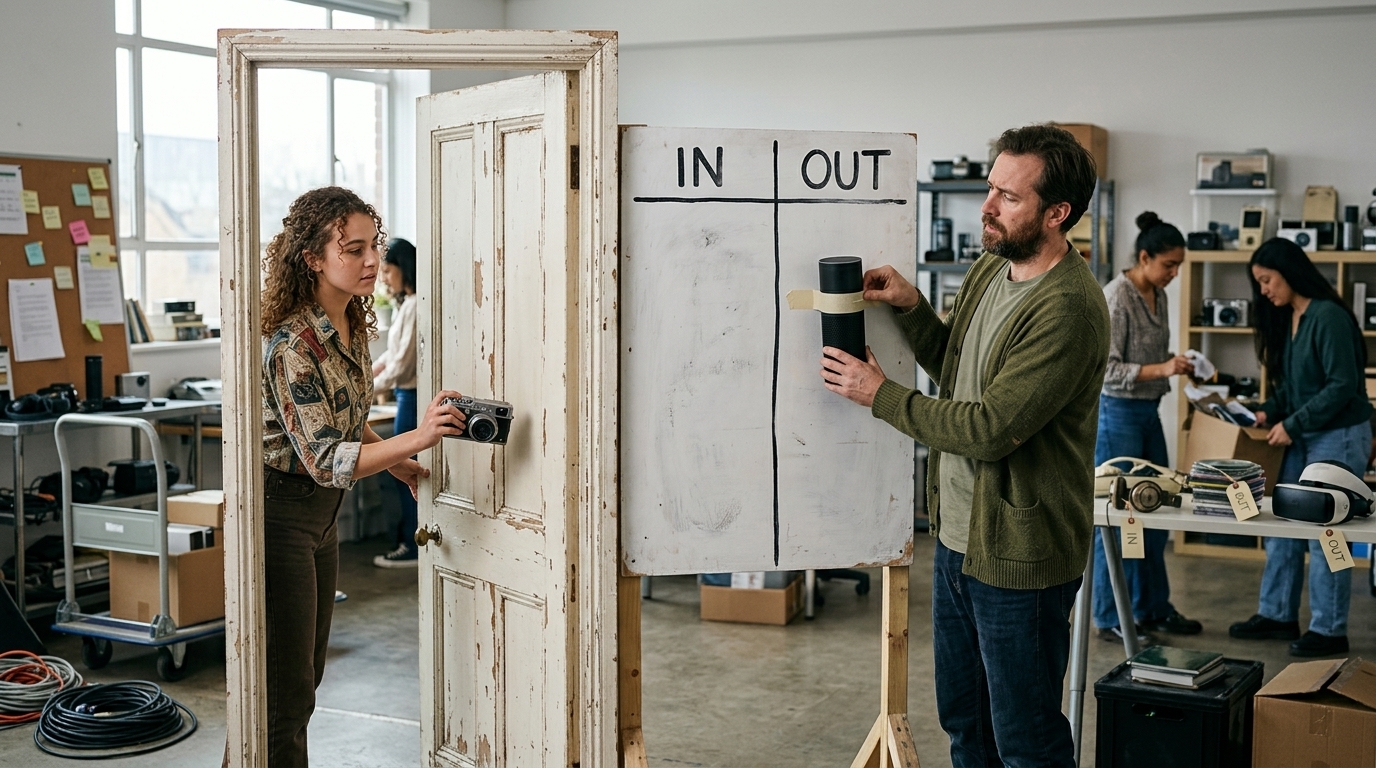
As we navigate the opening days of July 2026, tech culture stands at a pivotal crossroads. The Verge’s annual ‘In’ and ‘Out’ list is no longer just a quirky tradition; it has become a mirror reflecting our collective exhaustion with digital overload. After three years of relentless advancement in Generative AI, this summer marks a return to substance, privacy, and, paradoxically, intentional disconnection.
The Death of ‘AI Slop’ and the Rise of Local Intelligence
The years 2024 and 2025 were defined by a deluge of AI-generated content—what Verge editors now decisively label as “AI slop.” For Summer 2026, generic, algorithmically-generated content is officially OUT. Users have grown weary of the uncanny valley of perfect but hollow images and text that reads like it was written by an overly polite, soulless intern. In its place, human imperfection and “handcrafted” digital creativity are IN.
Simultaneously, we are witnessing a tectonic shift in how we interact with artificial intelligence. Massive cloud-based models that drain power and vacuum up data are starting to feel like relics of a less conscious era. The IN thing for 2026 is “Local AI” (On-device AI). With the launch of new processors capable of running complex LLMs directly on smartphones or laptops without an internet connection, privacy has become the new status symbol. Not “feeding” your personal data to the Big Tech clouds is the ultimate power move this summer.
Hardware: From VR Headsets to ‘Dumb’ Glasses and Minimalist Phones
The era of bulky headsets that isolate us from our surroundings seems to be fading. Despite the best efforts of industry giants, wearing a “face computer” at the beach or a cafe is officially OUT. What’s IN are sleek, lightweight Augmented Reality (AR) glasses that look like standard eyewear and offer only essential information: navigation cues, real-time translations, and notifications from a curated list of contacts.
Furthermore, the “digital minimalism” movement is gaining fresh momentum. Massive 7-inch smartphones that demand constant attention are now viewed as “noise.” On The Verge’s list, “Minimalist Phones” with E-ink displays and limited app ecosystems are the definitive trend for the holiday season. The ability to be reachable without being a hostage to the algorithm is the true luxury of 2026.
Social Media: The ‘For You’ Page is Dying, Small Communities are Thriving
Perhaps the most significant shift concerns the structure of our social lives online. The algorithm that dictates what we see—the infamous For You Page—is finally OUT. Doomscrolling fatigue has pushed users away from massive, public platforms. The IN trend for 2026 is “Dark Social”: private Signal groups, curated Discord servers, and small, niche networks built on protocols like ActivityPub.
Users are rediscovering authentic connection. Summer 2026 isn't about how many likes a sunset photo from Santorini can garner; it’s about sharing that moment with ten people who actually matter. Public broadcasting of one’s life is increasingly viewed as “cringe,” while digital intimacy has become the new normal.
Conclusion: The Return to the Human Core
The Verge’s 2026 list is more than a catalog of products; it’s a manifesto. After a decade where technology attempted to colonize every second of our attention, the backlash has arrived. This summer belongs to those who use AI as a tool rather than a crutch, those who prefer local processing over the cloud, and those who have the courage to leave their smartphone in the hotel room. Technology is becoming invisible again, allowing real life to take center stage.