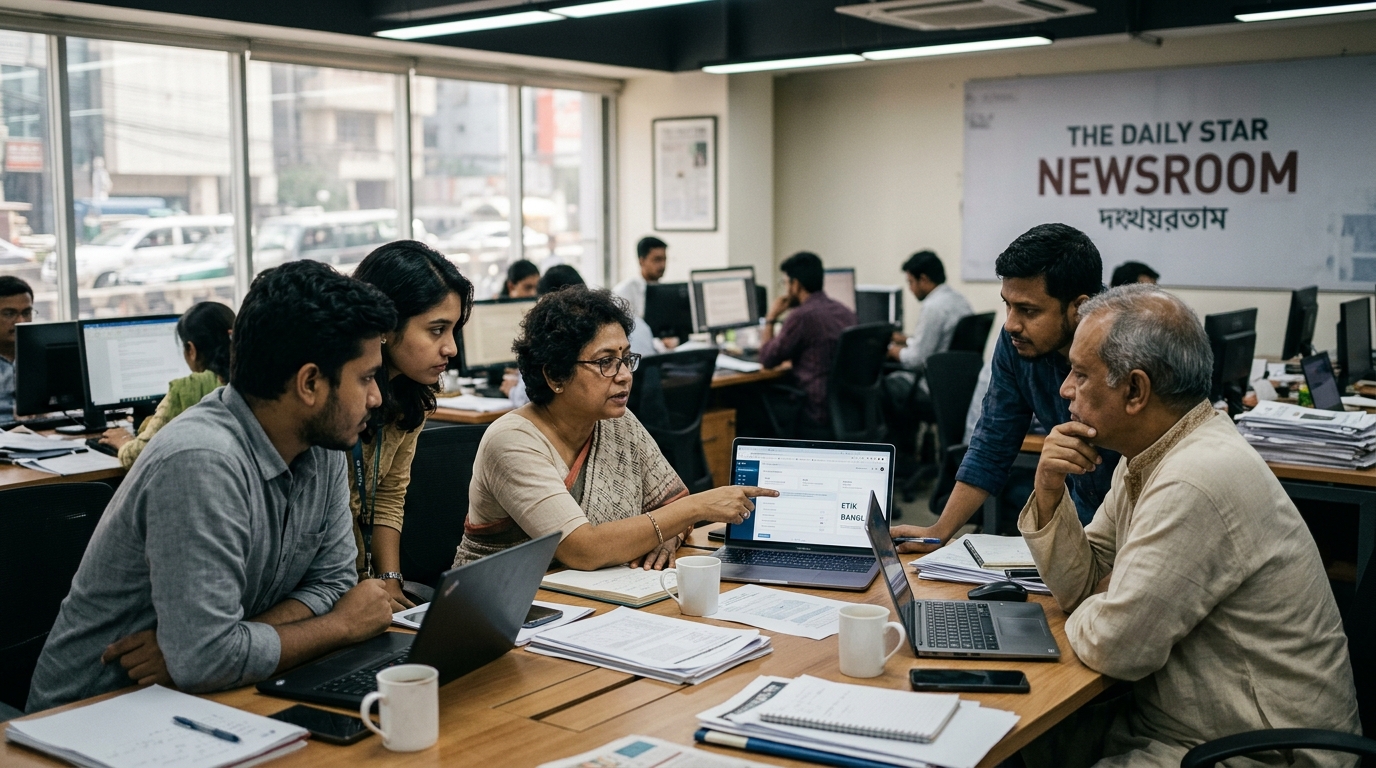
In an era where digital information moves at speeds exceeding human processing capacity, journalism finds itself at a critical crossroads. In Bangladesh, The Daily Star, one of the country's leading news organizations, has taken an initiative that could serve as a blueprint for all of South Asia: establishing strict ethical guidelines for the use of Artificial Intelligence (AI) in newsrooms. This move is not merely a technical adjustment but a profound political and social commitment to preserving truth in an environment saturated with algorithmically generated content.
The Challenge of Algorithmic Integrity
The integration of AI into journalism offers unprecedented possibilities: from automated analysis of massive datasets (Big Data) to rapid transcription of interviews and the creation of summaries. However, the risks are equally significant. The Daily Star recognizes that using tools like ChatGPT or Claude without human oversight can lead to 'hallucinations,' where AI fabricates false facts with a persuasive tone. In Bangladesh, a country with intense political polarization and frequent misinformation campaigns, the stakes involve the very credibility of the press.
The proposed ethical framework focuses on the principle of the 'Human-in-the-loop.' Every piece of content produced or assisted by AI must undergo rigorous scrutiny by experienced editors. Transparency is the second foundation: readers must know when and how the technology was used. This applies not only to text but also to images, as deepfakes threaten to erode public trust in visual evidence.
Cultural Nuances and the Linguistic Challenge
A specific aspect of the discussion in Bangladesh concerns language. Most Large Language Models (LLMs) have been trained primarily on English-language data, carrying Western biases and cultural norms. For a newspaper like The Daily Star, which publishes in English but speaks to an audience living and breathing Bengali culture, AI must be 'trained' to understand the local context. The ethical use of AI also means avoiding the reinforcement of stereotypes often inherent in the training data of algorithms.
Furthermore, there is the issue of access. The digital divide in Bangladesh means that AI could widen the gap between major media outlets and smaller, regional voices. The Daily Star argues that the ethical use of technology includes democratic access to tools that enhance the quality of information, rather than creating new information monopolies.
Privacy Protection and Intellectual Property
The use of AI raises serious questions about the protection of sources. When a journalist inputs sensitive information into an AI tool for analysis, where does that data end up? The Daily Star sets strict limits on using external AI platforms for processing confidential documents or testimonies to ensure source security—something vital in environments where press freedom faces pressure.
At the same time, the issue of intellectual property remains burning. As tech companies use newspaper content to train their models without compensation, The Daily Star joins the global movement calling for fair deals and recognition of the value of original journalism. The ethics of AI is not just about how we use it, but also about how we protect ourselves from the unchecked exploitation of our work by tech giants.
Conclusion: Journalism as a Beacon
The Daily Star's initiative is not an attempt to halt progress, but an effort to humanize it. In a world where AI can write an article in seconds, the journalist's value shifts from mere information relay to analysis, investigation, and ethical judgment. Artificial Intelligence may be the assistant, but the human remains the guarantor of truth. Bangladesh, through The Daily Star, demonstrates that even in developing economies, the discussion on tech ethics is more relevant than ever, serving as democracy's shield against digital confusion.