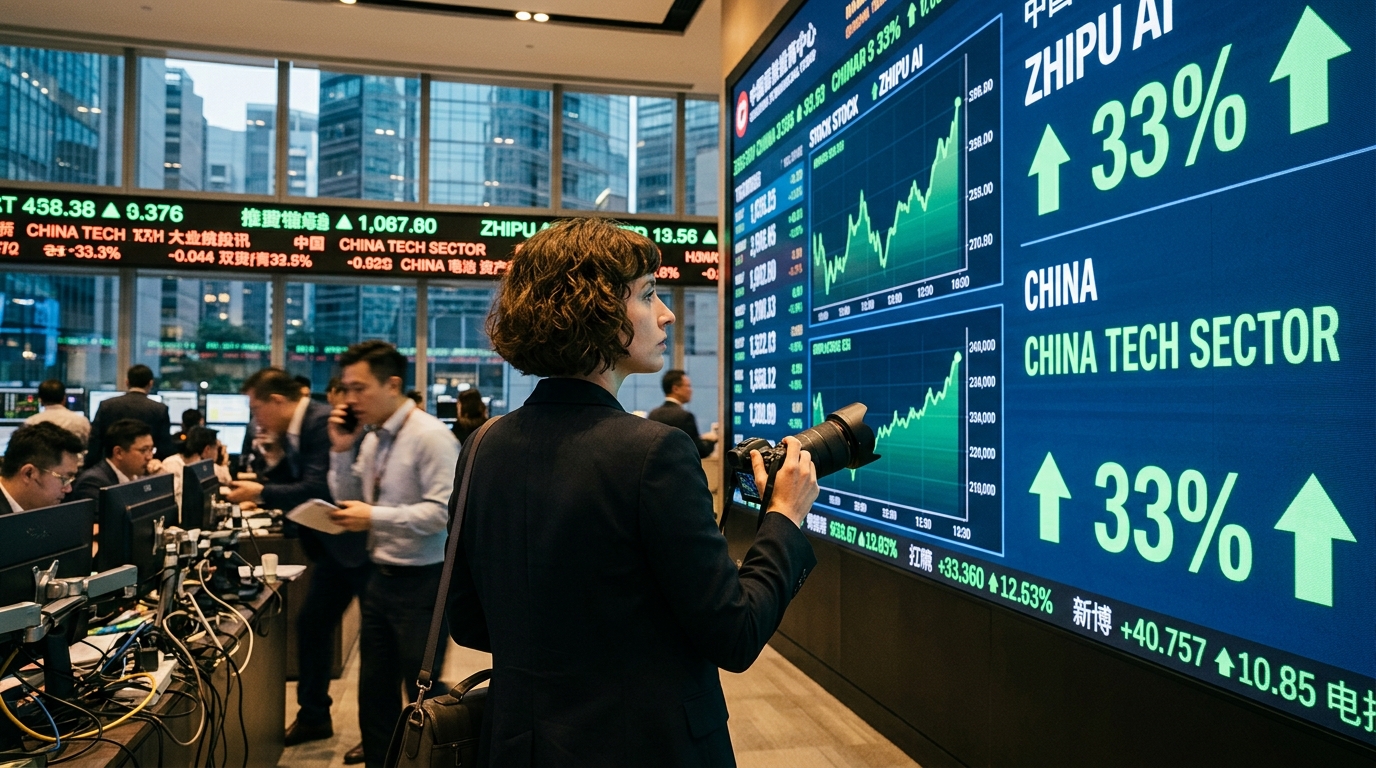
In a striking demonstration of the shifting dynamics in the global artificial intelligence market, Chinese startup Zhipu AI has seen a 33% surge in valuation and investor interest. This comes as Wall Street institutional investors pivot their capital toward Beijing’s domestic champions. The surge is a direct response to recent restrictions imposed by U.S.-based Anthropic on accessing its models from China, creating a power vacuum that local players are racing to fill.
The Anthropic Void and Zhipu’s Opportunity
The decision by Anthropic, the company behind Claude, to restrict its API access for users in mainland China was more than a technical adjustment; it was a geopolitical statement. However, markets abhor a vacuum. Zhipu AI, widely regarded as China’s answer to OpenAI, saw its prospects brighten as Chinese enterprises scrambled for reliable alternatives that are not subject to the whims of Washington’s export controls or corporate distancing.
Zhipu, backed by tech giants like Alibaba, Tencent, and Meituan, has already introduced its GLM-4 model, which rivals GPT-4 and Claude 3 in several key benchmarks. The company’s ability to offer solutions tailored to China’s linguistic and cultural nuances, while remaining technologically competitive, makes it the primary destination for capital fleeing Western platforms.
Wall Street’s Strategy: Risk vs. Reward
Despite ongoing tensions between the U.S. and China, major Wall Street investment houses appear to be taking a pragmatic approach. The 33% jump in Zhipu’s standing is largely fueled by the belief that China will achieve "sovereign AI"—an intelligence stack independent of Western supply chains. Investors see a massive internal market that is now effectively "locked" for domestic players.
- Zhipu AI boasts one of the most advanced open-source ecosystems in Asia.
- U.S. restrictions are acting as a catalyst for accelerated Chinese innovation.
- Liquidity from Wall Street suggests that financial interests often transcend political guidelines.
Analysts note that Zhipu is far from a mere "copycat." Its model architecture shows significant innovations in parameter efficiency, a critical factor in an environment where access to high-end semiconductors (like those from Nvidia) is constrained by U.S. sanctions. By doing more with less computing power, Zhipu is proving its resilience.
The Geopolitics of Intelligence: Two Worlds, Two AIs
This situation highlights the emergence of a "Digital Iron Curtain" in the AI sector. On one side, we have the Western ecosystem (OpenAI, Anthropic, Google), and on the other, the Chinese ecosystem (Zhipu, Baidu, Moonshot AI). This divergence is not just about code; it’s about values, regulatory frameworks, and the way AI interacts with the state and society.
"Artificial intelligence is transforming from a global utility into a national instrument of power. Zhipu’s rise is evidence that attempts to isolate China may ultimately lead to its technological fortification," says a senior technology analyst.
In conclusion, the surge of Zhipu AI represents a milestone. It demonstrates that the Chinese AI market is now mature enough to be self-sustaining, even as bridges with Silicon Valley are dismantled. For investors, the question is no longer whether Chinese AI will succeed, but which of the domestic titans will dominate the coming decade. As the world splits into two distinct AI spheres, Zhipu stands at the forefront of the Eastern front.