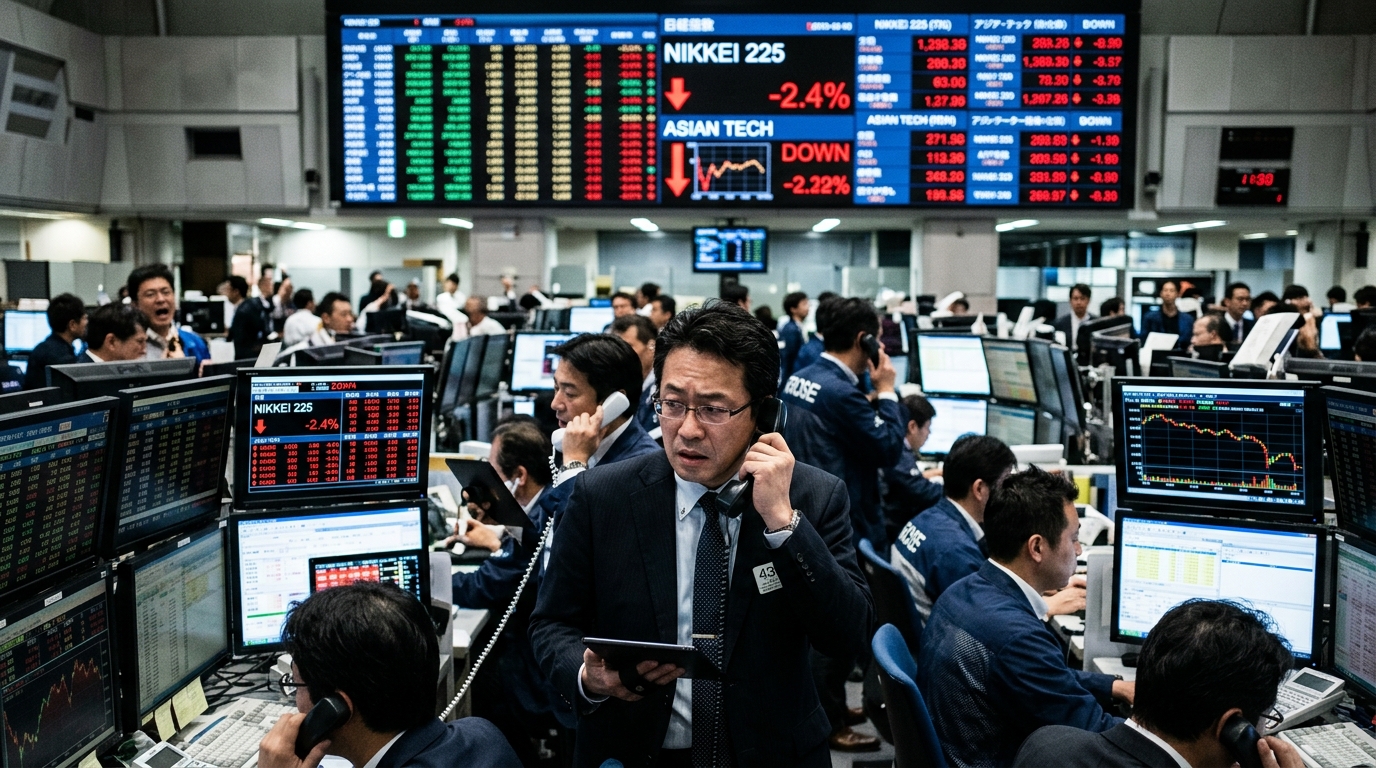
Global financial markets are witnessing a significant recalibration this Tuesday as a deepening rout in US megacap technology stocks has triggered a domino effect across Asian trading floors. For nearly three years, Artificial Intelligence has been the primary engine of global market growth; however, it now faces a rigorous period of valuation scrutiny. Nasdaq 100 futures tumbled as much as 1.8%, while S&P 500 contracts retreated by 1.2%, signaling a growing skepticism regarding the immediate profitability of AI investments.
The AI Profitability Reckoning
For months, market analysts have cautioned that the massive capital expenditures by tech titans—including Microsoft, Alphabet, and Meta—into AI infrastructure were not being met with a corresponding surge in revenue. Today, that caution has evolved into a full-scale retreat. Investors are no longer satisfied with visionary promises; they are demanding tangible returns on investment (ROI). This 'AI fatigue' is palpable as industry leaders like Nvidia and AMD face intense selling pressure, dragging down the entire semiconductor ecosystem with them.
"We have moved past the phase of unbridled enthusiasm and into the phase of accountability. The markets are now penalizing the lack of a clear, short-term monetization strategy for AI," noted a senior Wall Street strategist.
The contagion was not confined to New York. In Tokyo, the Nikkei 225 fell by more than 2%, led by losses in Advantest Corp. In Taiwan, TSMC—the world’s largest contract chipmaker—saw its shares drop by 3.5% as fears of cooling demand from US clients intensified. The intricate web of the global technology supply chain means that a tremor in Silicon Valley inevitably results in a shockwave in Taipei and Seoul.
Geopolitical Shifts: The US-Iran Factor
Simultaneously, the geopolitical landscape is undergoing a major shift. Investors are closely monitoring the progress of peace talks between Washington and Tehran. A potential de-escalation in the Middle East is a double-edged sword for the markets. While peace is fundamentally positive for global stability, the prospect of Iranian oil returning to the market is causing volatility in energy sectors.
- The potential lifting of sanctions on Iranian crude could significantly increase global supply, putting downward pressure on oil prices.
- Defense contractors saw their stock prices dip as the prospect of peace reduced expectations for future military spending.
- The US Dollar experienced volatility as investors balanced the need for safe-haven assets with the implications of a potentially less hawkish Federal Reserve.
The convergence of these two factors—a structural tech correction and a geopolitical pivot—has created a volatile environment. Capital is visibly rotating out of high-growth tech sectors and into value-oriented stocks that are less sensitive to technological hype and more grounded in traditional economic fundamentals.
Market Outlook: Correction or Crash?
The prevailing question is whether this represents a healthy market correction or the onset of a prolonged bear market. History suggests that technological cycles often undergo violent adjustments before reaching a sustainable equilibrium. Nevertheless, the physical and digital infrastructure built for AI remains in place, and its long-term value may only become clear once the current speculative dust settles. For now, all eyes remain on central bank communications and the next steps in international diplomacy, as the global economy searches for a new footing in a rapidly evolving landscape.