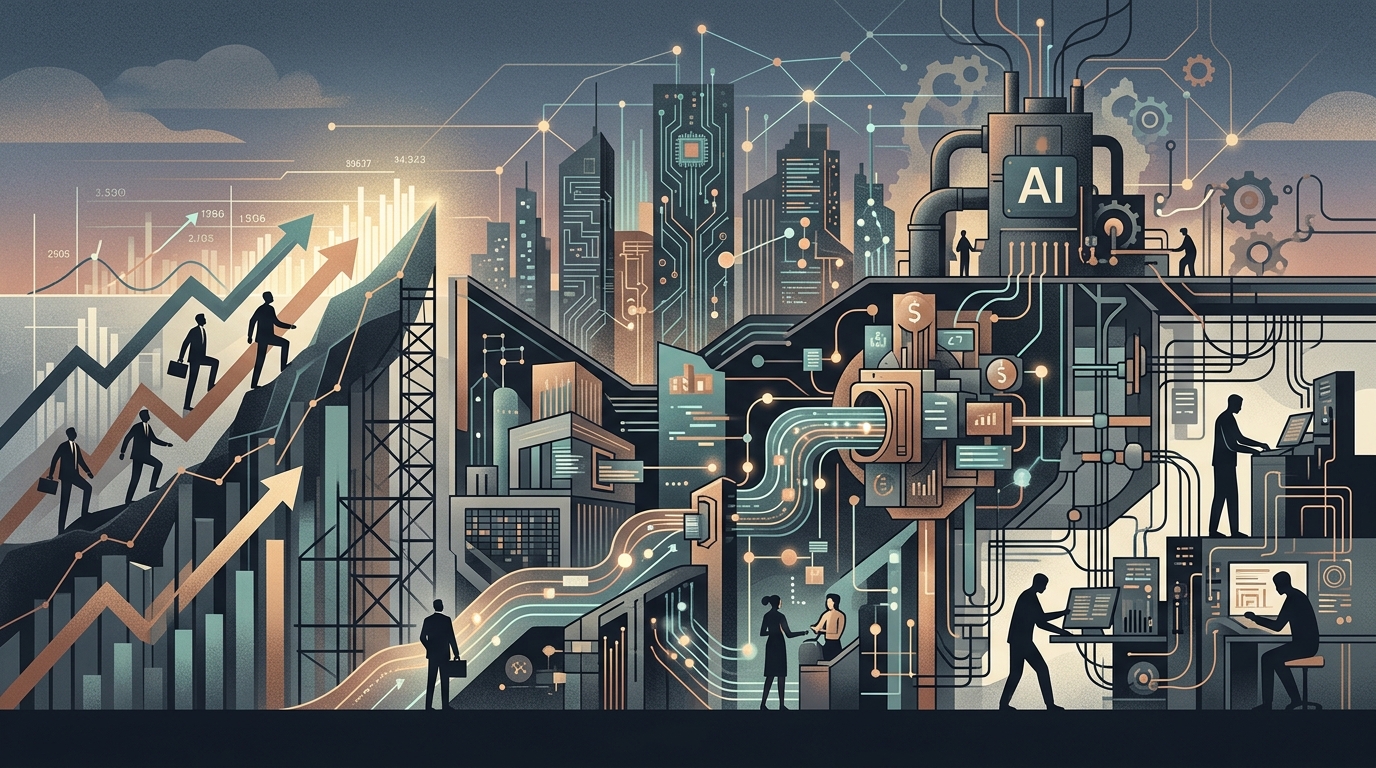
The era of uncertainty and hesitation surrounding Artificial Intelligence (AI) appears to be firmly in the past. According to the latest data released in mid-2026, 72% of businesses worldwide have actively integrated AI into their daily operations. What was once considered a futuristic experiment has now evolved into an essential tool for survival and competitiveness in the global market. This penetration is not superficial; it touches the very foundations of how value is produced, decisions are made, and human resources are managed.
The Transition from Hype to Substantial Integration
Throughout 2024 and 2025, most businesses were in a phase of "exploratory curiosity." Today, in 2026, the landscape has changed radically. AI is no longer used just for drafting an email or generating an image, but for optimizing entire supply chains and predicting consumer behavior with accuracy levels reaching 95%. The surge in adoption to 72% suggests that companies that previously abstained are now forced to follow suit to avoid being phased out of the market.
The sectors leading this race are IT, Marketing, and Customer Service. However, the biggest surprise comes from traditional industries, such as heavy manufacturing and agriculture. In manufacturing, predictive maintenance through AI algorithms has reduced factory downtime by 30%, while in agriculture, the use of autonomous systems and soil data analytics has skyrocketed productivity while simultaneously reducing the environmental footprint.
The Three Pillars of Corporate AI Integration
The infiltration of AI into enterprises can be categorized into three main axes:
- Operational Efficiency: Automating repetitive tasks allows employees to focus on strategic activities. In finance, for example, transaction clearing and fraud detection are now performed in real-time by machine learning systems.
- Customer Experience Personalization: AI enables companies to offer products and services tailored to each customer's individual needs. The chatbots of 2026 are no longer simple text interfaces but digital assistants with a complete understanding of user history and preferences.
- Data-Driven Decision Making: Business executives no longer rely solely on intuition. AI-powered Business Intelligence tools analyze vast amounts of data in seconds, providing "what-if" scenarios that guide investment moves.
The Human Resource Challenge and Ethics
Despite the impressive adoption rates, the AI "invasion" brings serious questions to the forefront. While 72% of businesses may support the technology, only 40% of them claim to be ready to address the resulting ethical challenges. Algorithmic bias and data protection remain at the center of the debate, especially with the tightening of the European Union's regulatory framework (AI Act).
"AI will not replace humans, but humans who use AI will replace those who do not," a senior executive from a leading tech firm noted.
The need for reskilling is more urgent than ever. Businesses are now investing billions in staff training programs, not just in using the tools, but in understanding their limitations. The culture of "lifelong learning" has transformed from a slogan into a fundamental business requirement.
Conclusion: A World in Perpetual Transformation
The dominance of AI in 72% of businesses marks the beginning of a new economic era. This is not a simple technological upgrade but a structural transformation of capitalism. The speed at which businesses manage to balance technological power with human judgment will determine the winners and losers of the next decade. In regions like Greece, the challenge is twofold: the adoption of innovation must be combined with the strengthening of digital infrastructure and ensuring that no social group is left behind in this rapid transition.