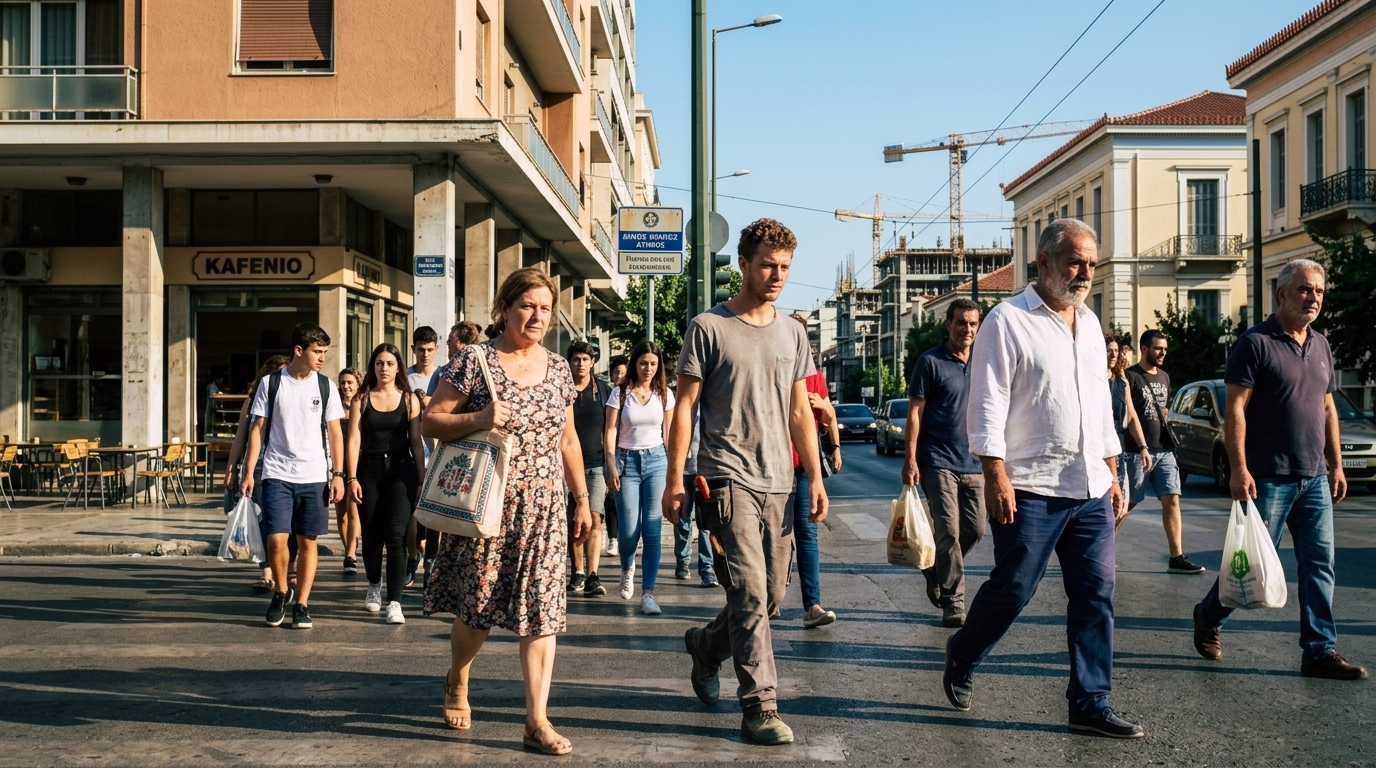
In the heart of Athens, amidst the glittering storefronts of multinationals and the growing queues at supermarkets, an economic drama is unfolding that national accounts struggle to fully capture. While the government and international rating agencies celebrate the Greek economy's growth rates—which often exceed the Eurozone average—the daily lives of citizens tell a different story. A recent report by the Institute of Labour of the General Confederation of Greek Workers (INE GSEE) confirms what the average Greek family feels in their wallet: real wages in Greece have increased by a meager 0.3% from 2019 to the present.
The Anatomy of Stagnation: Numbers That Cause Vertigo
The INE GSEE study leaves no room for misinterpretation. Despite successive increases in the minimum wage, the purchasing power of workers remains frozen at pre-crisis levels, or worse, at levels reminiscent of the early 2000s. The problem lies in the gap between nominal increases and inflationary pressures. While the minimum wage rose nominally, imported inflation in energy and, crucially, domestic inflation in food and rent, absorbed every trace of additional income.
According to the analysis, Greece ranks among the lowest in the European Union regarding purchasing power. The country appears trapped in a growth model based on consumption and tourism, yet the fruits of this activity do not trickle down to the base of the productive pyramid. Corporations are reporting historically high profitability, but the share of wages in national income remains one of the lowest in Europe.
Greedflation and the Cost of Living
One of the most critical factors explaining this stagnation is so-called "greedflation." The report highlights that a significant portion of price hikes is not solely due to production costs but stems from the widening profit margins of large business groups, particularly in energy, banking, and essential goods.
"Growth that does not include labor is growth with feet of clay," note INE GSEE analysts, warning of the risk of social destabilization.
Furthermore, the housing crisis acts as a "black hole" for incomes. With rents skyrocketing by 30-40% in some areas of Athens and Thessaloniki over the last five years, a 0.3% real wage increase feels like a bad joke. Workers are forced to allocate up to 50% of their income to housing, leaving little room for other basic needs, let alone savings.
Structural Deficits and the Low-Skill Trap
Why is Greece unable to follow the path of other European countries that saw their wages recover faster? The answer lies in the structure of the economy. An over-reliance on tourism and low-value-added services creates jobs that are primarily seasonal and low-paying. The lack of investment in technology and heavy industry means that labor productivity remains stagnant.
- Low penetration of collective bargaining agreements.
- High indirect taxation that disproportionately affects low incomes.
- Oligopolistic market structures that hinder healthy competition.
- Absence of effective oversight mechanisms in the labor market.
If Greece fails to change its productive model by transitioning to high-tech and innovative sectors, the gap with Europe will continue to widen. Growth will remain a number in Brussels reports, while society sinks into a new form of "working poverty," where even full-time employees cannot cover the cost of a decent living.
Conclusions: The Need for a New Social Contract
The challenge for the future is clear. Increasing GDP is not enough; its fair distribution is required. Strengthening collective bargaining, reducing indirect taxes on basic goods, and cracking down on profiteering is the only way forward. Without a bold policy to boost real wages, the Greek economy risks being trapped in a vicious cycle of low demand and social resignation. Growth must have a human face; otherwise, it is merely a statistical illusion.