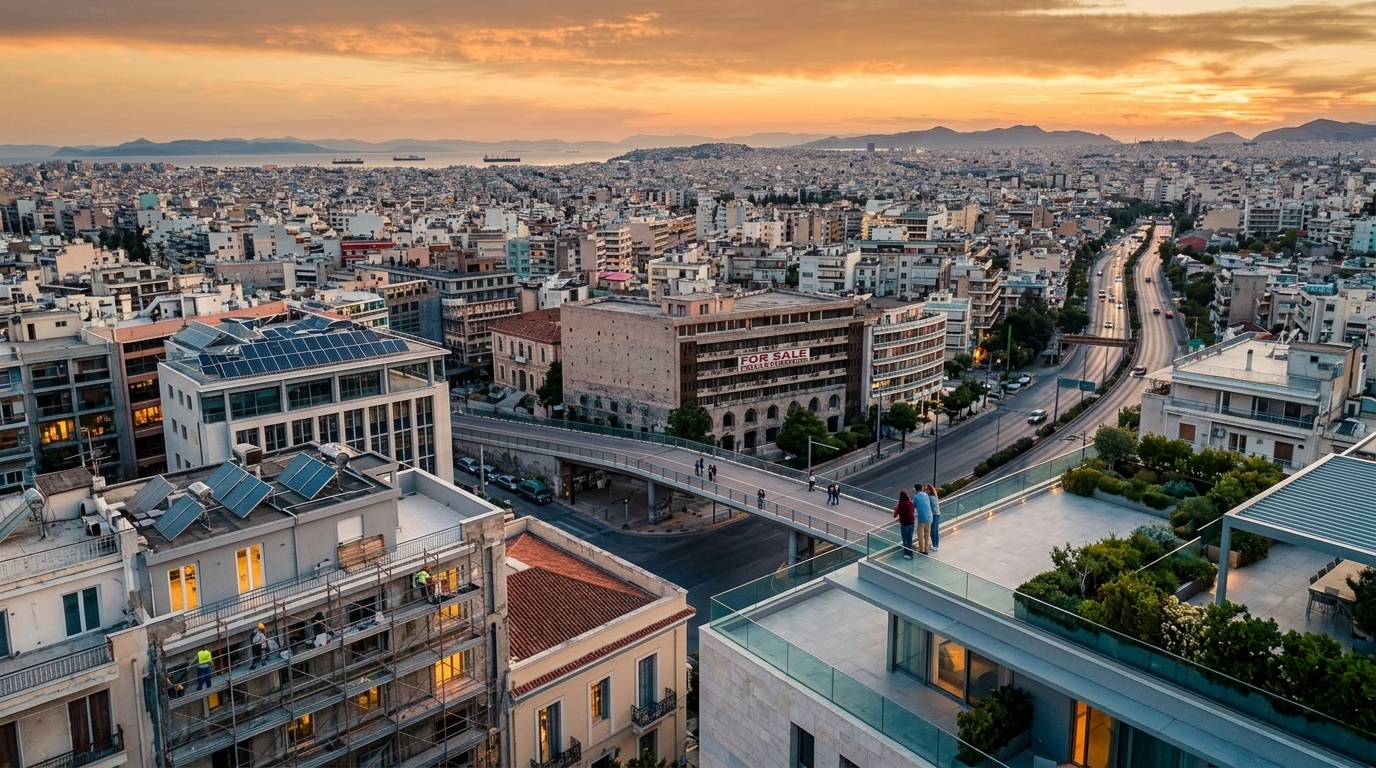
The Greek real estate market, after a prolonged period of intense turbulence and explosive price growth, is now entering a phase of maturity and redefinition. According to the latest data from the research conducted by the Uniko real estate services platform, the emerging picture is no longer that of an uncontrolled "rally," but of a market where the buyer is regaining some lost ground, becoming increasingly selective. The new reality is shaped by the intersection of high interest rates, the energy crisis, and a structural mismatch between the properties on offer and modern living requirements.
The Supply-Demand Gap: The Trap of Aging Properties
One of the most concerning findings of the research is the profound mismatch between the properties available on the market and those that citizens are actually seeking. The bulk of the residential stock in Greece, particularly in major urban centers like Athens and Thessaloniki, consists of constructions from the 1970s and 1980s. These properties, while often located in prime areas, fall significantly short in terms of energy efficiency, structural integrity, and modern layout design.
Buyers in 2026 are not just looking for "four walls." They are seeking homes that will protect them from rising energy costs and provide a sustainable living environment. Uniko's research highlights that demand for new builds or fully renovated properties remains high, despite prohibitive prices, while older, un-upgraded properties stay on the market for longer periods. This creates a two-tier market: "green" and modern properties that retain their value, and depreciated buildings that force their owners to offer significant discounts to achieve a sale.
Price Stabilization and Buyer Psychology
Despite expectations for a generalized drop in prices, the data points more towards a trend of stabilization. The growth rate of selling prices has slowed down significantly compared to the situation two years ago. This slowdown is partly attributed to buyer fatigue; many have exhausted their borrowing capacity due to the European Central Bank's high interest rates. Psychology has shifted from "buy now before prices rise further" to "wait for the right opportunity or a drop in interest rates."
Furthermore, the tightening of criteria for granting mortgage loans by banks has limited the number of potential buyers. Banks now demand higher down payments and scrutinize the energy class of the property, as "non-green" homes are considered higher risk for the future. Uniko points out that transactions now take more time to complete, as negotiations are tougher and legal and technical due diligence is more exhaustive.
The "Investment" Factor and the Social Dimension
The Greek real estate market continues to be influenced by tourism and short-term rentals, although the regulatory framework has become stricter. The shift of many owners towards platforms like Airbnb has reduced the stock for long-term leasing, indirectly forcing many renters to turn toward purchasing a home, often without having the necessary resources. The social dimension of the housing problem remains acute, as the gap between the average salary and the price per square meter remains chaotic.
"The real estate market is no longer a one-way street to profitability, but a complex puzzle where quality and energy shielding determine the winner," the Uniko analysis notes.
In conclusion, the new reality in the housing market requires a more realistic approach from all participants—buyers, sellers, and investors. The era of easy capital gains has passed. For individuals, the emphasis must be on construction quality and sustainability, while for the state, the challenge remains providing incentives for the renovation of the old stock to make it accessible to the average Greek family again. Stabilization is a positive sign, but the equilibrium remains fragile.