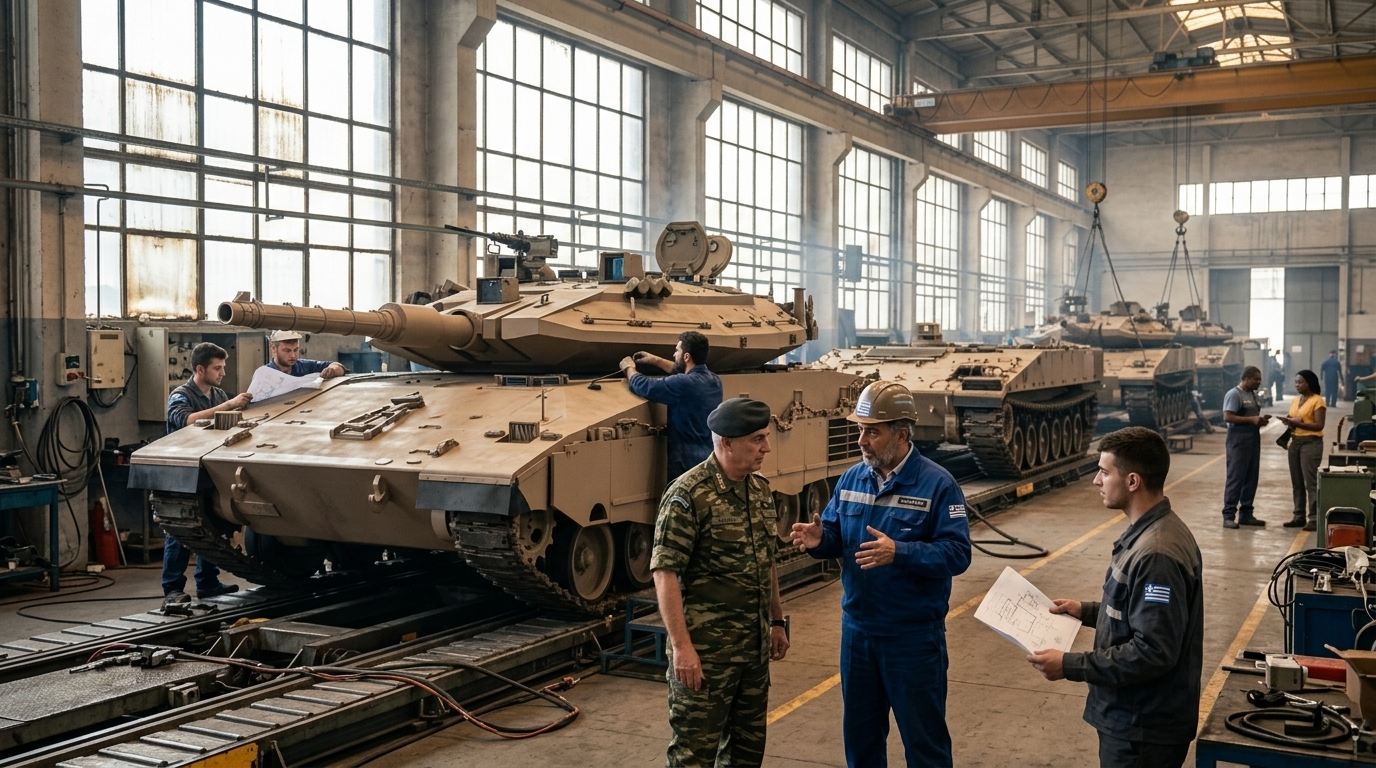
For decades, Greece has been one of the world's largest importers of defense equipment relative to its GDP. The billions of euros spent on fighter jets, frigates, and tanks were directed almost entirely toward foreign industries, leaving the domestic defense base in a state of decay. Today, the government's strategy is attempting a radical shift: establishing a minimum participation of 25% for the Hellenic Defense Industry (HDI) in every new armament program. This is not just a number, but a gamble for survival and industrial reconstruction.
The Strategic Importance of the 25% Threshold
The decision for the 25% limit comes at a time when geopolitical instability in the Eastern Mediterranean demands constant readiness. However, the economic dimension is equally critical. The participation of Greek industry means that a significant portion of taxpayers' money will return to the national economy through high-skilled jobs, the development of know-how, and the boost of exports. The "off-the-shelf" buying model proved unsustainable in the long run, as it deprived the country of the ability to maintain and upgrade systems using its own resources.
Implementing this policy requires cooperation between the public and private sectors. While state-owned giants like Hellenic Aerospace Industry (EAB) and Hellenic Defense Systems (EAS) are in a restructuring phase, a new generation of private companies in electronics, drones, and communications is emerging dynamically. These companies are the "key" to achieving the 25% goal, as they possess the flexibility and innovation required by modern defense technology.
Challenges and Structural Obstacles
Despite expectations, the road is not paved with rose petals. The Greek defense industry faces chronic problems of underfunding, bureaucracy, and the lack of a long-term national defense strategy. For a Greek company to participate in the construction of a Belharra frigate or an F-35 fighter, it must meet the strictest international standards and be competitive in cost and quality. The challenge is to prevent the 25% mandate from becoming a "tailor-made" provision that subsidizes non-competitive activities, turning it instead into a lever for real growth.
- The need for investment in R&D (Research and Development).
- Linking universities with defense production.
- Integration into the international supply chains of major manufacturers (Lockheed Martin, Naval Group, Dassault).
- Establishing a stable legal framework for defense procurement.
The Example of Innovation and the HAI
A pivotal role in this new effort is played by the Hellenic Center for Defense Innovation (HCDI). Its goal is to bridge the gap between the needs of the Armed Forces and domestic production, promoting solutions based on artificial intelligence, autonomous systems, and cybersecurity. The logic is simple: instead of buying everything, we develop our own subsystems that can later be exported to third countries. This is the model followed by countries like Israel and Turkey, turning defense into a core pillar of their GDP.
"The defense industry is not just a cost; it is an investment in national sovereignty and technological progress."
In conclusion, the 25% gamble is Greece's last chance to acquire a serious defense industry. If it succeeds, the country will cease to be a mere customer of the major powers and will become a reliable partner in the European defense architecture. If it fails, it will remain trapped in a cycle of expensive purchases that burden the debt without providing any developmental return.