

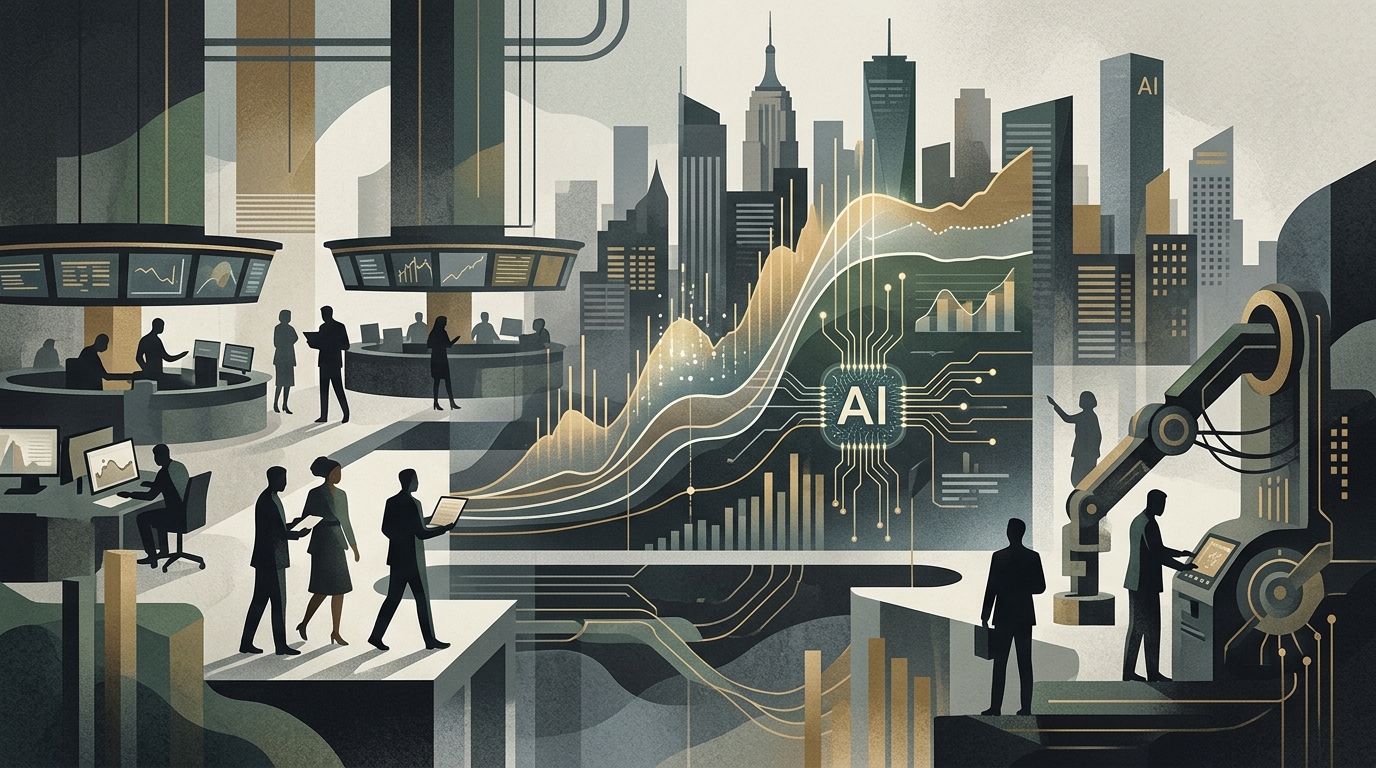
The discourse surrounding Artificial Intelligence (AI) often mirrors a form of secular evangelism. From the glass towers of Silicon Valley to the policy chambers of Brussels, the promise is uniform: a seismic shift in productivity that will finally cure the West's chronic economic stagnation. However, Christopher Pissarides, the Nobel-winning economist and one of the world's leading authorities on labor markets, is injecting a much-needed dose of realism into the conversation. According to Pissarides, AI, while undoubtedly revolutionary, may fail to move the needle on global GDP as much as the hyper-optimistic forecasts from major investment banks suggest.
The Service Sector Paradox and the 'Human Touch'
Pissarides' central thesis is rooted in the structural reality of modern developed economies. Unlike the Industrial Revolution, where automating the production of physical goods led to massive efficiency gains, today's economies are dominated by services. Sectors such as healthcare, education, hospitality, and personal care account for the lion's share of both employment and GDP. In these fields, productivity is inextricably linked to the time one human spends with another.
"You can use AI to write code faster, but you cannot use it to accelerate the care of the elderly or the emotional support of a student without fundamentally eroding the quality of the service," the Nobel laureate points out.
This phenomenon, often referred to as 'Baumol’s Cost Disease,' suggests that as technology boosts productivity in manufacturing or digital tasks, the relative cost of labor-intensive services rises, keeping overall economic growth lower than headline-grabbing tech breakthroughs might suggest. Pissarides argues that while AI will automate many white-collar tasks, a vast portion of the labor market—those jobs relying on empathy, physical dexterity, and human presence—will remain largely insulated from these efficiency gains.
The Challenge of Labor Redistribution
Despite his skepticism regarding a productivity 'explosion,' Pissarides does not downplay the profound changes AI will bring to the nature of work. He predicts a significant shift in required skill sets. Workers will increasingly need to focus on what machines cannot replicate: ethical decision-making, creative problem-solving, and complex relationship management. However, this transition poses a significant social risk. Those unable to pivot toward these 'human-centric' roles face marginalization—not necessarily through unemployment, but through being relegated to low-value, low-wage service roles that the machine simply doesn't care to do.
- AI will undoubtedly enhance efficiency in specific professions like law, programming, and administration.
- Labor-intensive sectors will continue to absorb the majority of the workforce, acting as a drag on aggregate productivity.
- The necessity for lifelong learning is becoming critical, yet state infrastructure remains woefully unprepared.
- A four-day work week might become a reality, but perhaps as a tool for labor distribution rather than a result of overwhelming surplus wealth.
Solow’s Ghost and the Reality of Data
Pissarides’ warnings echo the famous 1987 paradox by Robert Solow: "You can see the computer age everywhere but in the productivity statistics." He fears that AI might follow a similar trajectory. While individual firms might see localized profit surges, the national productivity indices may remain sluggish. This is because the workforce is being pushed into low-productivity sectors (like social care) to meet the demands of an aging population, effectively canceling out the gains made in the digital sphere.
In conclusion, Pissarides provides a necessary corrective to tech-utopianism. Technology does not operate in a vacuum; it is constrained by the laws of supply and demand, demographics, and the immutable requirements of human interaction. AI will change how we live and work, but the dream of a frictionless, hyper-growth economy reminiscent of the post-war boom remains, for now, an economic mirage. The challenge for policymakers is not just the adoption of AI, but the management of an economy where human labor remains both expensive and indispensable in the areas that matter most to society.





