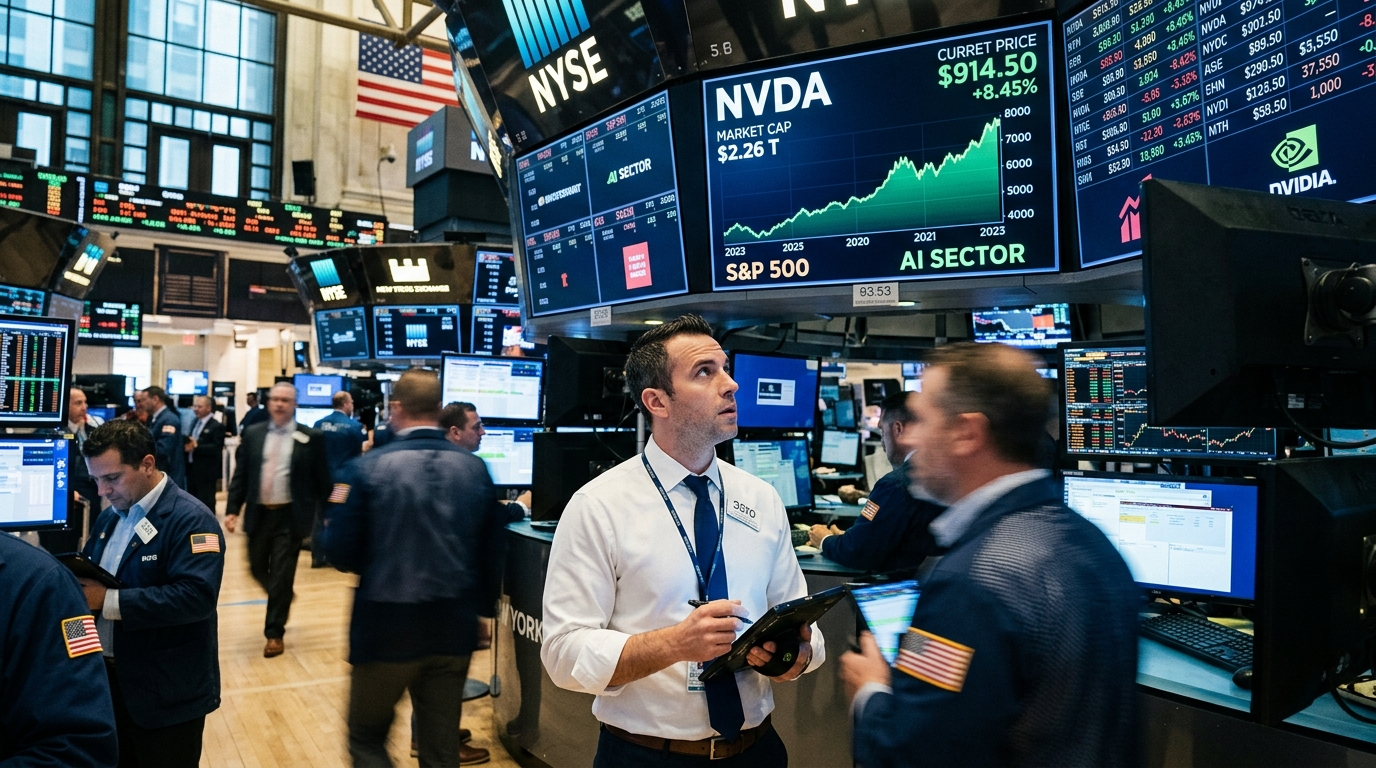
In the history of financial markets, few moments can compare to the explosive rise of Nvidia. As we navigate June 2026, the company that began by designing graphics cards for video games has transformed into the undisputed 'railroad' of the new industrial revolution. Reaching a $1 trillion market capitalization in record time was merely the beginning of a trajectory that has left even the most optimistic Wall Street analysts in awe.
The Architecture of Dominance
Nvidia's success isn't just built on manufacturing more powerful chips. Its true strength lies in the CUDA ecosystem, a software platform that allows developers to harness GPU power for general-purpose computing. This has created a massive 'moat' around the company, making it extremely difficult for customers to transition to competing solutions from AMD or Intel. Today, in 2026, we see the 'Rubin' architecture taking the reins from 'Blackwell,' promising even greater energy efficiency in a world hungry for computational power but constrained by climate commitments.
Wall Street Predictions: From Training to Inference
Analysts from Goldman Sachs and Morgan Stanley are highlighting a critical market shift. While the previous three years were characterized by the 'training' of massive language models, 2026 is the year of 'inference.' This means AI is now being integrated into everyday applications, from autonomous driving to personalized medicine. Wall Street predicts that:
- Capital expenditures (CAPEX) from major cloud providers (Microsoft, Google, AWS) will remain at record levels.
- Demand for specialized AI chips at the 'edge' (Edge AI) will skyrocket.
- Nvidia will continue to enjoy profit margins nearing 75%, despite the entry of new players into the market.
Geopolitics and the Supply Chain
We cannot analyze Nvidia's path without considering the geopolitical chessboard. Dependence on TSMC in Taiwan remains the 'Achilles' heel' of the entire industry. Recent investments in fabrication plants in the US and Europe are beginning to bear fruit, but full decoupling from Asia is a decade-long project. Wall Street warns that any disruption in the Taiwan Strait could erase trillions from global market value within hours.
"Nvidia is no longer a semiconductor company; it is the custodian of global intelligence," says a lead analyst at JP Morgan.
The Bubble That Didn't Burst
Many compared the AI surge to the dot-com bubble of 2000. However, there is a fundamental difference: earnings. Unlike the companies of 2000 that had only promises, Nvidia and its partners are generating billions in actual cash flow. The challenge for the future is not demand, but manufacturing capacity and the availability of electricity for the massive data centers required. As we approach the end of 2026, the question is not whether AI is the future, but who will be able to power it.