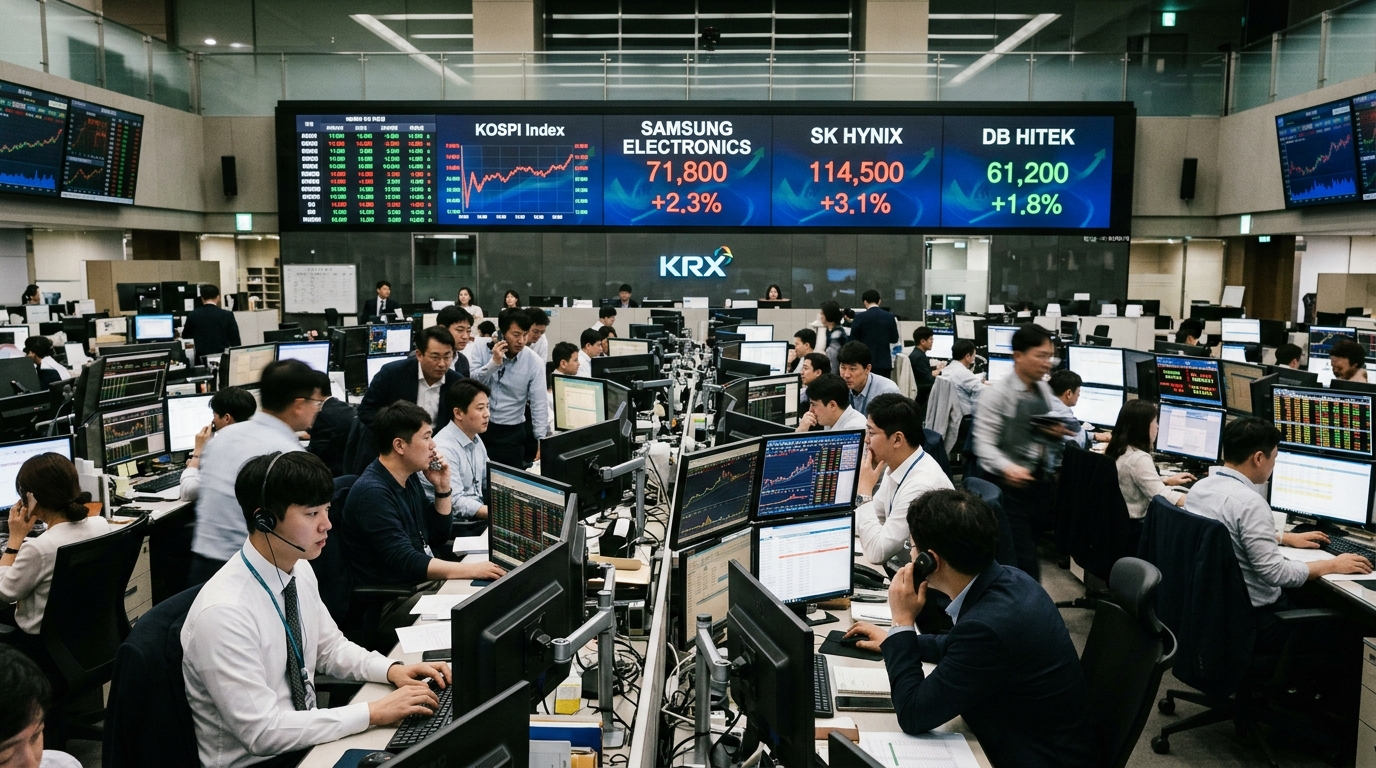
The global semiconductor market continues to resemble a high-stakes rollercoaster, but for investors in Seoul, the recent downturn on Wall Street was merely a passing tremor. South Korean chip heavyweights staged a robust recovery on Wednesday, defying the pessimistic sentiment that had gripped the U.S. tech sector following a sharp selloff. The catalyst for this resilience is a fundamental economic imbalance: supply remains critically tight in the face of an insatiable global appetite for Artificial Intelligence (AI) infrastructure.
The Strategic Dominance of High Bandwidth Memory (HBM)
To understand why Korean stocks are rebounding while their American counterparts face volatility, one must look at High Bandwidth Memory (HBM). This specialized memory is the lifeblood of AI accelerators. SK Hynix, currently the primary supplier for Nvidia’s high-end GPUs, saw its shares climb as market analysts confirmed that production capacity for 2024 and most of 2025 is already fully committed. Samsung Electronics followed suit, bolstered by reports that its HBM3E chips are nearing final certification for use in next-generation AI servers.
The market is beginning to realize that the "AI bubble," if it exists, has not yet reached the physical manufacturing layer. As Big Tech firms continue to funnel billions into massive data centers, the requirement for advanced memory remains the primary bottleneck in the supply chain. This scarcity acts as a valuation floor for Korean manufacturers, which are increasingly viewed as more grounded investments compared to high-multiple U.S. software firms.
Decoupling from Wall Street and Geopolitical Realities
Historically, the South Korean stock market (KOSPI) has been a mirror of the Nasdaq. However, we are witnessing a significant decoupling. While U.S. markets are hyper-focused on Federal Reserve interest rate paths and inflationary pressures, Asian markets are prioritizing industrial output and physical supply constraints. The current tightness isn't just a result of high demand; it is driven by the extreme technical difficulty of manufacturing these components. Low yields in HBM production mean that even at full capacity, the industry cannot produce enough chips to satisfy the current cycle.
Furthermore, the geopolitical landscape provides a unique backdrop. As U.S. export controls on China tighten, South Korea occupies a pivotal role. It serves as the West’s indispensable manufacturing hub while simultaneously navigating its complex trade relationship with Beijing. The recent rebound suggests that investors are betting on Seoul’s ability to remain the essential link in the global supply chain, regardless of the political friction between Washington and Beijing.
Outlook for the Second Half of 2026
Looking ahead, the momentum in the semiconductor sector is expected to remain positive despite periodic market corrections. Analysts point to three decisive factors for the remainder of the year:
- The Transition to HBM4: The next generation of memory will require even deeper integration between memory makers and foundries like TSMC, potentially reshaping industry alliances.
- Recovery in Consumer Electronics: Beyond AI, the traditional markets for PCs and smartphones are showing signs of life, boosting demand for standard DRAM and NAND flash.
- The Energy Challenge: Semiconductor fabrication is immensely energy-intensive. Korea’s ability to secure stable, green energy for its massive "mega-clusters" will be the next major hurdle for long-term growth.
In an era where silicon is the new oil, the nations and companies that control the means of production hold the ultimate leverage. South Korea, through Samsung and SK Hynix, is not just exporting components; it is exporting the core infrastructure of the digital age. The rebound of their stocks is a stark reminder that in the information economy, the physical reality of the factory floor remains the ultimate arbiter of value.