

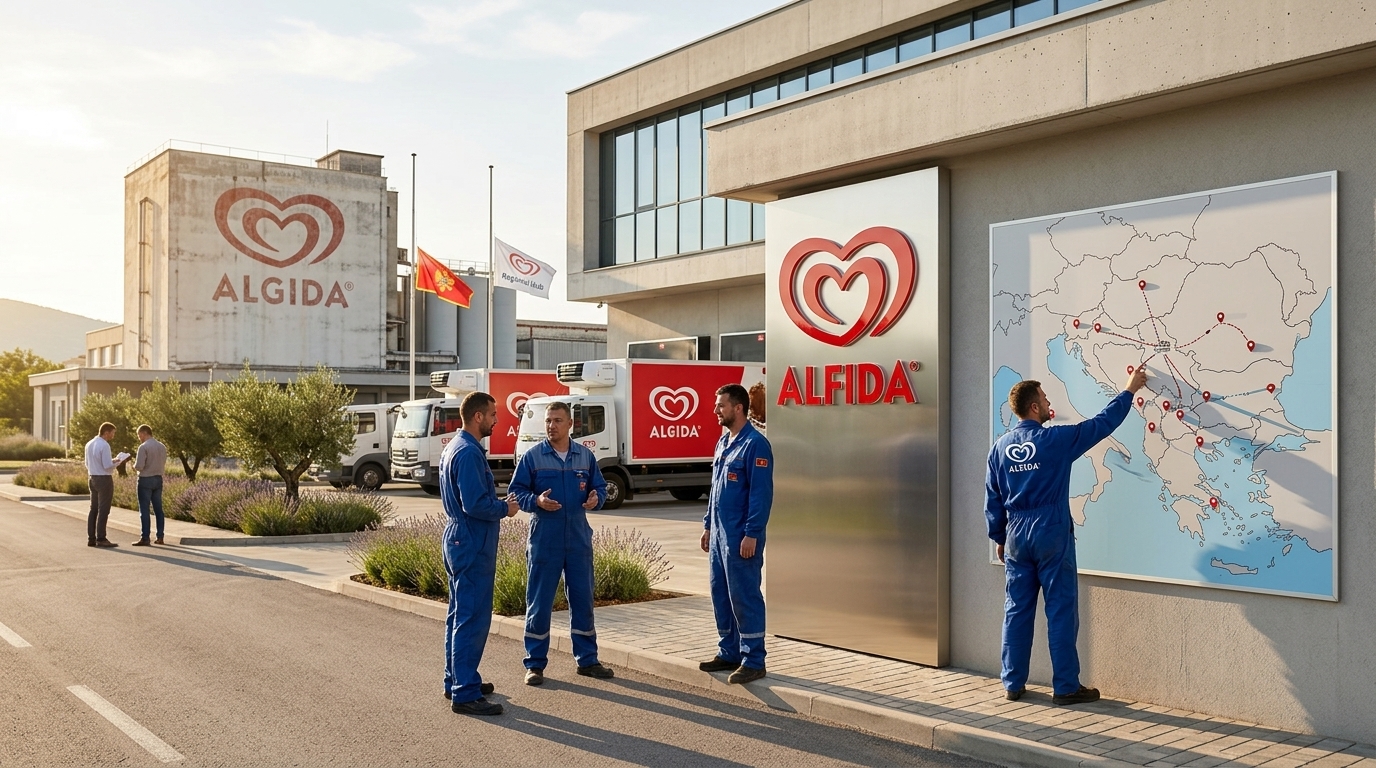
The news of the ice cream division's spin-off from the global giant Unilever was not merely a corporate restructuring; it was the precursor to a significant geopolitical shift on the business map of Southeast Europe. Starting in 2026, the Greece-based Algida Ice Cream Company ceases to be a simple subsidiary and evolves into an autonomous regional player with expanded responsibilities covering the entire Balkan peninsula. This move reflects not only confidence in the managerial capabilities of Greek executives but also the strategic importance of Greece as a gateway and distribution hub for the emerging markets of the Balkans.
The 'Decoupling' Strategy and Independence
Unilever's decision to separate ice cream from the rest of its portfolio (which ranges from detergents to personal care) was based on a simple economic reality: ice cream is a business with entirely different dynamics. It requires specialized cold supply chains, is directly affected by seasonality, and has different profit margins. By making Algida Ice Cream Company autonomous, the company gains the necessary flexibility to make decisions faster, without the bureaucratic constraints of a mammoth multinational group.
For the Greek management, the challenge is twofold. On one hand, they must maintain dominance in the domestic market, where brands like Algida and Magic (Magnum) are synonymous with summer. On the other hand, they are called to integrate and develop markets in Albania, North Macedonia, and other neighboring states, where consumer habits are evolving rapidly. The new organizational structure allows for the centralization of operations (logistics, marketing, procurement) in Athens, creating economies of scale that were previously unattainable.
Greece's Role as a Regional Hub
The emergence of Greece as an administrative center for the Balkans is no coincidence. The country now possesses the infrastructure—especially in logistics and food technology—required to support such an expansion. Algida Ice Cream Company is systematically investing in modernizing its distribution network, which is its 'heavy artillery.' In the ice cream industry, the battle is won in the freezers, and the Greek company boasts one of the most extensive and well-maintained networks in Europe.
- Expansion of the sales network in Albania and North Macedonia.
- Unification of marketing departments to achieve a single communication strategy.
- Investments in 'green' low-energy consumption freezers.
- Development of new products catering to local Balkan preferences.
The Greek management has already proven its resilience during the economic crisis and the pandemic, a fact that was decisive in the parent company's decision (prior to the spin-off) to assign it this expanded role. The ability to manage complex crises has become a comparative advantage for Greek executives on the international stage.
Economic Outlook and Challenges
Despite the optimism, the road is not without obstacles. Inflation continues to squeeze consumers' disposable income, while the cost of raw materials (sugar, milk, cocoa) remains at high levels. Furthermore, the climate crisis, although seemingly favoring ice cream consumption due to warmer summers, brings with it extreme weather events that can disrupt the supply chain. Algida is called to balance quality and price in a region where purchasing power varies significantly from country to country.
"The spin-off is not the end of an era, but the beginning of a new one, where Greek entrepreneurship takes the helm of growth in our broader neighborhood," market sources state.
In conclusion, Algida Ice Cream Company enters 2026 with increased autonomy and responsibility. If it manages to transfer the expertise and success of the Greek market to the Balkans, it will serve as a model for how Greek subsidiaries can evolve into regional protagonists, strengthening the country's economic footprint in Southeast Europe.





