

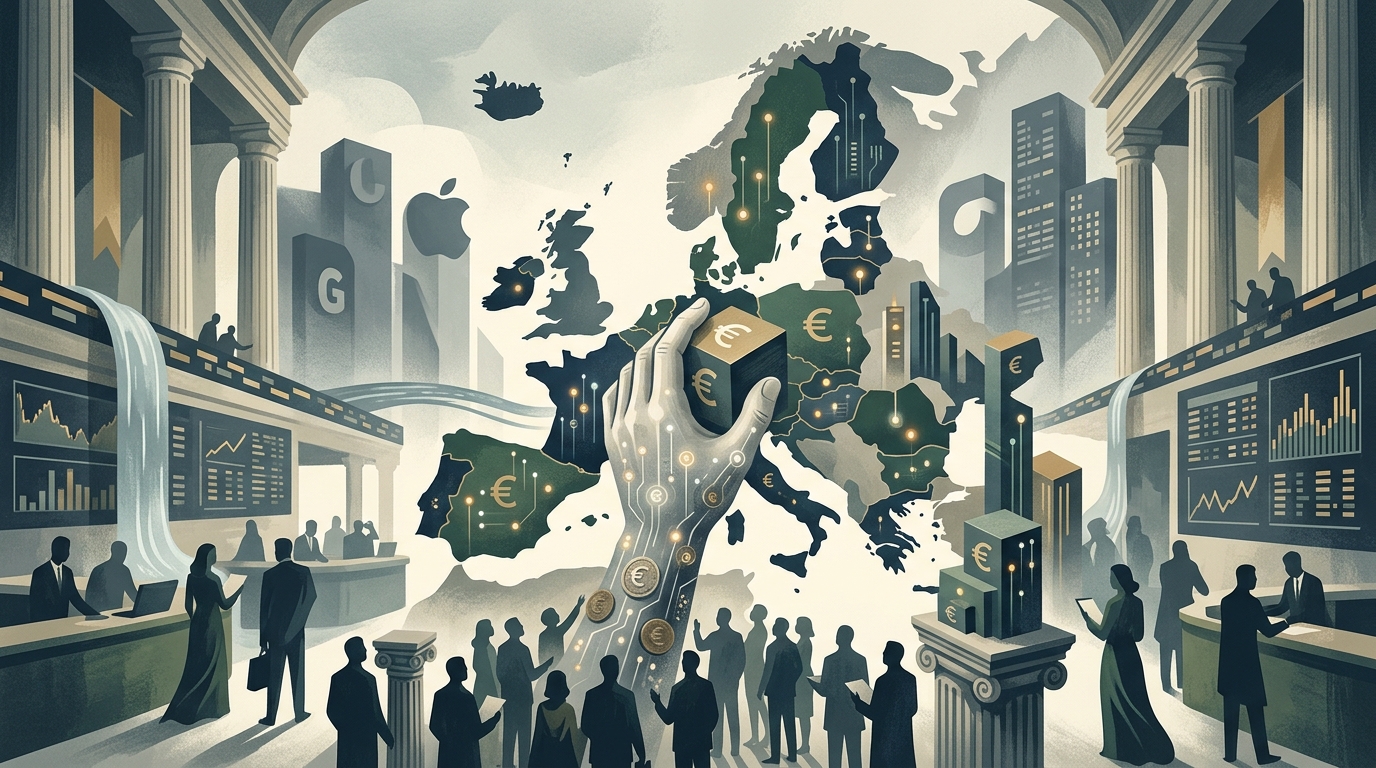
Europe stands today at a historical crossroads. Despite possessing one of the world's largest pools of private savings, its inability to channel these funds into the real economy and innovation represents its "Achilles' heel." As we navigate 2026, the debate over the Capital Markets Union (CMU) and the Banking Union is no longer a technocratic exercise but an existential necessity for the survival of the European social model.
The Paradox of European Savings
The issue is not a lack of money. European citizens hold trillions of euros in bank accounts with near-zero returns. Simultaneously, European businesses, particularly tech startups, are forced to seek funding across the Atlantic. This "capital drain" means that Europe indirectly finances American innovation, while its own industrial base remains dependent on traditional bank lending.
According to recent analyses, the investment gap between Europe and the US has widened dangerously. While capital markets are the primary source of business funding in the US, 70% of funding in Europe still comes from banks. This creates rigidity: when banks become conservative during crises, the European economy suffocates.
Obstacles to Integration
Why does the Capital Markets Union remain an unfinished project? The answer lies in fragmentation. There are 27 different insolvency laws, 27 different tax regimes, and 27 different supervisory authorities. A German investor wishing to invest in a Greek or Portuguese company faces a labyrinth of bureaucracy and legal uncertainty.
- Supervisory Convergence: The need for a "European SEC" (modeled after the US Securities and Exchange Commission) is more intense than ever. A single authority could enforce common rules and reduce transaction costs.
- Tax Incentives: Harmonizing taxes on dividends and capital gains could encourage individuals to move their money from deposits to investments.
- Insolvency Law: The lack of common rules for business liquidation deters foreign investors, who fear that in the event of failure, recovering their capital will take decades.
"Europe can wait no longer. We need a market that functions as one if we want to fund our green transition and digital sovereignty," say leading financial analysts in Brussels.
The Geopolitical Dimension and the Draghi Report
The discussion has taken a new turn following Mario Draghi’s landmark report on competitiveness. Draghi made it clear that Europe needs additional investments of 800 billion euros annually. These amounts cannot be covered by public funds or the Recovery Fund alone. Mobilizing private capital is the only way to prevent the Old Continent from becoming a "museum" of the global economy.
Competition with China, which heavily subsidizes its industries, and the US, which attracts capital through the Inflation Reduction Act, makes market integration a matter of national security. Without deep capital markets, Europe will remain vulnerable to external shocks and continue to lose its brightest minds to Silicon Valley.
Conclusion: Political Will vs. National Egoism
The bet is now political. Many member states fear that integration will strip power from national authorities or favor large financial centers like Paris and Frankfurt. However, the cost of inaction is far greater than the cost of ceding sovereignty. Creating a true Banking Union and a Capital Markets Union is the key to a Europe that is not just a consumer of technology, but a global leader in innovation and prosperity.





