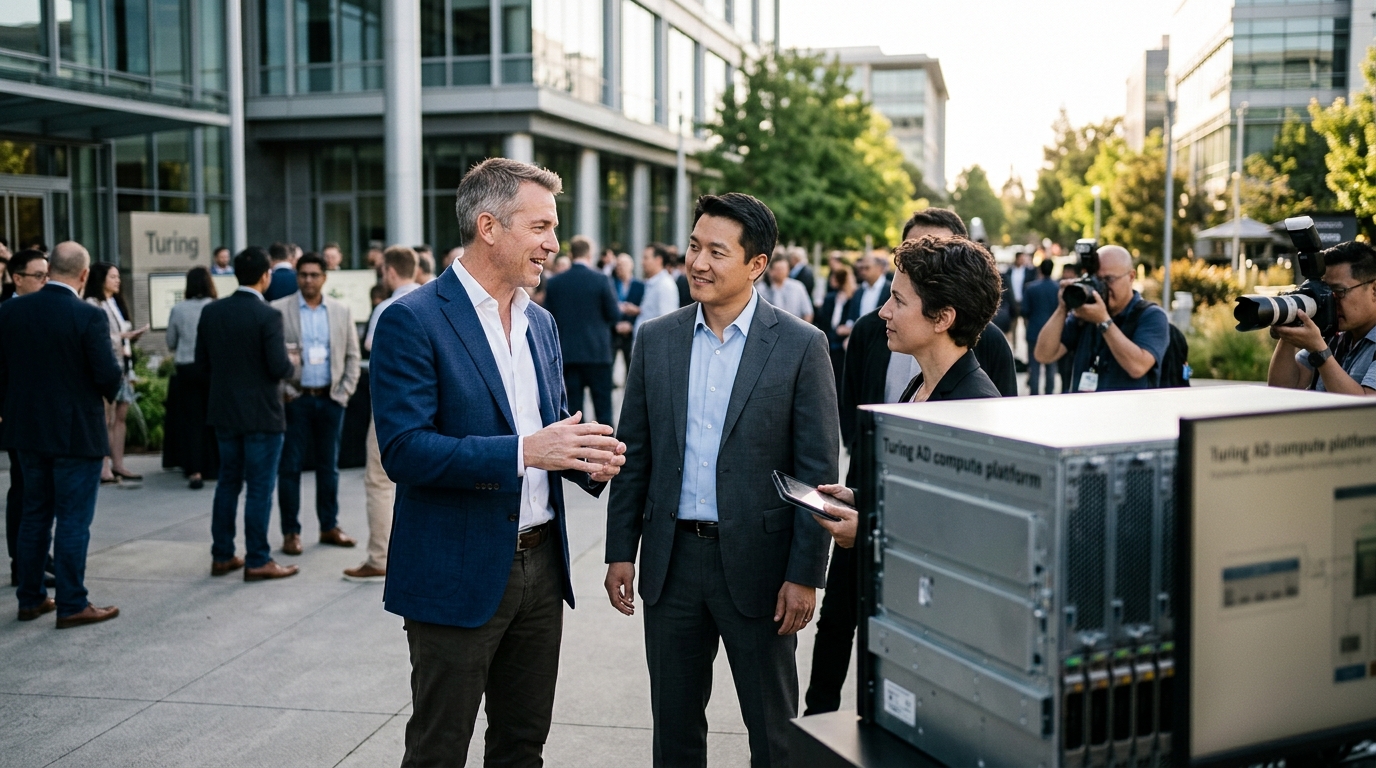
In a move poised to reshape the power dynamics of the autonomous driving industry, Tokyo-based startup Turing Inc. announced today, July 6, 2026, that AMD Ventures has officially joined its roster of backers. The agreement extends beyond a mere capital injection; Turing has committed to a full-scale adoption of Advanced Micro Devices (AMD) AI accelerators within its computing systems, pivoting away from the near-total reliance on Nvidia that has characterized the sector for years.
The Strategic Shift to End-to-End AI
Turing Inc. has set an ambitious target to develop fully autonomous (Level 5) vehicles by the end of the decade. Unlike traditional methodologies that rely on rigid rule-based code and a plethora of LiDAR sensors, Turing is betting on an "End-to-End" AI approach. This strategy involves a single, massive neural network that ingests raw camera data and outputs driving commands—steering, acceleration, and braking—directly, effectively mimicking human intuition and spatial reasoning.
This paradigm shift demands colossal computational resources, particularly within the data centers where Large Vision Models (LVMs) are trained. By adopting AMD’s MI300 series and the upcoming MI350 accelerators, Turing gains access to high-performance alternatives that offer competitive price-to-performance ratios. This is especially vital as Nvidia's supply chain remains stretched thin by global demand, causing significant lead times for AI infrastructure.
AMD vs. Nvidia: The Battle for the Car's Brain
For AMD, investing in Turing is a clear declaration of intent. While Nvidia currently dominates the landscape with its DRIVE platform, AMD is aggressively penetrating the market by championing open software standards like ROCm. This allows companies like Turing to tailor hardware performance to their specific algorithmic needs. This shift reflects a broader market trend: the search for a "second source" to break monopolistic dependencies and drive down infrastructure costs.
- Model Training: Turing will utilize AMD GPU clusters to process billions of kilometers of simulated driving data.
- On-board Inference: The next generation of Turing vehicles will feature custom silicon based on AMD architecture for real-time decision-making.
- Energy Efficiency: The new architecture promises lower power consumption, a critical factor for the range of electric autonomous vehicles.
"Our partnership with AMD is not just about hardware; it is about the freedom to build the future of mobility without being throttled by computational scaling limits," stated Turing’s CEO during the announcement.
The Japanese Vision for Future Mobility
Japan, a traditional titan of the automotive world, has recently found itself trailing in the software-defined vehicle and EV race against Tesla and Chinese competitors. Turing aims to become the "Tesla of Japan," merging Japanese manufacturing precision with cutting-edge American silicon. The backing from AMD Ventures provides the necessary credibility to attract further institutional investment and accelerate public road testing.
However, significant hurdles remain. Transitioning from laboratory training to navigating the complex, neon-lit streets of Tokyo is a monumental leap. AMD’s GPUs must prove their reliability in the harsh environments vehicles inhabit—facing extreme temperatures and constant vibration. The industry is watching closely to see if this partnership will trigger a mass migration from the Nvidia ecosystem toward more diversified hardware solutions in the quest for Level 5 autonomy.