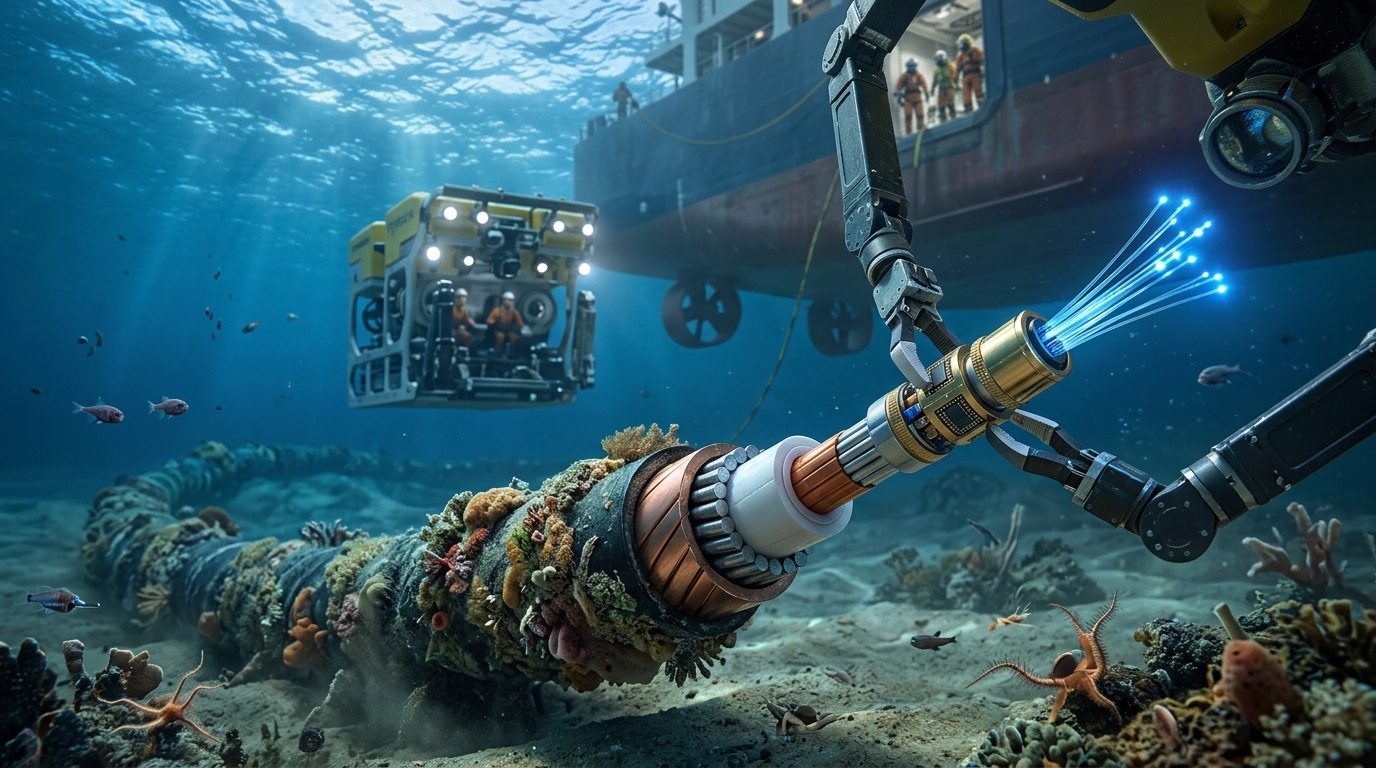
Meta, the parent company of Facebook and Instagram, has announced the construction of a massive new subsea fiber-optic cable named "Petal." The project, slated to become operational in 2029, will span 7,000 kilometers, connecting the United States directly to France.
Record-Breaking Capacity
Petal is set to become the world's first transatlantic cable to offer petabit-class capacity. It will be capable of transmitting data at speeds of up to 1 million gigabits per second (Gbps), which translates to approximately 125 terabytes per second. To put this into perspective, this bandwidth is sufficient to transfer 25,000 high-definition (HD) movies every single second.
Multi-Core Fiber Innovation
The technological breakthrough behind Petal lies in its use of multi-core fiber (MCF) technology. Unlike conventional cables that use a single core per fiber, each fiber in the Petal system will contain two cores carrying optical signals in opposite directions. The cable will feature 24 pairs of these dual-core fibers, totaling 96 individual cores.
- Design & Construction: NEC (Japan)
- Fiber Supply: Sumitomo Electric
- Signal Amplification: "Fan-in/fan-out" technology to independently amplify signals within repeaters.
Meta representatives stated that this combination of dual-core technology and advanced signal processing allows for a doubling of data capacity without a proportional increase in energy consumption. Petal follows Meta's previous infrastructure investments, including Marea (2018), Amitié (2023), and Anjana (2025), offering more than five times the capacity of the original Marea cable.