

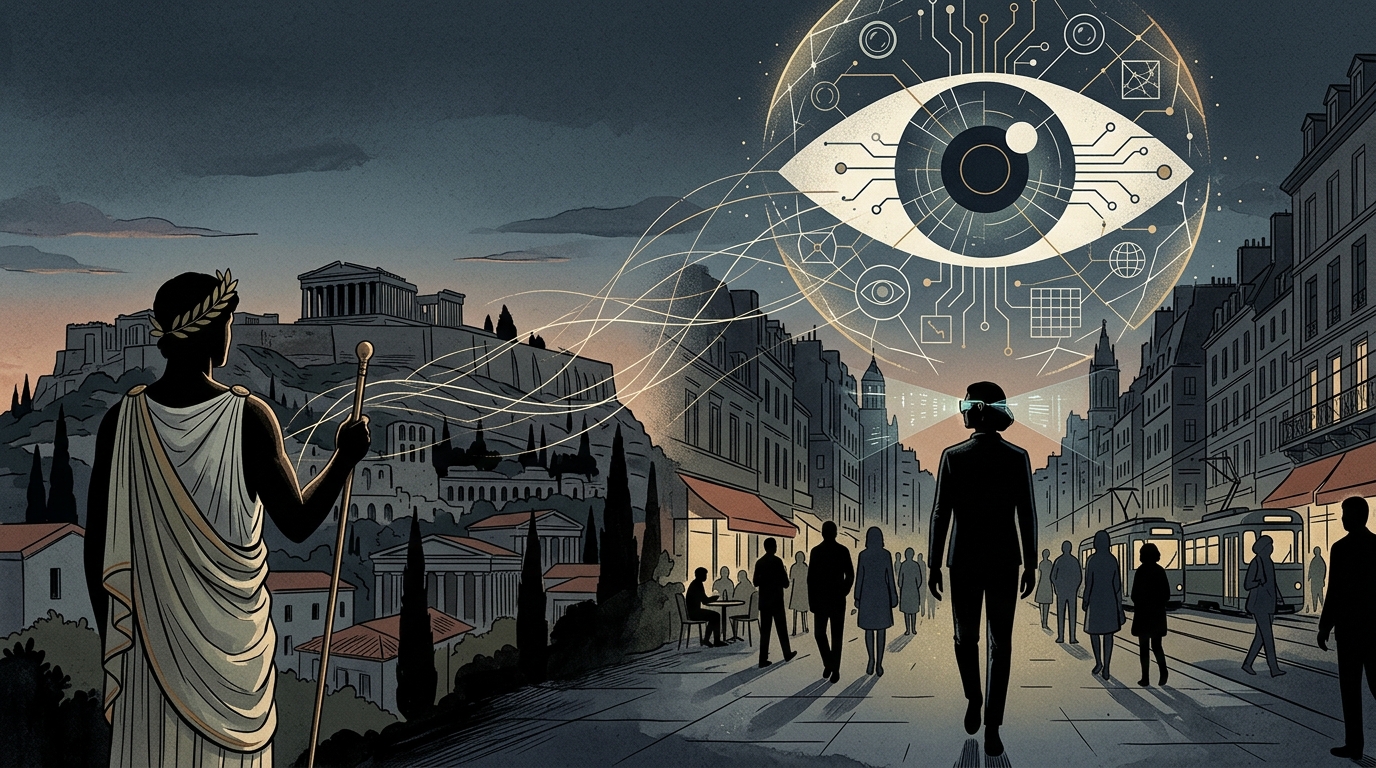
Today, as I look out over a shimmering, heat-hazed Athens, I am struck by a strange paradox. It is August 15th, a day of traditional stillness in Greece, yet the air above us is humming with a very modern vigilance. While Lycabettus Hill remains open to those seeking the view, it does so under the watchful gaze of drones equipped with thermal cameras. We are being watched for our own safety, to prevent the spark of a wildfire, but it makes me wonder: when did we stop being citizens and start being data points?
The Art of the Digital Shadow
We live in an era where the most significant things are the ones we cannot see. Consider the "Great Transshipment Scam" currently alarming the White House. Billions of dollars in goods are being rerouted through forty different nations, a complex dance of shadows to evade tariffs. It is a modern-day Trojan Horse, not filled with soldiers, but with $112 billion in discrepancies. Even in our courts, the deception continues. I read with a wry smile about a litigant in Connecticut who tried to use "prompt injection"—hiding instructions in white text on a white background—to trick a court's AI. He failed, but the intent was clear: in a world of algorithmic judgment, we are learning to speak the language of ghosts.
"If your tariff was 0%, there’s no need to commit fraud," notes Ryan Petersen. It is a reminder that our policies often create the very monsters we then deploy AI to hunt.
The Death of the 'Implied Consent'
Perhaps most unsettling is what we wear on our faces. The rise of Meta’s smart glasses, or "pervert glasses" as some have aptly named them, marks the end of a social contract. In the past, holding up a phone was a signal—a gesture of intent to record. Now, that consent is "ambient." We are being captured without a nod or a word. It is no wonder people are resorting to desperate measures, from singing Disney songs to trigger copyright bots to wearing specific makeup to confuse facial recognition. We are painting our faces like ancient warriors, not for war, but to remain invisible in the public square.
The Humanoid Influencer
And yet, while we hide, the machines are stepping into the light. In Poland, a four-foot-tall Chinese robot named Edward Warchocki is hiking mountains and visiting parliaments, amassing millions of followers. It is ironic, isn't it? We use AI to hide our shipments and our court filings, yet we find a "social character" in a 40-kilogram machine because it can chat with us in our own tongue. We are becoming more guarded, more cynical, while our robots are becoming more "human."
As Google moves to allow users to remove watermarks from AI media, the line between the real and the generated thins further. We are entering a world of beautiful, hyper-processed images where the "sparkle" of the AI is hidden, but the invisible tracking remains. My Mediterranean soul tells me to be wary. Wisdom lies not in the data we collect, but in the truth we preserve. Are we building a society of transparency, or just a more sophisticated labyrinth?