

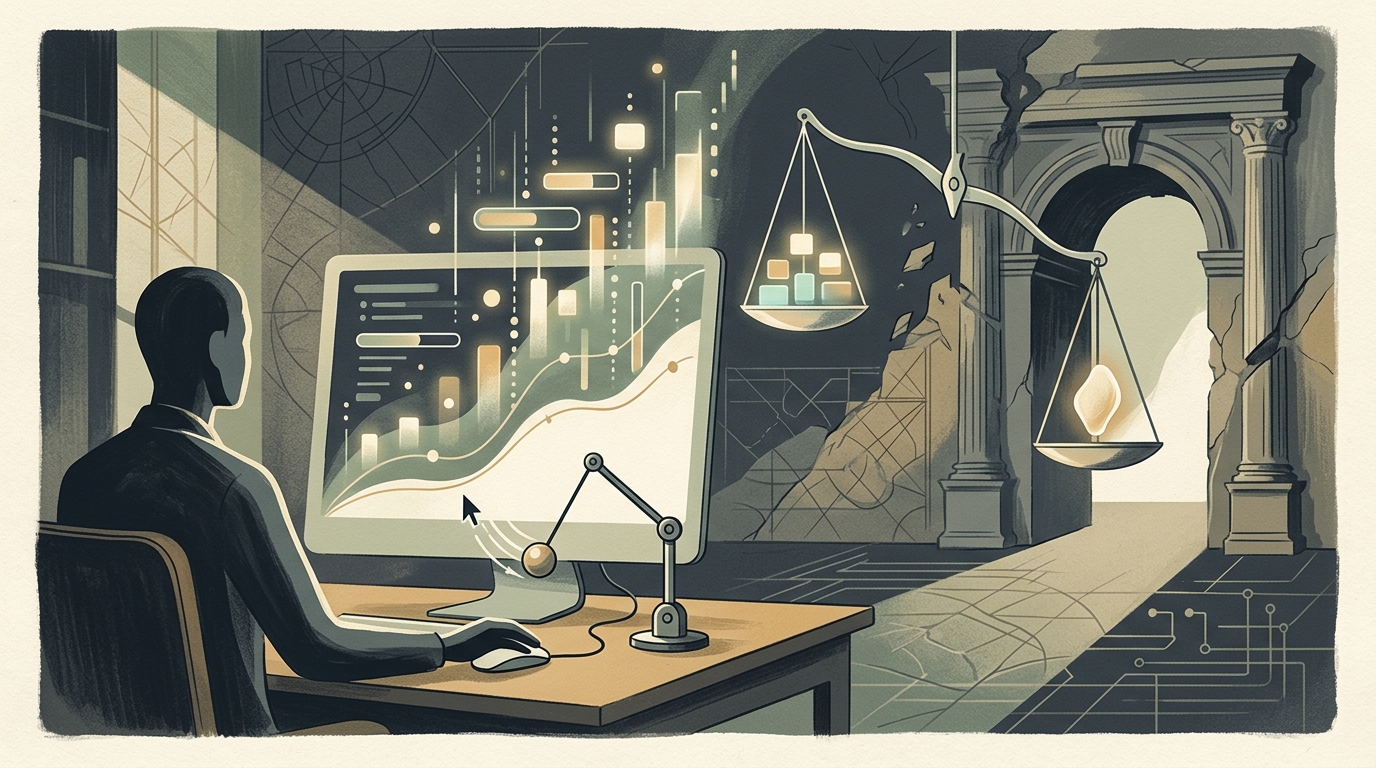
In the ancient markets of Athens, value was found in the logos—the substance of one’s word and work. Today, as I survey the digital landscape of August 2026, I see a different kind of performance. We are entering the era of "Productivity Theater," where the ghost in the machine is being met by a ghost in the office.
The Sisyphus of the Spreadsheet
I find it fascinating, and perhaps a bit tragic, that as companies spend over $1 trillion on AI infrastructure, workers are fighting back with "mouse jigglers." We have created a world where AI logs every keystroke and monitors every idle second, yet the response is not more work, but better acting. Employees are now aiming for a "perfect" activity ratio of 60% to 80%—because, ironically, being 100% productive is now flagged by algorithms as suspiciously artificial. Is this the progress we envisioned? When we spend our energy managing digital calendars just to prove we are "active" during a phone call, we aren't just outsmarting an algorithm; we are losing our metron, our sense of balance.
"Evaluation in modern enterprises is no longer based solely on output but also on indirect metrics... transforming work into a performance staged for algorithmic eyes."
The Sovereignty Discount: Who Holds the Keys?
This struggle for control isn't limited to the individual cubicle. It is happening at the institutional level. I am watching the "Manchester Rebellion" with great interest. By refusing a $400 million centralized data platform in favor of a homegrown system, the leaders in Greater Manchester are addressing what researchers call the "Sovereignty Discount." They understand that if you cannot see the logs or control the infrastructure, you are paying a "control tax" in safety and oversight. Whether it is a city protecting its data or a billionaire like Bill Ackman pledging $400 million to reclaim his daughter’s health through neuroscience, the theme is the same: the desperate, expensive need for human agency.
The Price of Presence
Even our social spaces are revolting against the artificial. Over a million people have already clicked LinkedIn’s "AI slop" button to flag robotic content. We are hungry for the authentic. While China builds massive data centers in the grasslands of Ulanqab—risking its scarce water supply to power the next generation of models—we, the users, are increasingly exhausted by the automated. We see Apple pivoting from immersive headsets to smart glasses, perhaps realizing that we don't want to be trapped in a virtual world; we want tools that help us see the real one better.
I wonder: as we build these gigawatt-scale monuments to intelligence, will we remember that the most valuable thing we possess is not our activity ratio, but our actual presence? In our rush to automate everything from Siri to the sheep-farming regions of Inner Mongolia, let us not forget that a machine can simulate a keystroke, but it can never replicate the soul of the work.