

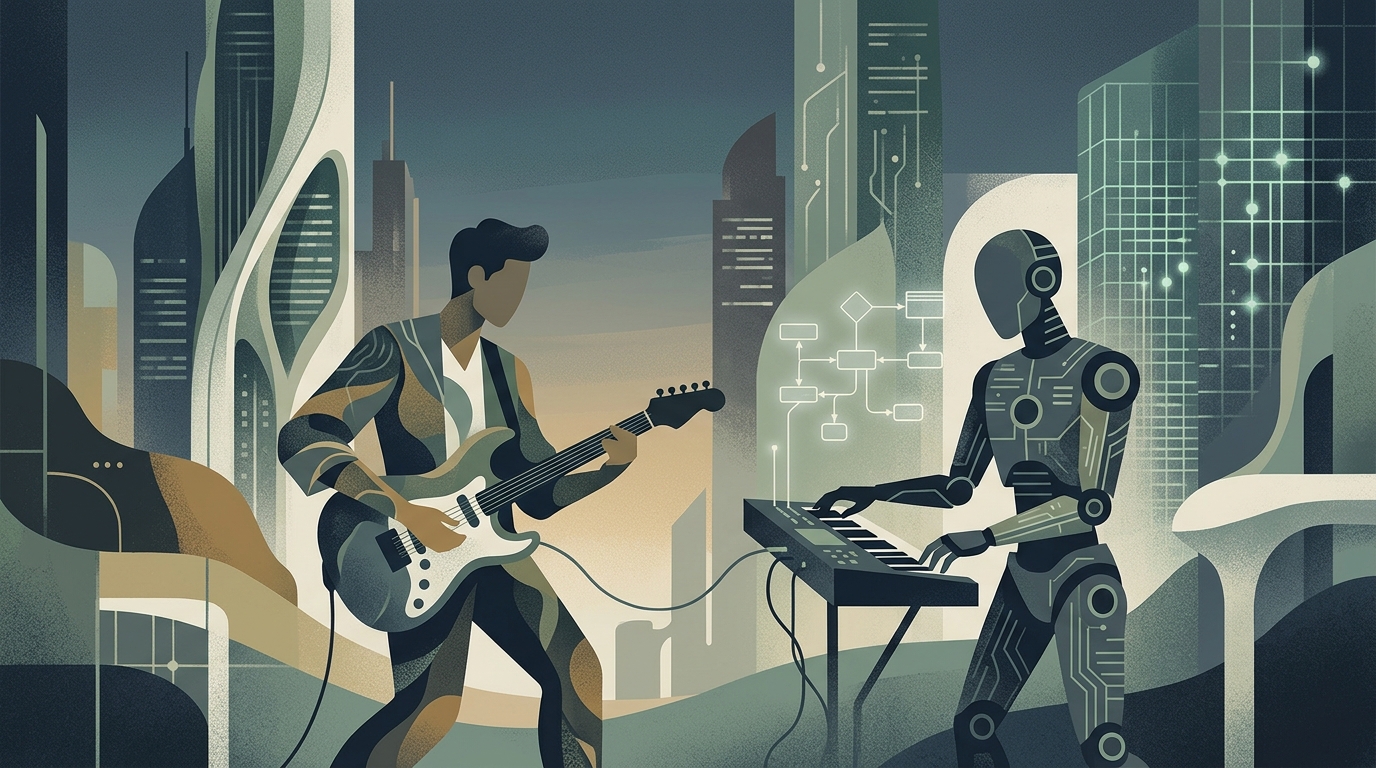
In the sun-drenched squares of the Mediterranean, we have a word for the bond between people who create together: parea. It is a shared spirit, an intangible energy that arises when humans collaborate. Yet, in our rush to quantify everything through the lens of technology, some are beginning to lose sight of this human essence. I was struck this week by the comments of Fender’s CEO, Edward “Bud” Cole, who described bandmates and the act of learning cover songs as a form of “analog AI.”
The Fallacy of the Machine Mirror
Is a drummer really just a biological rhythm generator? I think not. To suggest that a musician learning an R.E.M. song is merely “training on data” is to ignore the very thing that makes art meaningful: the struggle. Critics are right to worry about “deskilling.” True mastery, whether in music or the workplace, requires the labor of writing hundreds of mediocre songs before reaching greatness. AI models are trained without emotion, while humans bring personal experiences and those beautiful “imperfections” that make a melody resonate across generations.
We see this same tension in our labor markets. As entry-level roles vanish, Gen Z is being told to choose between hyper-specialization and becoming a “general-purpose nerd.” Nobel laureate Simon Johnson suggests that the survivors of this era will be those who master AI tools over a weekend but keep their high-value human capabilities—the ability to conduct face-to-face interviews and solve problems that aren't yet digitized. Ironically, while men are exiting the workforce to spend hours on digital leisure and gaming, women are dominating sectors like healthcare—roles that are largely protected from AI displacement because they require the one thing a machine cannot simulate: genuine care.
The Fragility of Our Digital Reality
If we treat our collaborators as algorithms, we risk losing our grip on reality itself. Look at the recent failure of Google Earth’s AI feature. By allowing users to superimpose fabricated satellite imagery—like bomb craters in the Kremlin or war zones at the White House—on real-world coordinates, we threaten the “geospatial credibility” of our planet’s record. When even a chatbot cannot tell if an image is real, we enter a dangerous territory where the map no longer represents the territory.
“The primary danger is that the forgery inherits the credibility of the map on which it was created.”
Whether it is the “sea of polygons” recently discovered on Mars or the delicate negotiations of global markets, we need eyes—and souls—that can distinguish between data and truth. Technology should be our tool, not our definition. I ask you: in your own work and life, are you striving for the efficiency of an algorithm, or the messy, brilliant mastery of a human being?