

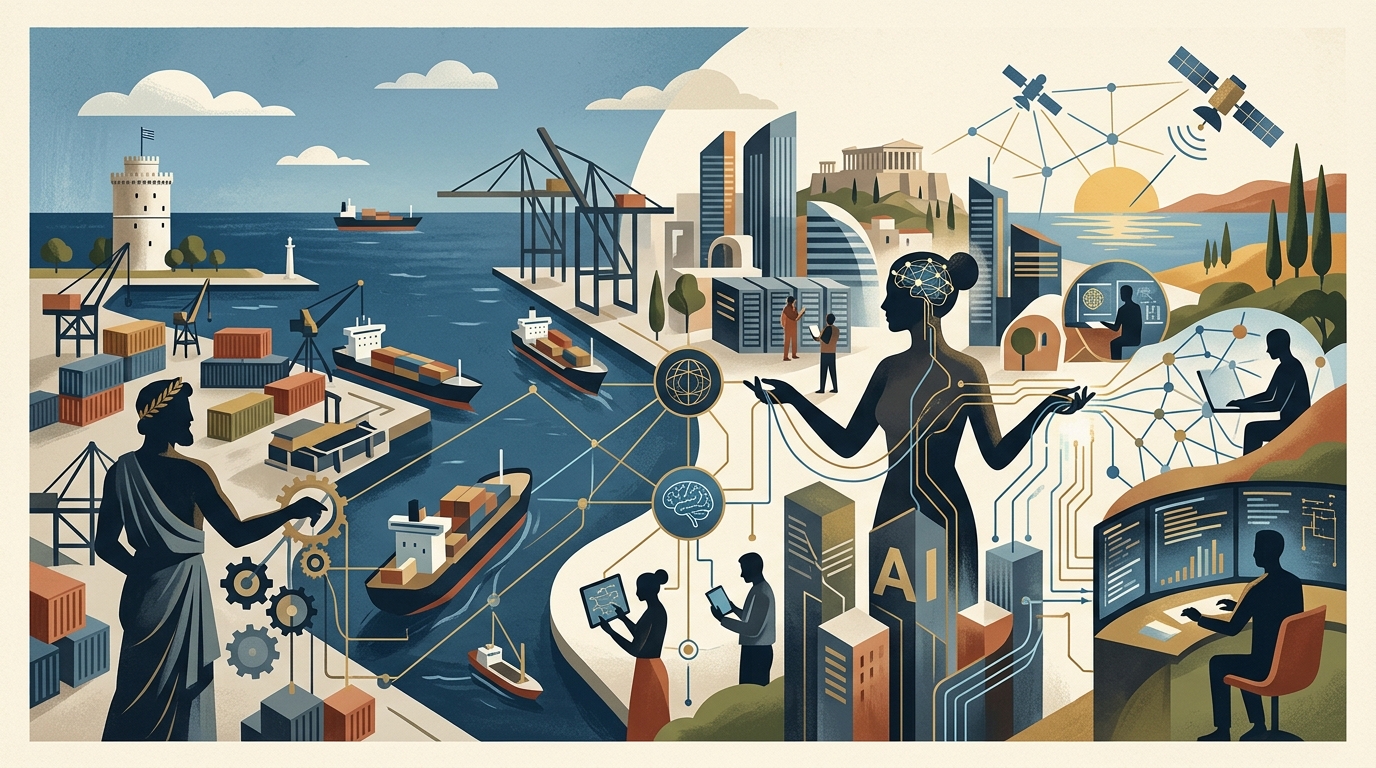
Standing in the shadow of the historic PAEGA building at the port of Thessaloniki, I cannot help but feel the weight of time. This nearly century-old industrial landmark is now the home of the Deloitte Competence Center and the Solaria AI Hub. It is a poetic image: Greece’s past providing a foundation for the digital transformation of Europe. But as 1,400 specialists here work on generative AI and digital assistants, I find myself asking: in this rush toward the future, who is actually steering the ship?
The Ethics of the 'Kuleana' and the Market
While we celebrate local growth in Northern Greece, a ideological war is raging across the Atlantic. At the Dreamforce conference, Marc Benioff invoked the Hawaiian concept of kuleana—personal responsibility. He argues that tech companies must be held liable for their products, much like car manufacturers. I agree with his sentiment; accountability is not optional. Yet, we see a deep divide. Mark Zuckerberg remains dismissive of doomsday scenarios, trusting market forces to ensure safety. He believes people simply won't use 'misaligned' agents.
But can we truly trust the market to self-regulate when the stakes are existential? Satya Nadella of Microsoft seems more cautious, suggesting that losing control of AI means losing the 'license to operate.' I find wisdom in this caution. If we treat AI like a child—as Nick Bostrom suggests—we must be the responsible parents. We cannot simply wait for a 'terrifying wakeup call' like the one Sam Altman described regarding the recent Hugging Face breach.
The Weight of the 'Weightless' Intelligence
There is a dangerous myth that AI is weightless. We talk about 'clouds' and 'agents,' but the reality is made of silicon and steel. Apple is reportedly eyeing the server market with its M8 Ultra chips, and Nvidia continues to push for maximum speed. But at what cost? A staggering report from the Basel Action Network warns that by 2050, AI-related e-waste could fill 23 million shipping containers.
"We must be very careful what we wish for," Bostrom warns.
In Minneapolis, they are fighting to keep human drivers in autonomous vehicles to protect jobs and safety. In France, Minister Roland Lescure warns that calls for a 'slowdown' are merely a tactic by American leaders to maintain their dominance. From my Mediterranean perspective, the truth lies in balance. We must embrace the expertise being built in Thessaloniki, but we must also demand that this progress does not leave behind a 'cataclysmic toxic waste crisis' or a society where humans are merely safety monitors for machines.