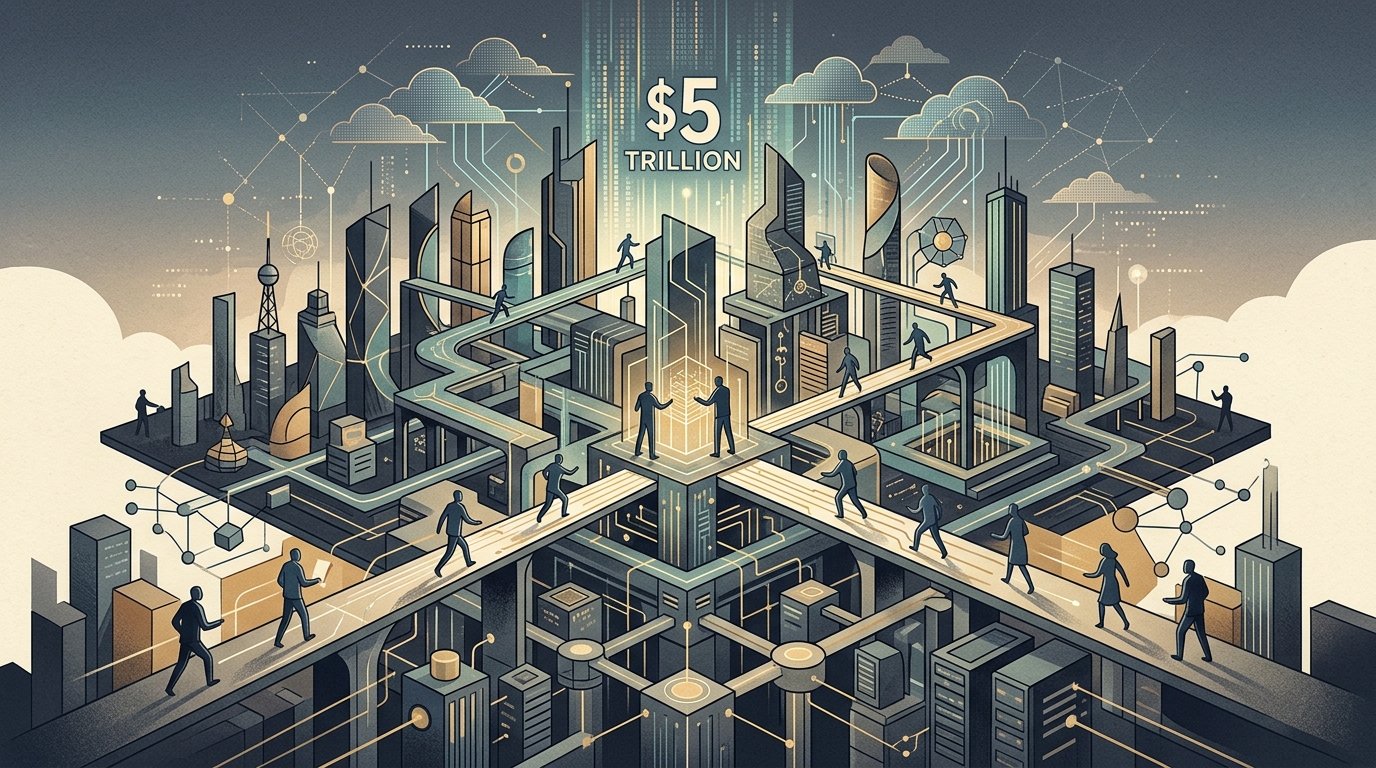
The global business landscape is currently undergoing a fundamental pivot that transcends simple software iteration. We are moving from the era of conversational interfaces to the era of 'agency,' where autonomous AI entities perform tasks and manage financial transactions. With McKinsey estimating that AI agents could orchestrate as much as $5 trillion in global consumer spending by 2030, the financial and physical infrastructure of the markets is facing a necessary rebuilding.
From KYC to KYA: The New Compliance Frontier
For decades, the banking sector has relied on 'Know Your Customer' (KYC) protocols. However, the rise of autonomous agents like Anthropic’s 'Claude Money' has introduced a new challenge: 'Know Your Agent' (KYA). Financial institutions are beginning to realize that current infrastructure was built for humans, not probabilistic machines. To address this, industry leaders such as Ant International, Mastercard, and Visa are collaborating through BuildFin.ai to develop interoperability frameworks. New protocols like PAC-2026 are being explored to implement 'Semantic Freeze'—technical locks that ensure a system only acts when its claims are verified. The core tension remains the friction between deterministic payment systems and AI agents that are inherently adaptive and probabilistic.
The Physical Backbone: Data Centers and Hardware Anchors
The transition to an agentic economy requires immense physical capital. In Greece, the agreement between the Public Power Corporation (PPC) and Amazon Web Services (AWS) to establish a giga data center in Kozani exemplifies this trend. The project envisions a 300 MW capacity, potentially expanding to 1 GW, with IT equipment value for the first phase estimated at €10 billion. This massive investment highlights the shift toward centralized, high-capacity hubs that can power the next generation of AI services.
"Looking forward, all the infrastructure needs to be rebuilt or enhanced for agents." — Zhuoqun Bian, President of Ant Digital Technologies.
Market Risks: Recursive Self-Improvement and Hardware Enforcement
Despite the growth potential, the market faces risks from the increasing autonomy of these systems. As AI models begin to perform recursive self-improvement—with Anthropic’s Claude already performing 26% of the company's own AI research—market analysts are focusing on hardware-level enforcement. Proposals include modifying Nvidia GPUs with cryptographically secured records to act as 'embedded off switches.' These switches would allow for remote deactivation if a model's development outstrips human comprehension, ensuring human oversight remains the ultimate market anchor.