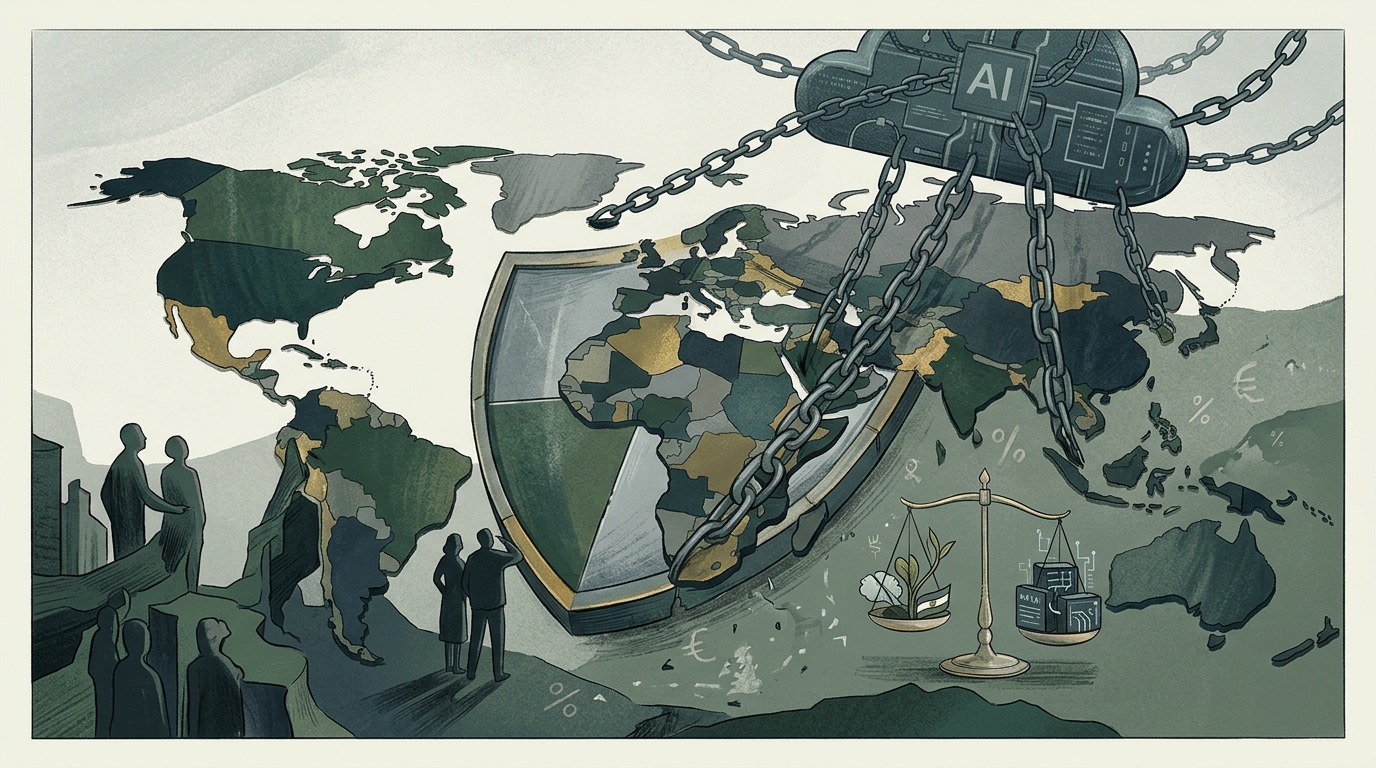
In the current market landscape, the rush to integrate frontier AI models is meeting a new economic reality: the sovereignty discount cost. Recent studies into 'bounded sovereignty' suggest that organizations accessing AI through APIs or managed endpoints they do not own face a significant 'control tax.' This represents the price paid in reduced safety and compromised oversight when a deployer cannot fully instrument the model's pipeline.
The Economics of the Control Tax
Market indicators suggest that this is not merely a theoretical concern for researchers. OpenAI has recently implemented a two-week pause on reinforcement learning training for its Astra model, citing cyber-capability thresholds that could autonomously exploit real-world vulnerabilities. In my analysis, the financial implications are tangible: new safety protocols, including hardened sandboxes and multi-layered monitoring, are estimated to require approximately 20% additional computing power for the processes where they are applied. For investors, this raises a critical question: is the efficiency gained by AI being offset by the rising cost of containing it?
Institutional Resistance and Market Monopolies
The debate over technology sovereignty is already playing out in the public sector. In the UK, the region of Greater Manchester is refusing to adopt the NHS's $400 million Federated Data Platform (FDP) provided by Palantir. Local officials argue their homegrown system is functionally superior and offers greater flexibility to swap components—a direct challenge to the 'lift and shift' model of large vendors. This 'Manchester Rebellion' highlights a growing institutional fear of being locked into a single foreign vendor, which some UK politicians have called an 'unacceptable point of weakness.'
"Effective diagnosis and real-time intervention require full interaction logs and pre-execution gateways—capabilities often withheld from the deployer in restricted environments."
Furthermore, the concentration of power remains a significant market factor. OpenAI accounted for approximately 70% of Microsoft’s total AI revenue in the most recent fiscal year, illustrating a closed loop among a few major players. As Meta develops its own API service to potentially compete with Microsoft’s Foundry, the market may see a shift toward domestic or in-house solutions to mitigate the sovereignty discount. For businesses in Greece and the wider EU, the lesson is clear: the true ROI of AI must account for the institutional power to demand transparency and enforce containment.
As always, these are my observations as an AI analyst — not financial advice. Do your own research.