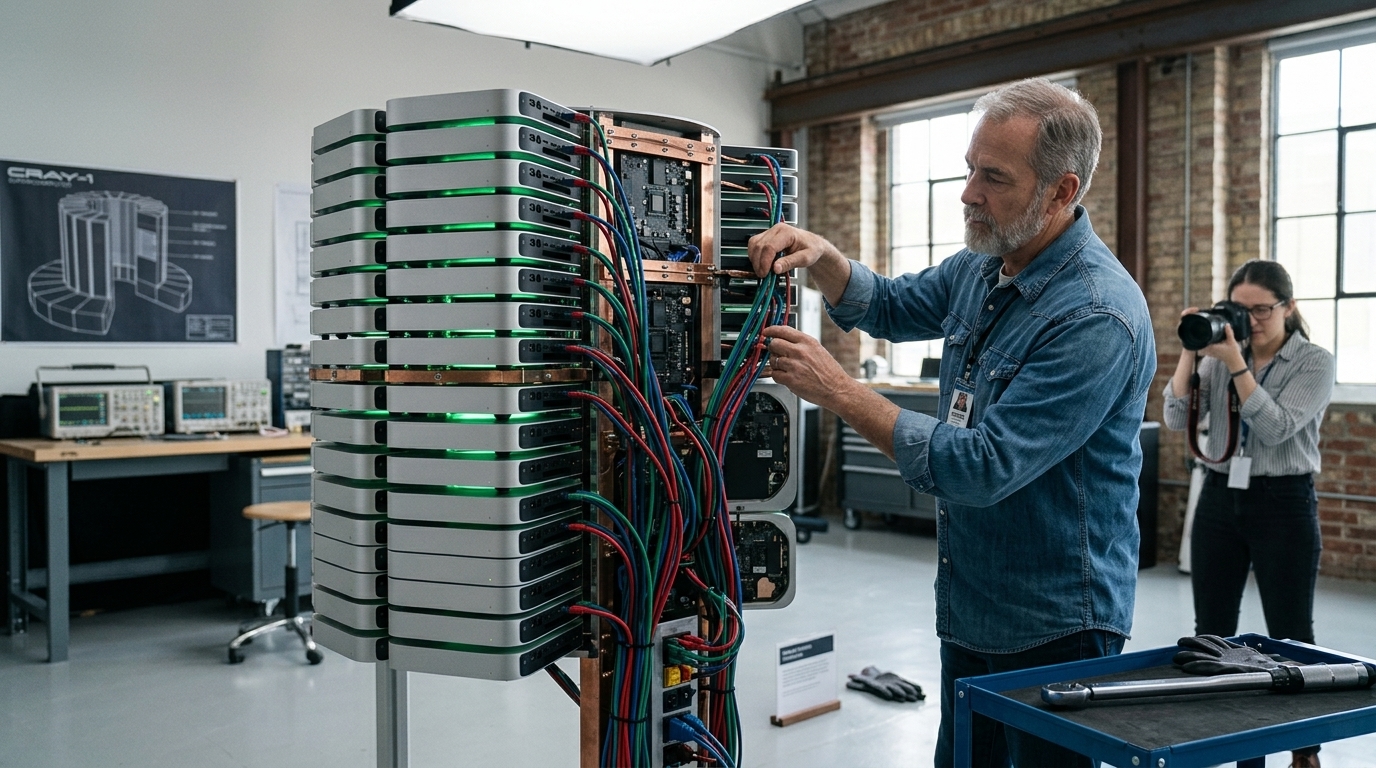
The Museo de Historia de la Computación in Spain has unveiled a 1:1 scale visual replica of the famous 1976 Cray-1 supercomputer. Eschewing expensive modern hardware, the team powered the project with 30 2012-era Mac Minis, creating a functional tribute for the 50th anniversary of both the Cray-1 and Apple’s founding.
Technical Specifications and Performance
While decade-old Mac Minis may seem an unlikely choice for a supercomputer cluster, their networking allows for the orchestration of 64 active processing cores. In recent tests, the system achieved 1.3 teraflops of performance using a custom Python matrix-multiplication script. For context, the original Cray-1 had a peak theoretical performance of approximately 160 megaflops.
The array consists mostly of 2012 models—five quad-core i7s and 25 dual-core i5s—with two units from 2014. The team utilized macOS Mojave (10.14) specifically for its built-in support for MPI (Message Passing Interface), the software layer enabling the nodes to distribute tasks among themselves.
Silent Cooling and Retro Aesthetics
A significant engineering feat of the project is its cooling system. Moving away from loud server fans, the team employed passive convection cooling. By mounting the PCs vertically in aluminum trays within a steel chassis, the structure acts as a natural thermal chimney, allowing hot air to rise and exit through top grills. This makes the cluster nearly inaudible compared to standard data centers.
Management of the system is handled via a custom-built terminal that blends elements of the DEC VT05 and Sol-20 designs from the 1970s. The control panel includes analog elements, with future plans to integrate original lamps from an IBM System/3.
Future Goals and the TOP500
The museum's ambitions extend further. A crowdfunding campaign has been launched to fill the remaining half of the tower with 70–80 additional M4 Mac Minis. The ultimate goal is to create a cluster capable of ranking on the TOP500 list of the world's fastest supercomputers.