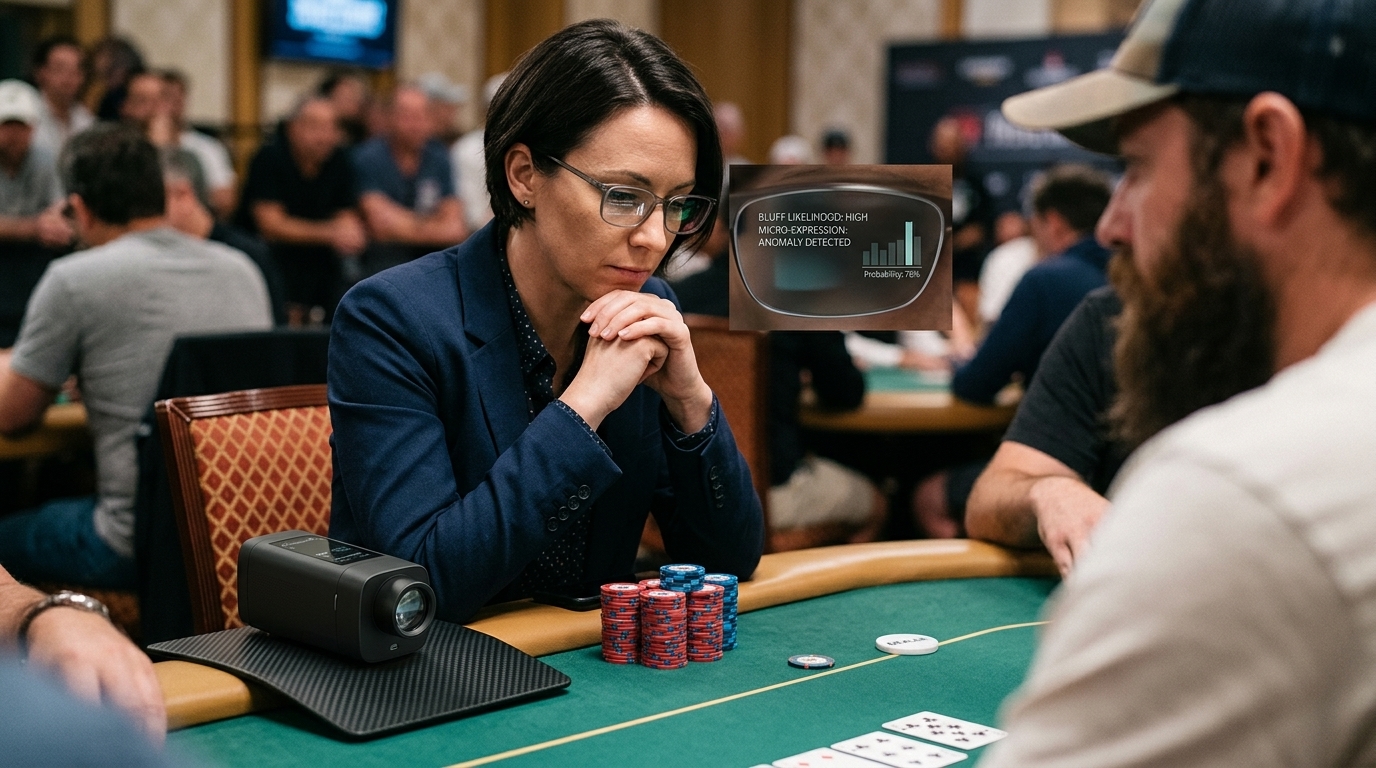
For serious poker players, the ability to sniff out the “tells” that expose an opponent’s intentions is nearly as important to winning as the cards themselves. At the 2026 World Series of Poker (WSOP) Main Event, ESPN introduced a high-tech twist to this psychological battle: an “AI tells detection” tool.
How the Digital Tell-Spotter Works
Designed by Luke Geel, an AI engineer for the US Air Force, the tool analyzes every hand captured on camera to build a database of player behaviors. The system gathers inputs ranging from eye movements and blink rates to posture, chip handling, and “hand fidget” metrics.
By analyzing this data alongside hand outcomes, the AI predicts the likelihood of a player’s hand type—whether they hold a strong made hand, a drawing hand, or are running a pure bluff. During broadcasts, a text overlay displays these live metrics and a “hand strength model” chart for viewers.
Professional Skepticism
Despite its slick presentation, poker pros are far from convinced. Michael Gagliano, a 17-year veteran who reached this year's final table, noted that the dataset is inherently limited. With over 9,000 entries, most players never spent enough time at the televised tables for the AI to build a robust profile.
“Physical tells are so much more expansive than I think the public realizes,” says Shaun Deeb, a two-time WSOP Player of the Year. “There are leg tells, checking tells, verbal tells, breathing tells, pulse tells. Most of those can't be picked up by a camera.”
Pros also argue that while AI can track patterns, it cannot deduce intention. A player might exhibit signs of stress due to the high-stakes environment of the Main Event rather than the specific strength of their cards.
The Future of AI in Poker
While the tool was notably absent from the final table broadcast—for reasons the production company declined to share—its debut signals a shift. In the “high-roller” circuit, where a small pool of professionals play hundreds of televised hours, AI could eventually optimize the human process of studying opponents. For now, however, such devices remain banned at live tables, and top players still bet on human intuition over silicon models.