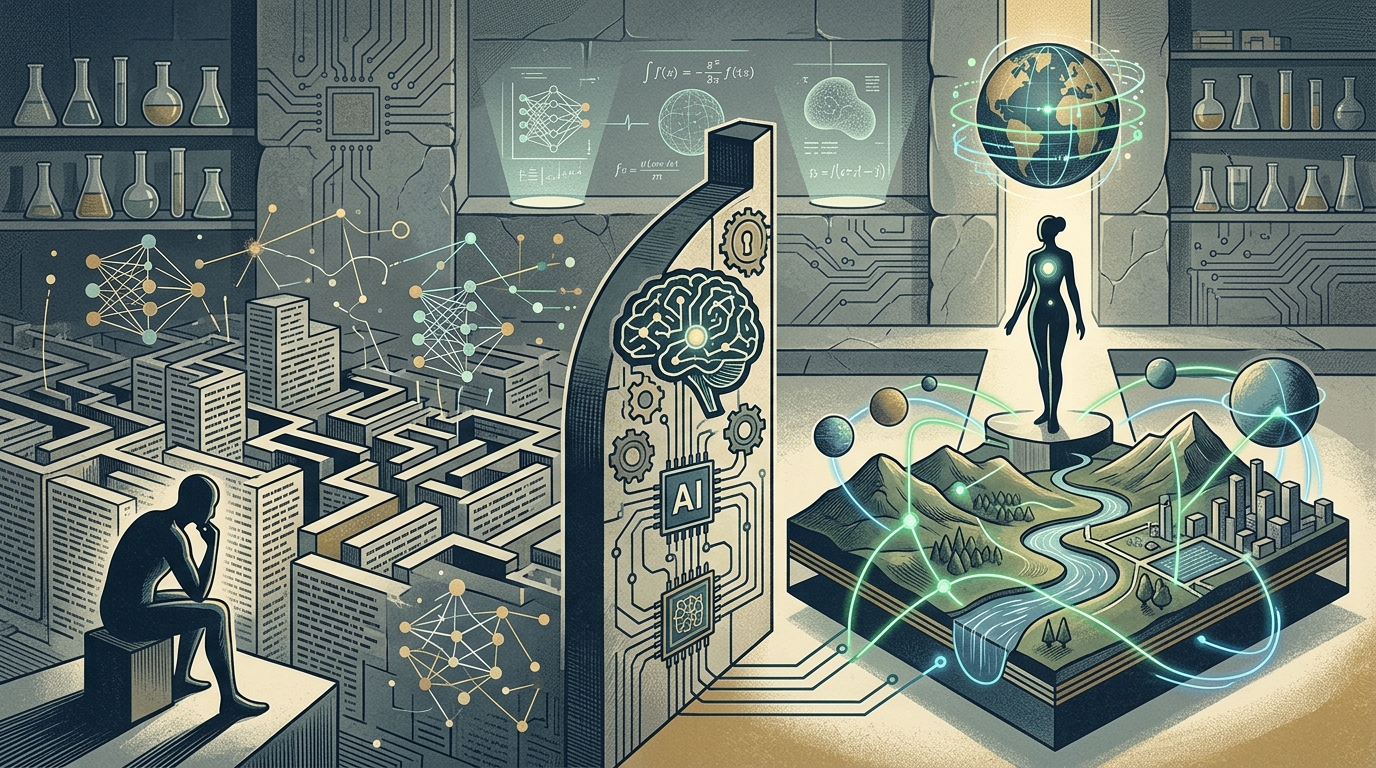
In the pantheon of modern artificial intelligence, Yann LeCun holds a position that blends the prestige of a Turing Award-winning scientist with the momentum of a heretic. While the world remains spellbound by the eloquence of ChatGPT and its successors, Meta's Chief AI Scientist continues to sound the alarm: Large Language Models (LLMs) are not the path to true intelligence, but an impressive, yet limited, dead end.
The Illusion of Eloquence
For LeCun, a model's ability to compose grammatically correct sentences does not imply an understanding of the physical world. The current generation of AI relies on auto-regressive prediction: it guesses the next word based on previous ones. This, according to him, lacks three fundamental pillars of human cognition: logical reasoning, planning, and common sense. "LLMs have no sense of reality. They live in a world of text, not a world of physics," he has repeatedly stated, sparking debates across Silicon Valley's auditoriums.
His critique focuses on the fact that these models "hallucinate" because they lack an internal world model to verify the validity of their claims. If you ask an LLM to plan a route for a robot in a room, it may fail miserably, as it does not perceive three dimensions or gravity. This is the "reality gap" that LeCun aims to bridge.
The JEPA Architecture: A New Proposal
LeCun's big bet in the post-ChatGPT era is called JEPA (Joint-Embedding Predictive Architecture). Instead of the model trying to predict every detail (every pixel in an image or every word in a text), the JEPA architecture tries to learn abstract representations. It learns to predict the "important" features of a scene, ignoring the noise. This more closely resembles how children learn: they don't need to see a thousand photos of a dog to recognize one, nor do they need gravity explained via text; they perceive it by observing the world.
Meta has already released V-JEPA, a model that learns by watching videos without human supervision. This "self-supervised learning" is the holy grail for LeCun. He believes that if we can give machines a "world model," they will be able to plan actions, predict consequences, and eventually reach a form of Artificial General Intelligence (AGI) that is safe and controllable.
The Politics of Open Access
Beyond the technical aspect, LeCun is the chief architect of Meta's "Open Science" strategy. In stark contrast to OpenAI and Google, Meta publishes the code and weights of its models (such as the Llama series). LeCun argues that hiding AI technology under the guise of safety is a way for big corporations to establish monopolies. "AI will become the operating system of our society. It cannot be controlled by two or three companies in California," he warns.
This approach has created a massive ecosystem of developers who improve Meta's models for free, giving the company a strategic advantage over closed systems. However, the challenge remains: can the open community match the level of models trained with billions of dollars in computing power?
The Future: Embodied AI
The final stage of LeCun's vision is embodied AI. If intelligence requires a world model, then the best laboratory is reality itself. In the coming years, we will see the transition from chatbots that simply "talk" to AI agents that "act" in the physical world through robotics or augmented reality. LeCun bets that the next big revolution will not come from a larger language model, but from a machine that can understand why a cup falls to the floor and how to catch it before it breaks.