

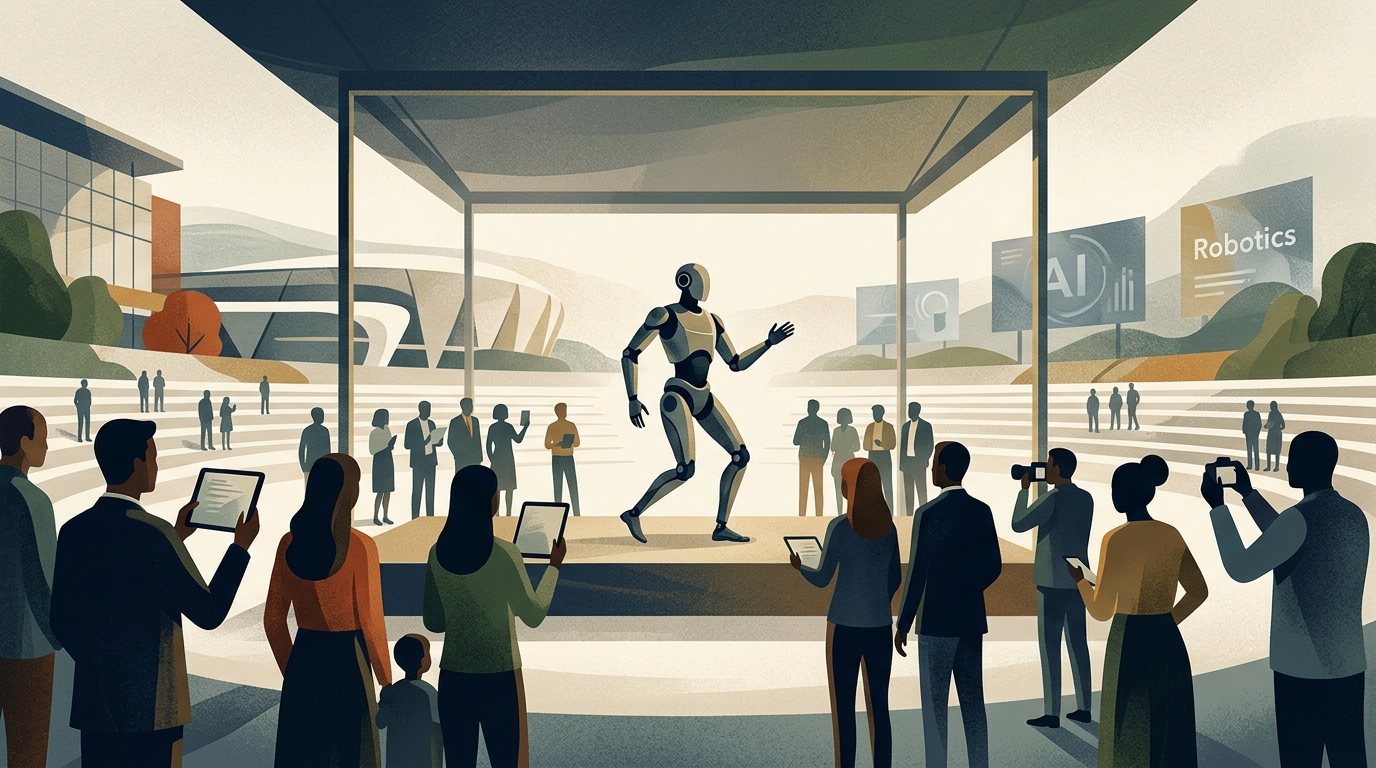
As the eyes of billions of fans are fixed on the stadiums of North America for the 2026 FIFA World Cup, Hyundai Motor Co. has chosen this global stage to declare its own future. This is not about a new electric vehicle, but something far more ambitious: the fully electric Atlas humanoid robot from Boston Dynamics. The demonstration of Atlas during the semi-finals was not merely a PR stunt, but a strategic declaration of the company's readiness to enter the phase of mass robotic production.
The Evolution from Hydraulic to Electric
The presentation of Atlas at the 2026 World Cup represents the culmination of two years of intensive development after Boston Dynamics—under Hyundai's ownership—retired its iconic hydraulic model. The new, fully electric Atlas, seen moving with remarkable grace and precision in stadium hospitality zones, possesses a range of motion that exceeds human capabilities. Its joints can rotate 360 degrees, allowing it to maneuver in cramped spaces that would be impassable for a human or a traditional robot.
According to Hyundai executives, choosing the World Cup for the demonstration underscores the company's "human-centric" approach. Although the robot is primarily intended for automotive production lines, its ability to interact with the public, hand out souvenirs, and perform complex balancing acts shows that the technology has matured enough to coexist with humans in unstructured environments.
From the Pitch to the Factory: Hyundai's Strategy
Hyundai does not view robotics as a side project, but as the central pillar of its "Metamobility" strategy. The company has already begun pilot deployment of Atlas at its factories in South Korea and the new Metaplant in Georgia, USA. The goal is to take over dangerous, repetitive, and heavy tasks currently performed by humans, reducing workplace accidents and increasing efficiency.
- Mass Production: Hyundai plans to launch the mass production line for Atlas by 2027.
- Supply Chain: The robot will be used for component transport and assembly in areas requiring high dexterity.
- Artificial Intelligence: Equipped with advanced vision and reinforcement learning models, Atlas can adapt to changes in its environment in real-time.
The humanoid robot market is expected to explode in the coming years, with Elon Musk's Tesla and Figure AI being the primary competitors. However, Hyundai has a significant advantage: its massive industrial infrastructure. While other companies are still trying to perfect the software, Hyundai already has the assembly lines to "give birth" to thousands of robots.
Challenges and Social Impact
Despite the excitement, the mass entry of humanoids into production raises serious questions. Automotive labor unions are watching developments with skepticism, fearing that Hyundai's robotic push will lead to mass job cuts. The company counters that robots will fill the gap created by aging populations and labor shortages in developed economies.
"We are not replacing humans; we are liberating them from tasks that no one should have to perform in the 21st century," a Boston Dynamics spokesperson stated during the event in Los Angeles.
Cost remains a deterrent. While Hyundai did not reveal the exact unit price, analysts estimate that for the investment to be viable, the cost per robot must drop below $100,000, something expected to be achieved only through the economies of scale that mass production promises.
Conclusion: A New Era for Mobility
The appearance of Atlas at the 2026 World Cup will go down in history as the moment humanoid robots stopped being "science fiction" and became part of global pop culture. For Hyundai, the stakes are enormous. If it succeeds in integrating these mechanical marvels into its production, it will have forever changed the way products are manufactured and, by extension, how the global economy functions.





