

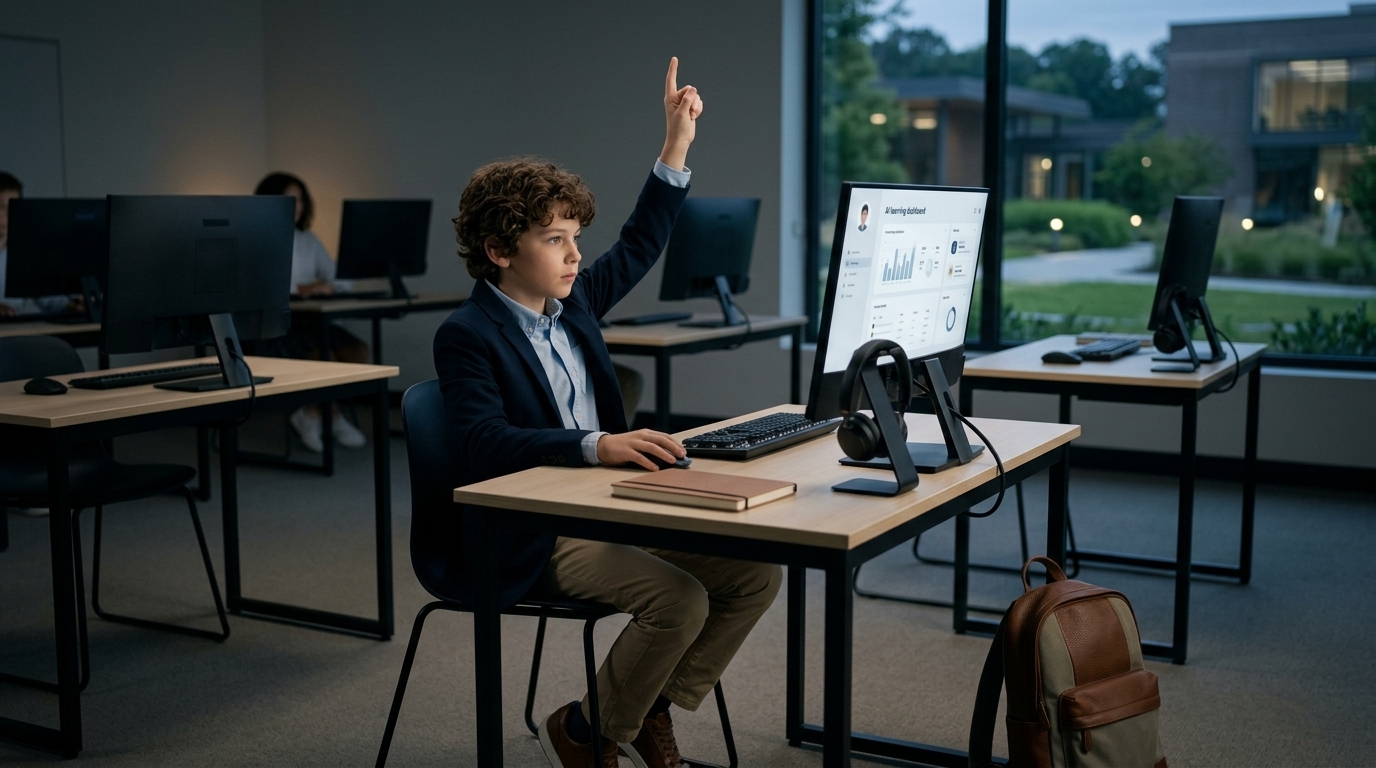
In an era where the average citizen views Artificial Intelligence (AI) with a mixture of awe and suspicion, a new trend is emerging among the American financial elite. While most worry about the 'hallucinations' of large language models or job displacement, wealthy parents in Austin, Silicon Valley, and New York are turning to a radical form of education: schools where AI is not just a tool, but the primary pedagogue.
Deconstructing the Traditional Schoolhouse
Schools like Alpha and Forge Prep are redefining the concept of learning by rejecting the 'industrial education' model that dominated the 20th century. At Alpha, for instance, students don't sit in desks listening to a lecture. Instead, they spend two hours daily on an AI platform that adapts precisely to their level and pace. The rest of the day is dedicated to 'life skills' such as public speaking, entrepreneurship, and critical thinking.
The promise is alluring: personalized learning that allows students to complete math or language curricula in a fraction of the time it would take in a traditional setting. Proponents of this model argue that AI never gets tired, has no biases, and can provide instant feedback—something a teacher in a classroom of 25 children finds impossible to achieve.
The Risk of a 'Digital Aristocracy'
However, this shift raises serious ethical questions. Education has historically been the great equalizer, but the advent of AI-driven schooling threatens to widen the gap. While the wealthy purchase access to sophisticated algorithms that act as personal Socrates for their children, the public education system struggles with underfunded infrastructure and outdated curricula. Are we creating a new class of 'AI-native' leaders who will have learned to wield technology as an extension of their intellect, while the rest remain mere consumers or victims of automation?
Quality of Knowledge and the Human Element
Another critical aspect is reliability. As critics point out, AI has repeatedly proven it can err with confidence. From incorrect historical dates to nonsensical cooking advice, the technology is far from infallible. In these schools, the adult's role transforms from 'teacher' to 'guide.' The guide doesn't teach the subject matter but helps the child manage their interaction with the machine. This begs the question: what is lost when the intellectual connection between teacher and student—the inspiration stemming from human experience—is replaced by optimized code?
'Education is not the filling of a pail, but the lighting of a fire,' Yeats famously said. Can an algorithm light that fire, or is it merely filling the pail more efficiently?
As we look at the global landscape in 2026, the discussion is no longer theoretical. We are seeing the first seeds of adaptive learning in elite institutions worldwide. The challenge moving forward will be whether AI will be used to democratize excellence in education or if it will serve as the ultimate wall separating the privileged from the rest.
Conclusion: An Experimental Generation
The children of the wealthy attending these schools today are the 'guinea pigs' of a new era. If the experiment succeeds, we will see a generation that thinks faster and acts more strategically. If it fails, we will have created an elite with technical prowess but lacking the social empathy and critical capacity that only human friction can provide. What is certain is that the traditional classroom, as we knew it, is breathing its last for those who have the means to leave it behind.





