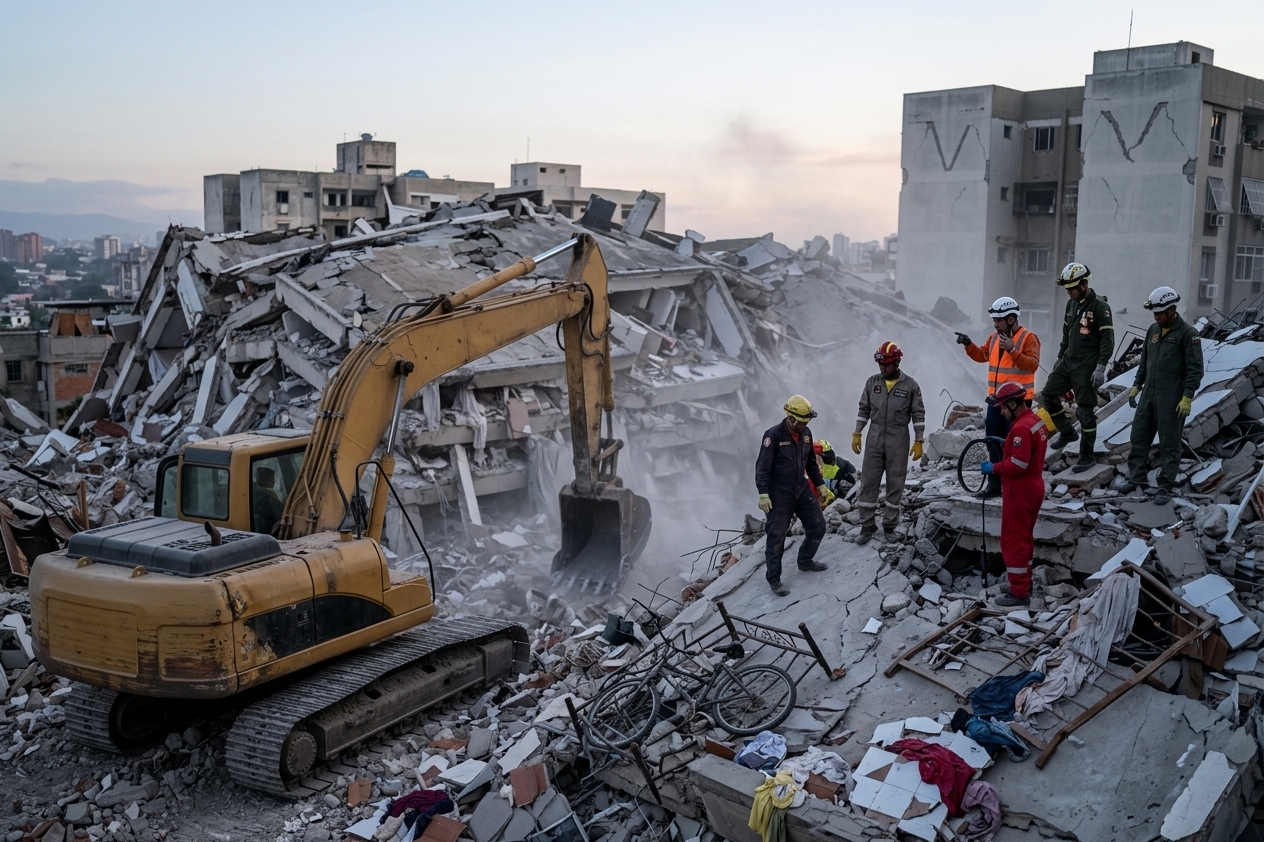
Venezuela, a nation that has become synonymous with economic instability and political upheaval in recent years, is now facing a natural disaster that threatens to vanish any hope of recovery. The recent double earthquake that rattled the northern part of the country left behind not just rubble, but an economic crater that, according to preliminary assessments, reaches 6% of the nation's Gross Domestic Product (GDP). In an economy already struggling with hyperinflation and international sanctions, this blow is viewed by many analysts as the 'coup de grâce' for the national infrastructure.
Technology at the Forefront of Assessment
Given the difficulty of accessing many affected areas and the traditional lack of transparency from state agencies in Caracas, the international community turned to advanced tools to evaluate the situation. The published assessment is based on a combination of high-resolution satellite imagery, demographic data, and AI algorithms that simulate structural damage. The use of remote sensing allowed researchers to map damage to critical infrastructure—such as bridges, refineries, and power grids—long before the first official reports reached the ground.
Satellites recorded extensive collapses in urban centers near the Boconó fault, the primary seismic threat to the country. The analysis indicates that 6% of GDP is not just a figure; it translates into the total destruction of industrial zones that represented the nation's last hope for productivity. Pre- and post-event imagery reveals that the quality of construction, degraded by years of neglected maintenance, acted as a force multiplier for the devastation.
Infrastructure in a State of Collapse
Venezuela's problems did not begin with the earthquake, but they were certainly exacerbated by it. For over a decade, investment in the maintenance of basic infrastructure has been nearly non-existent. Roads, water networks, and telecommunications were already at a breaking point. The double earthquake simply exposed the vulnerability of a state unable to protect its citizens from the elements. Residential damage is incalculable, with thousands left homeless in areas where state aid is practically non-existent.
- Collapse of major road arteries connecting Caracas to vital ports.
- Severe damage to power transmission networks, causing prolonged blackouts.
- Destruction of schools and hospitals in rural and marginalized areas.
The resulting humanitarian crisis is immediate. Without access to clean water and with a healthcare system collapsing under the weight of the injured, Venezuela urgently needs international assistance. However, political polarization and sanctions make the flow of such aid extremely complex. Satellite images also show that informal settlements (barrios) on the hillsides surrounding the capital have suffered the greatest losses, once again hitting the most vulnerable segments of the population.
Oil and Economic Hemorrhage
Perhaps the most concerning aspect of the disaster for the global market is the damage to PDVSA facilities. Although initial government reports attempted to downplay the incident, satellites show structural damage to at least two major refineries and export terminals. Oil remains the country's sole source of foreign currency, and any disruption in its production or export translates into an immediate loss of revenue that could have been used for reconstruction.
"Venezuela hasn't just lost buildings; it has lost the ability to fund its own future," remarked a financial analyst monitoring the region.
A 6% hit to GDP is a figure that would buckle even a healthy economy. For Venezuela, it means that resources intended for the import of food and medicine must now be diverted to restoring the state's basic functions. The international community is now called upon to decide whether to set aside political differences to prevent a total humanitarian collapse in Latin America.
Conclusions and Outlook
The road ahead for Venezuela is fraught with difficulty. Reconstruction requires not only capital but also a radical shift in the management of public infrastructure. The reliance on satellite technology for damage assessment highlights the trust gap between the government and the rest of the world. Without a coordinated effort involving international organizations, the 6% GDP loss could soon morph into a permanent recession, triggering new waves of migration to neighboring countries.