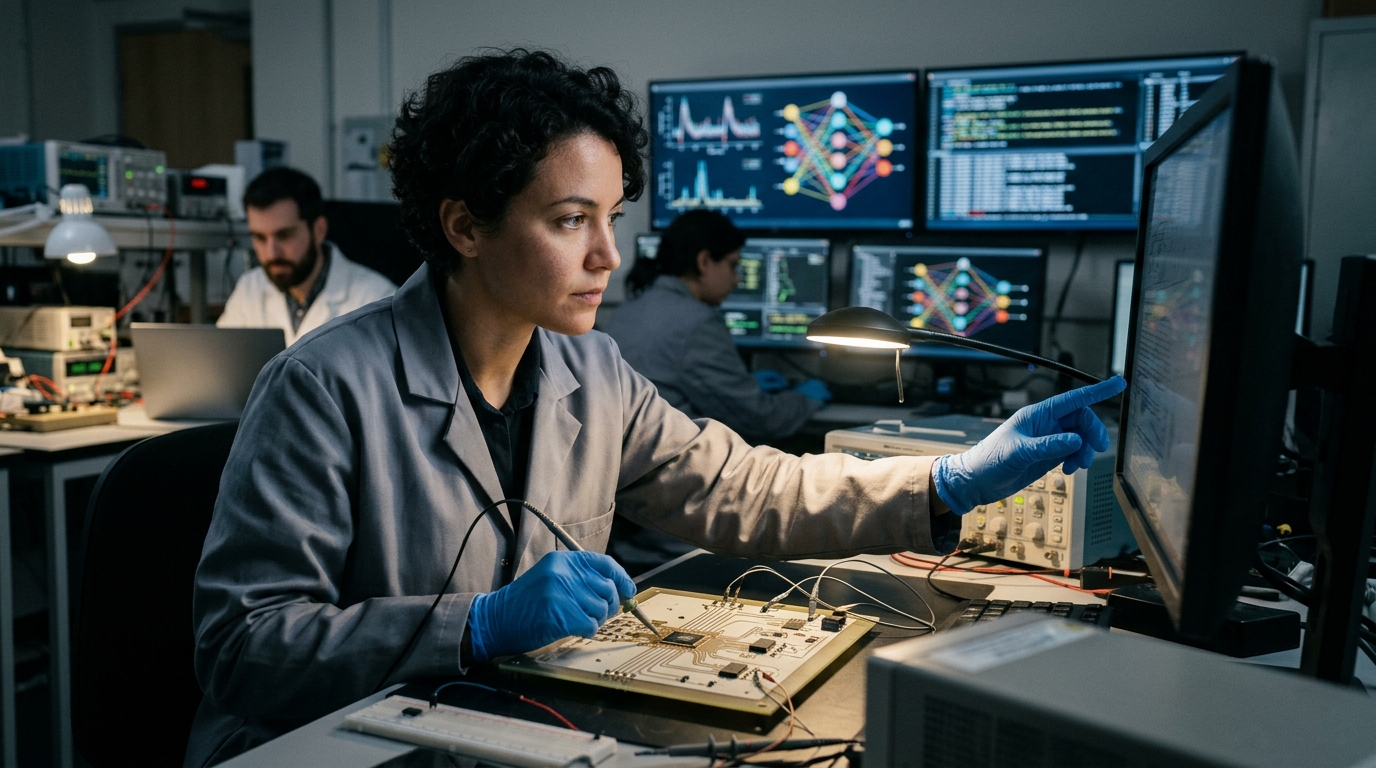
The quest for a computing architecture that can rival the energy efficiency and processing power of the human brain has brought researchers to the threshold of neuromorphic engineering. At the heart of this endeavor lie artificial synapses, the building blocks designed to mimic the function of biological synapses. However, a recent comprehensive analysis in the journal Nature highlights a critical hurdle—and simultaneously an opportunity: the non-idealities of these components.
In the digital world of traditional computing, precision is everything. A bit is either 0 or 1. In the analog world of artificial synapses, however, things are more complex. These devices, often based on technologies like memristors, phase-change memory (PCM), or ferroelectric transistors, suffer from phenomena such as non-linearity, asymmetry in weight updates, and noise. These 'flaws' are not merely technical errors but inherent characteristics of the physics of the materials used.
The Nature of Non-Linearity and Asymmetry
One of the greatest challenges described in the research is the non-linear response of artificial synapses. In an ideal scenario, when we apply a signal to increase or decrease the 'strength' (weight) of a synapse, the change should be proportional and predictable. In reality, most devices exhibit a sharp change at the beginning and a saturated response thereafter. This makes training neural networks directly on the hardware (on-chip training) extremely difficult.
Furthermore, asymmetry—the fact that strengthening a synapse follows different dynamics than weakening it—introduces errors that accumulate during learning. While algorithms like backpropagation rely on mathematical symmetry, the hardware refuses to comply. This gap between 'ideal' code and 'imperfect' hardware is the primary battlefield for engineers over the next decade.
Noise as a Feature: Stochasticity in Learning
Despite the difficulties, the Nature study suggests a subversive approach: instead of trying to completely eliminate these non-idealities, perhaps we should leverage them. The human brain is a highly noisy machine. Stochasticity—the random variability in neuronal behavior—seems to play a role in creativity, problem-solving, and avoiding local minima during learning.
Researchers are finding that the inherent noise of artificial synapses can function as a natural 'regularization' mechanism, preventing the model from overfitting to data. This shift from deterministic to probabilistic computing could lead to a new generation of AI that is more resilient and requires significantly less energy, as it won't have to 'fight' against the physics of the hardware.
Bridging the Gap: Software and Hardware in Symbiosis
The solution to the problem of non-idealities will not come solely from material improvement. It requires a holistic approach called 'hardware-software co-design.' This means developing algorithms that are inherently resilient to hardware flaws or can adapt to the peculiarities of each specific chip.
- Developing algorithms that exploit non-linearity for more complex representations.
- Using on-device calibration techniques to balance differences between devices.
- Designing architectures that allow for parallel processing, reducing reliance on the precision of a single synapse.
In conclusion, the research published in Nature reminds us that the road to true artificial intelligence is not a straight line of digital perfection, but a path filled with analog challenges. Embracing the 'friction' and imperfections of the physical world may be the key to unlocking the next great revolution in computing power.