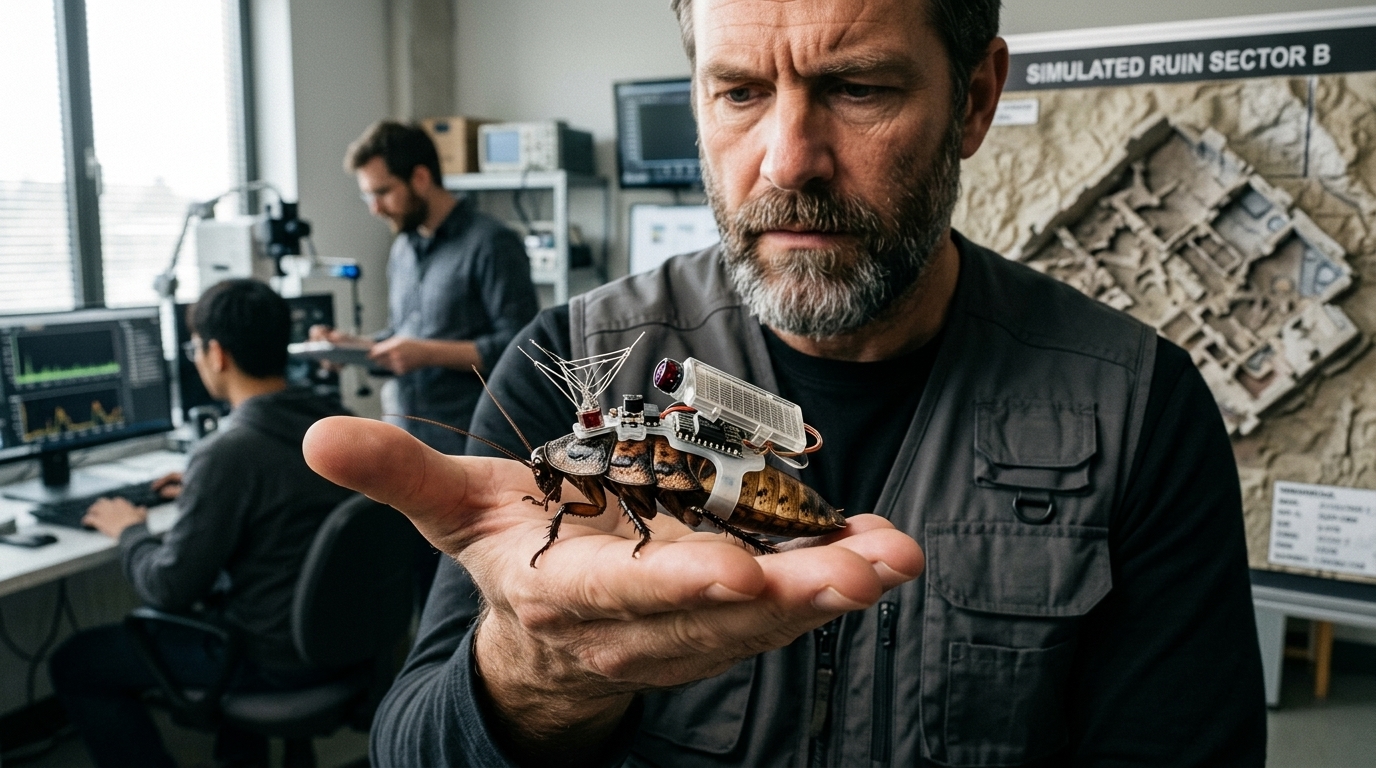
Small robots and drones have long been explored for disaster response, but reaching the deepest crevices of collapsed buildings remains a challenge. New research from the University of Queensland (UQ) and the University of New South Wales (UNSW) suggests that the next generation of first responders might not be entirely mechanical, but biological.
Introducing the 'Paraborg'
The research team utilized the giant burrowing cockroach, native to northern Queensland, to create the "Paraborg." These insects, which can grow up to 87 millimeters in length and weigh 40 grams, are robust enough to carry equipment weighing up to 1.5 times their body mass. The team developed two specialized versions: one equipped with a camera to scout for victims and another featuring an automated injection system for emergency medication.
Remote Control and Chemical Actuation
To steer the insects, researchers embedded electrodes into their antennae and cerci—sensory organs at the rear of the abdomen. By applying electrical stimuli at frequencies between 10 and 40 hertz, they could remotely control the cockroach's direction and walking speed. Steering is achieved by stimulating each antenna independently, while speed is regulated through the cerci.
The injection mechanism is particularly innovative, employing a spring system triggered by a chemical reaction. When activated, citric acid and baking soda mix to produce carbon dioxide, creating enough pressure to push a syringe plunger. This allows the cyborg insect to deliver life-saving aid before human rescuers can reach the site.
Mission Success and Future Deployment
In controlled tests, the success rate for close-range injections (within 150 mm) reached 95%, while the full mission success rate stood at 72%. However, the researchers acknowledge that lab conditions do not yet reflect the complexity of real-world debris and uneven terrain. Bio-robotics researcher Tan Vo Doan suggests that with adequate resources, these cyborg rescue teams could be deployed within five to ten years, leveraging the natural strengths of insects for specialized missions.