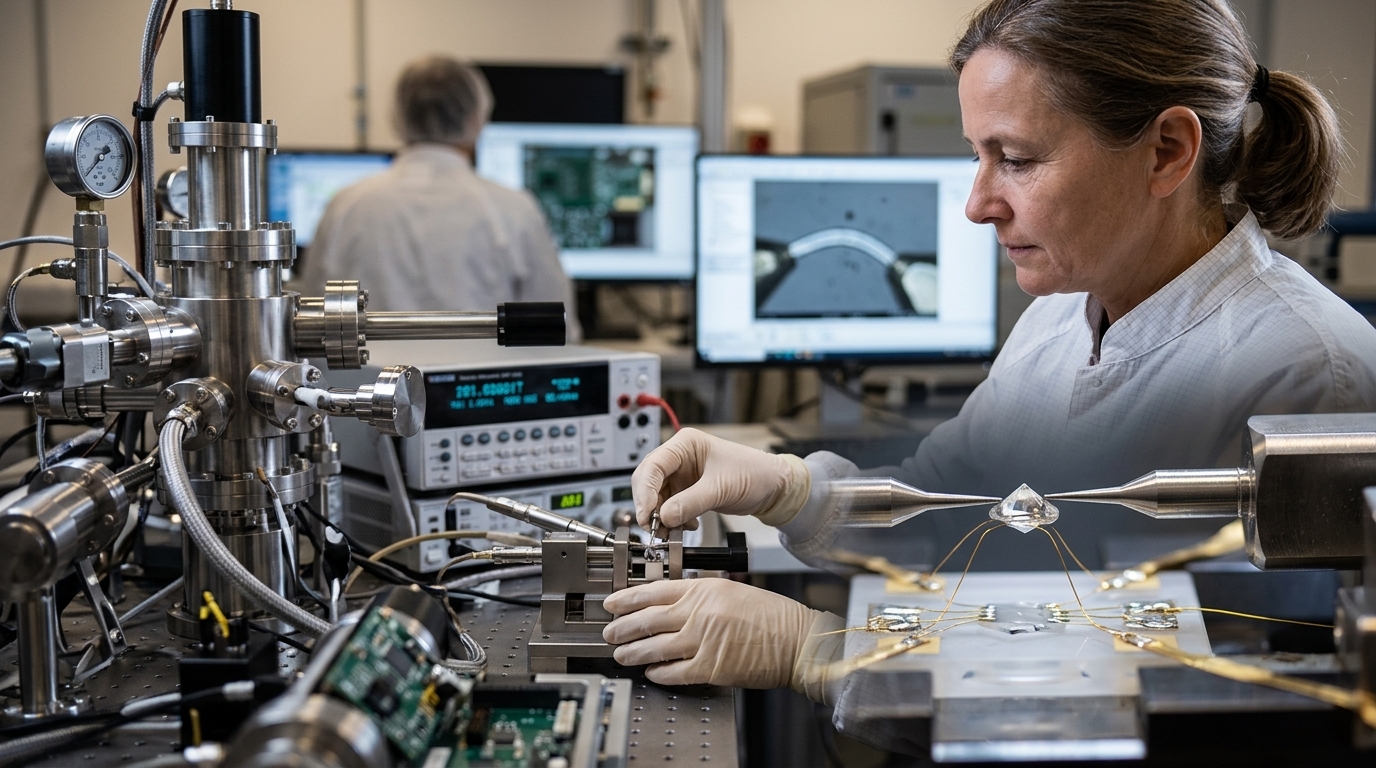
For over a century, the scientific consensus held that diamonds were non-piezoelectric—meaning they could not generate an electrical charge when subjected to mechanical stress. However, a new study by researchers from the University of Hong Kong, published in the journal Science, has overturned this long-standing belief, proving that the world's hardest mineral can indeed become a power source when transformed into an ultra-thin membrane.
The Technology of Bending
The key to this discovery lies in scale. While bulk diamonds are famously rigid, the research team developed polycrystalline diamond membranes only a few micrometers thick. Using a technique called microwave plasma chemical vapor deposition (CVD), they grew the diamond atom-by-atom onto a silicon substrate.
The membrane was then carefully detached and mounted onto a flexible PET substrate. By applying controlled force to bend the assembly, the scientists confirmed the generation of voltage, successfully ruling out environmental factors or triboelectricity (static from friction).
The Mechanism of Power
The phenomenon is attributed to "grain boundaries"—the asymmetric regions separating the microscopic crystals that make up the polycrystalline film. When the material is deformed, this asymmetry shifts the electrical polarization, creating a potential difference between the surfaces. The strongest response was observed at a thickness of approximately 5 micrometers, with a voltage coefficient that exceeds many conventional piezoelectric materials.
Medical and Technological Implications
Given diamond's chemical stability, durability, and biocompatibility, this discovery is poised to attract significant interest in several fields:
- Self-powered medical implants that harness body movement for energy.
- Smart sensors and wearable electronic devices.
- Advanced micro-electromechanical systems (MEMS).
While clinical applications for implants remain a long-term goal, this laboratory breakthrough proves that under the right conditions, a material once thought inert can effectively convert pressure into power.