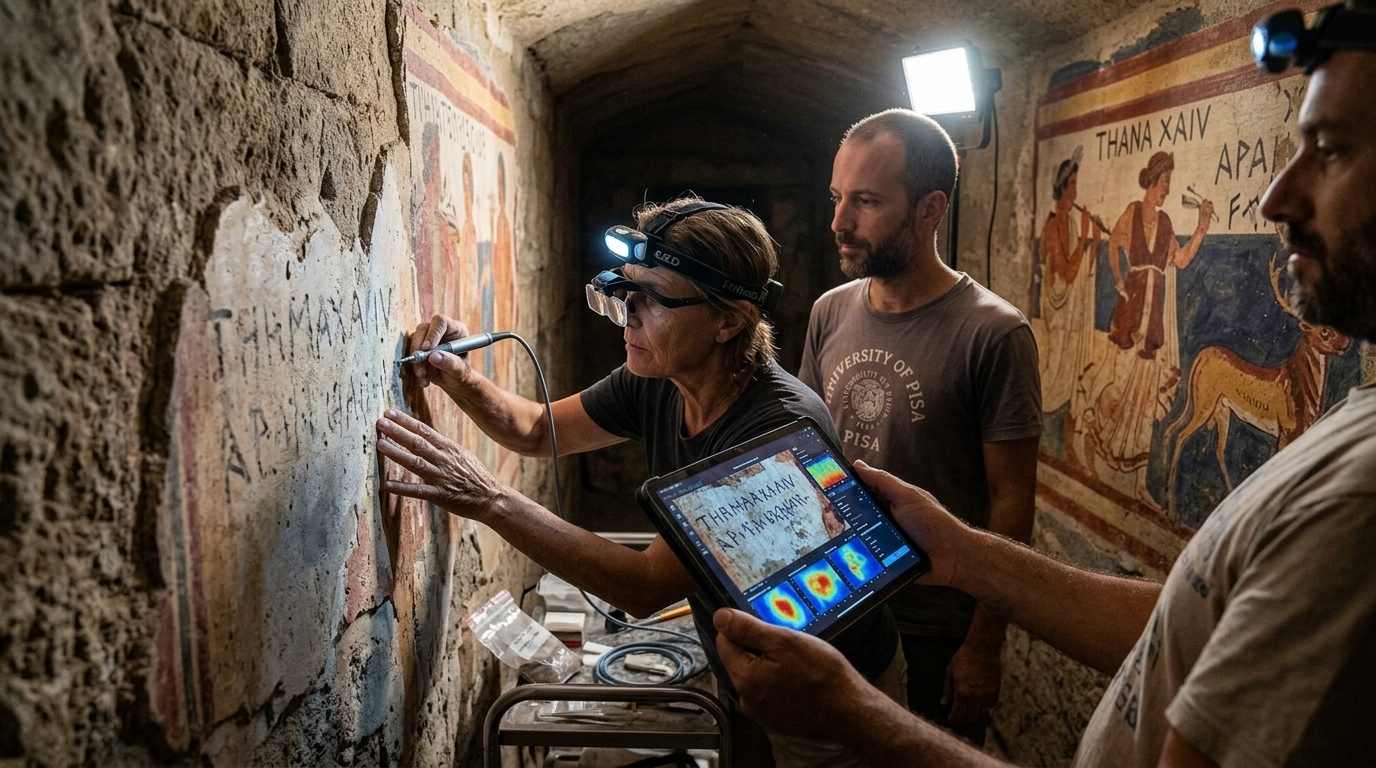
Every ancient language ever deciphered has required an "anchor" — typically a bilingual text like the Rosetta Stone to provide a basis for comparison. However, scripts such as Linear A from Minoan Crete and the Etruscan language of pre-Roman Italy lack such anchors, presenting a formidable challenge that has frustrated linguists for over a century.
AI as a Research Accelerator
Artificial Intelligence is not replacing linguists but rather supercharging their intuitions. Its primary strength lies in large-scale pattern testing, checking hypotheses against entire archives in minutes rather than years. AI can identify recurring sequences that the human eye might miss and even help restore fragmented inscriptions by predicting missing characters. Furthermore, through "cross-lingual transfer," models trained on known languages can sometimes infer patterns in closely related unknown ones, as seen with the decipherment of Ugaritic.
The Case of Linear A
In June 2026, an AI engineer and amateur linguist claimed a breakthrough in Linear A. Starting with a single hunch about a Semitic root, he used AI-generated scripts to test the pattern across the existing corpus. He reportedly matched values to 40 symbols and compiled a 408-word dictionary, suggesting Linear A belongs to the Semitic language family. Crucially, the AI did not generate the idea; it served as a research assistant, cross-referencing a human hypothesis with thousands of characters at high speed.
The Hard Limits of Statistics
Despite these advancements, AI faces a strict boundary: statistical pattern matching cannot generate meaning from nothing. A model can become "fluent" in the sense of knowing which signs follow others, yet never understand what those words actually refer to. This is compounded by the scarcity of data; the entire corpus of Linear A consists of only about 7,500 characters. With such limited data, almost any hypothesis can find scattered matches. Without a comparative anchor or expert verification, AI’s role remains that of a fast assistant in a very old, very human puzzle.